- The paper presents a shell-based model of neutron-loaded jets that quantitatively links jet variability and neutron-proton microphysics to prompt gamma-ray and GeV–TeV neutrino emission.
- The methodology incorporates statistical variability, detailed n-p collision physics, and radiative dissipation history to reveal an anti-correlation between photon and neutrino efficiencies.
- Simulations show that high baryonic loading with strong fluctuations produces photon-dim, neutrino-bright GRB transients, informing targeted multimessenger transient surveys.
Relaxation and Multimessenger Signatures of Time-Variable Neutron-Loaded Relativistic Jets
Introduction and Motivation
The study addresses the dissipative dynamics and multimessenger counterparts of time-variable, neutron-rich relativistic jets produced in long gamma-ray bursts (GRBs) within the collapsar framework. This regime is characterized by strong jet inhomogeneity and temporal variability, leading to internal shocks and relaxation processes both below and above the photosphere, influencing the partition of energy between high-energy photons (gamma rays) and neutrinos. Previous treatments typically adopted highly idealized collision models; this work systematically incorporates statistical jet variability, neutron-proton (n-p) microphysics, and detailed dissipation history, enabling robust predictions of GeV–TeV neutrino emission in GRBs and their connection to photon radiative efficiency (2512.10253).
Shell-Based Model of Neutron-Loaded Jet Relaxation
The model generalizes classical internal shock frameworks by incorporating shells with variable baryon loading and specific energy, sampled via a log-normal distribution. As the jet emerges from stellar breakout it remains neutron-rich, and is modeled as a set of co-evolving, discrete shells, each potentially possessing distinct Lorentz factors and neutron/proton ratios. The key stages include:
- Adiabatic Expansion & Acceleration: Shells convert internal energy into kinetic energy, up to a saturation radius determined by specific energy and breakout parameters.
- Neutron-Proton Decoupling: Neutrons decouple when nuclear mean free paths exceed the shell thickness, leading to inelastic n-p collisions and GeV–TeV neutrino production through pion decay.
- Photospheric Emission: Shells with sufficiently high baryon loading emit prompt gamma rays near or below the photosphere, with efficiencies determined by the conversion of internal energy at the Thomson optical depth unity surface.
- Shell Collisions: Interactions across both sub-photospheric and supra-photospheric radii drive energy dissipation. Neutron presence modifies shock structure and mediates non-thermal neutrino production, even in otherwise photon-thick regions.
The dynamical evolution—whether photon or neutrino dominated—is governed by the interplay of the jet baryonic loading (⟨ηini⟩), amplitude of variability (A), and injection timescale (δt).
Dissipation and Energy Partitioning
The simulations cover a wide grid of parameters (A=0.5,1,2; δt=1ms−100ms; ⟨ηini⟩=50−800), all with fixed total jet power and duration. The dissipation history displays clear radial separation between prominent cooling channels and is highly sensitive to the initial jet conditions.
The canonical case, with moderate energy per baryon and variability (⟨ηini⟩=200, A=1, δt=10ms), is characterized by early time n-p decoupling (at rnp∼1011 cm), followed by photospheric gamma-ray emission (at rph∼2.5×1011 cm). Shell-collision-driven dissipation (photonic and neutrinic) ensues at r≳2cδtΓini2, with the radiative channel determined by the baryonic composition and Lorentz factor contrast of colliding shells.
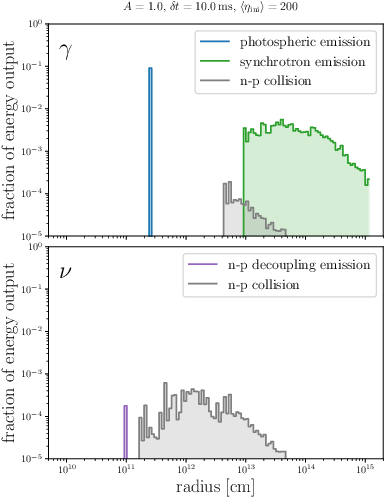
Figure 1: Energy dissipation by photon radiation (upper panel) and neutrino radiation (lower panel) in a jet with A=1, δt=10 ms, ⟨ηini⟩=200; the radial profile distinguishes the dominant emission zones.
With greater variability amplitude (A=2) or lower baryonic loading (⟨ηini⟩), photon dissipation becomes even more efficient, especially when many shells fail to convert internal to bulk energy before reaching the photosphere. Conversely, for low specific energy jets (⟨ηini⟩=50), the population is dominated by kinetic-energy-dominated, slow shells lacking photospheric emission and featuring enhanced sub-photospheric n-p collisions, resulting in high neutrino efficiency and suppressed photon output.
Key quantitative results:
- In gamma-ray-bright jets (⟨ηini⟩≥800, A≳1), photon radiative efficiency reaches 60−80% while GeV–TeV neutrino efficiency remains 0.1−10%.
- In jets with substantial baryon loading and strong fluctuations (⟨ηini⟩=50, A=2), photon efficiency drops below 4% while neutrino efficiency climbs to 20%.
- Photon and neutrino efficiencies display an anti-correlation; parameter regimes conducive to efficient neutrino production yield photon-dim, neutrino-bright GRB transients.
GeV–TeV Neutrino Spectra and Implications for Observations
The model computes the full neutrino energy spectra originating from n-p (and n-n) collisions, with interaction physics handled via GEANT4-based simulations. The spectral peak for most explored parameter sets falls within $10-30$ GeV, consistent with kinematic expectations for inelastic n-p collisions at moderate relative Lorentz factors.
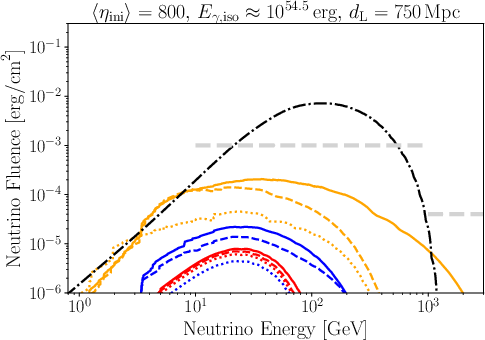
Figure 3: GeV–TeV neutrino energy spectra for different jet parameter sets and comparison to IceCube template predictions.
Critical deviations from common templates, such as those adopted in IceCube analyses, are observed:
- The model generically produces broader spectra than single-Γrel templates, with the high-energy tails (up to TeV) emerging only for jets with larger A (more violent variability).
- For jets with exceptionally high baryonic loading, the limit on achievable peak energy is set by the Lorentz factor at the photosphere, not by injection-specific energy, due to delayed acceleration and frequent shell merging below the photosphere.
- Only parameter sets featuring low specific energy, pronounced variability, and short timescale injection produce total neutrino fluence comparable to observed GRB lines, e.g., BOAT GRB analogs, under standard normalization.
IceCube non-detections, including for GRB 221009A, do not impose significant constraints for most parameter sets, as the predicted normalization falls well below the template-based exclusion limit, primarily due to the inherent energy partition conferred by the dynamical relaxation process.
Implications for Multimessenger Transient Surveys
A critical conclusion is the anti-correlation between photon and GeV–TeV neutrino radiative efficiencies. Consequently, high-luminosity, photon-bright long GRBs (such as the BOAT GRB) are sub-optimal targets for neutrino searches, as their dissipation history is dominated by photospheric emission. Instead, jets with lower initial specific energy and elevated variability—likely responsible for X-ray–rich and soft-spectrum GRBs—constitute the most efficient neutrino factories in this framework.
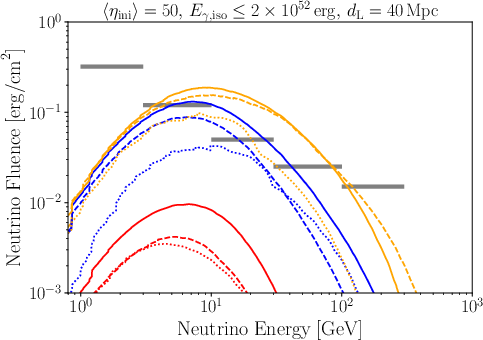
Figure 5: Same spectra as in Figure 3, but for a photon-dim, neutrino-bright jet; illustrates the enhanced detectability in sensitive neutrino observatories at smaller distances.
Theoretical targeting of photon-faint, neutrino-bright sources urges future all-sky transient surveys (e.g., Einstein Probe) combined with high-cadence GeV–TeV neutrino facility upgrades (e.g., IceCube-Gen2) to focus on soft-spectrum, low-luminosity GRB subpopulations.
Conclusion
This investigation quantitatively links the relaxation of time-variable neutron-loaded relativistic jets in long GRBs with their observable photon and neutrino signatures. The explicit incorporation of jet variability and neutron microphysics within a shell framework enables physically motivated predictions of GeV–TeV neutrino spectra, radiative efficiencies, and their anti-correlation with prompt gamma-ray emission. These results directly inform multimessenger search strategies, highlight the limited neutrino return from canonical bright GRBs, and motivate dedicated searches for soft, photon-faint, yet neutrino-bright transients as primary detection candidates. Future developments may incorporate hadronic acceleration and additional nonthermal processes to extend predictions into the PeV regime.