- The paper presents a layered NTN architecture leveraging LEO satellites, HAPS, and LAPS to enable global quantum communication networks.
- It details solutions for physical-layer challenges such as atmospheric turbulence and pointing errors using adaptive optics and miniaturized quantum hardware.
- Experimental performance and theoretical analysis demonstrate robust entanglement distribution, secure key generation, and scalability for quantum cryptography.
Quantum Internet in the Sky: Non-Terrestrial Quantum Networks for Ubiquitous Connectivity
Introduction
The paper "Quantum Internet in the Sky: Vision, Challenges, Solutions, and Future Directions" (2512.10181) articulates a comprehensive framework for realizing a global-scale quantum network utilizing non-terrestrial platforms (NTPs) such as low Earth orbit (LEO) satellites, high-altitude platform stations (HAPS), and low-altitude platform stations (LAPS). The paper delineates the system-theoretic vision, analyzes the functional roles and integration strategies for each NTP layer, rigorously discusses the physical and operational challenges unique to non-terrestrial quantum links, and proposes robust solutions and research directions towards fault-tolerant, scalable, and high-dimensional quantum networking in the NTN context.
This synthesis provides critical analysis of the layered architecture, scrutinizes the channel impairments and SWaP constraints, evaluates the efficacy of the proposed system designs, and expounds on the implications for large-scale quantum information science and future quantum-enhanced intelligent systems.
Vision and Layered Architecture of the Quantum Internet in the Sky
The conceptual foundation rests on a multi-tier FSO-based network mesh, exploiting photonic qubits transmitted via free-space optical links among stratified NTPs—LAPS (drones, <5 km), HAPS (quasi-stationary, 19–22 km), and LEO satellites (constellations at several hundred kilometers), as depicted in (Figure 1).
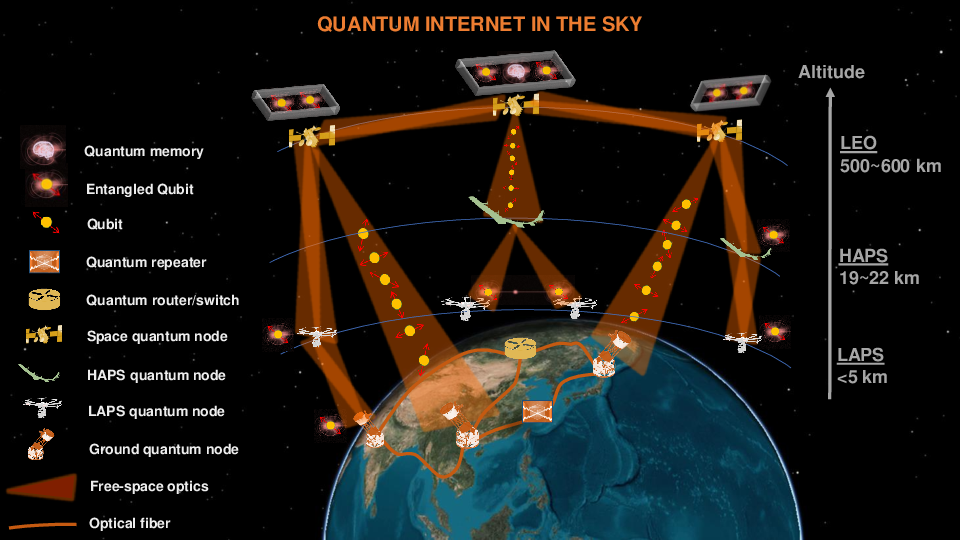
Figure 1: Hierarchical architectural concept of the Quantum Internet in the Sky, integrating LAPS, HAPS, LEO satellite constellations, and ground stations into a 3D quantum FSO mesh for end-to-end entanglement-based services.
The architecture leverages strongpoints of each layer:
- LEO Satellite Layer: Ensures global coverage, high-throughput quantum links (>1000 km), and supports entanglement distribution over vast distances with quantum memory and repeaters. Entanglement swapping and quantum routers enable dynamic interconnection of otherwise disjoint ground/HAPS/LAPS segments.
- HAPS Layer: Facilitates persistent quantum links unaffected by lower atmospheric turbulence, enabling quasi-stationary relaying and extended entanglement distribution.
- LAPS Layer: Provides agile, rapidly deployable quantum connectivity for last-mile scenarios (disaster recovery, urban environments) while constrained by battery capacity and platform SWaP.
End-to-end device-independent QKD, distributed quantum computing, and teleportation protocols are provisioned, with the architecture supporting entanglement swapping to direct quantum states between arbitrary nodes without classical repetition. Layer interoperability and entanglement-based quantum routing are central to the network vision.
Physical Layer Challenges and System Constraints
The non-terrestrial quantum link environment induces unique physical-layer impairments, such as:
- Atmospheric turbulence and cloud blockage: Severe for LEO-to-ground, mitigated with ground-based adaptive optics and site diversity.
- Geometrical and pointing losses: Narrow beam divergence is essential for link budget, but introduces high PE vulnerability due to platform dynamic pointing errors.
- Finite-key effects: Statistical fluctuations in QKD key rates are amplified due to limited transmission windows during LEO passes or battery bounds on LAPS.
- Background noise and polarization misalignments: Particularly challenging for SWaP-limited, dynamic platforms under strong solar irradiance.
Each scenario (LEO-to-LAPS, LEO-to-HAPS, HAPS-to-LAPS, LEO-to-Ground) is analyzed for dominant impairments. Notably, SWaP constraints on NTPs limit aperture diameters and processing hardware, necessitating aggressive miniaturization and optomechanical precision.
Proposed Technical Solutions and System Analyses
The paper develops technical solutions tightly aligned to the NTN environment:
- Miniaturized OGS and QKD Terminals: Gimbal-based coarse pointing and fine tracking (closed-loop mirrors, position sensors), lightweight and power-efficient optoelectronics for microsatellite/CubeSat and drone integration.
- Dynamic Polarization Tracking: Motorized half-wave plates for real-time polarization frame synchronization in the presence of temporal platform attitude changes and Doppler/phase disturbances.
- Direct SPAD Coupling: SWaP-constrained LAPS use SPAD arrays for efficient photon detection, eschewing lossy fiber coupling.
- Beam Divergence Adaptation: Actively controlled divergence to counter PEs, minimizing outages and geometric loss.
Quantitative performance is demonstrated, e.g., for a LEO-CubeSat-to-HAPS link operating at 810 nm with a 9 cm transmitting telescope and a 35 cm HAPS receiver: A weak PE regime yields secret-key lengths >0.6 Mbits over a 200 s window, sufficient for one-time pad applications; strong PEs degrade key rates by over 66%.
Under high spectral irradiance, HAPS-to-LAPS entanglement fidelity remains >80% using a 33 µrad divergence, but is rapidly degraded in the presence of wide divergence or severe PEs, underscoring the necessity of precise ATP control.
For LEO-to-ground, the Fried coherence length and Greenwood frequency analysis for 810 nm vs 1550 nm demonstrates clear turbulence resilience advantages for telecom-band implementations, reinforcing the value of mature silicon photonics and adaptive optics on ground stations.
Implications and Theoretical Expansion
The layered NTN-based quantum network dramatically extends the global reach, redundancy, and performance bounds of quantum networking, integrating classical NTN and 6G paradigms. The entanglement-based, mesh-oriented architecture supports low-latency, high-security quantum cryptography, distributed quantum computing, and enables robust multi-user, location-independent quantum information services. The fusion of SWaP-optimized photonics, adaptive networking protocols, and cross-layer control is essential for practical deployment.
The analysis of finite-key effects, pointing/tracking algorithms, and adaptive optics uplifts the theoretical model realism, directly informing both system engineering and quantum information-theoretic protocol design for lossy, noisy, and temporally variable non-terrestrial channels.
Future Research Directions
The authors articulate a composite research roadmap:
- High-dimensional quantum comms: Expanding from qubits to qudits (d>2) leverages higher state space, boosting QKD rates, information density, and resilience. Generation, transmission, and detection of OAM and other spatial modes remain experimental bottlenecks at scale.
- Multipartite and groupwise entanglement: Enabling simultaneous multi-user (k-party) protocols for distributed QKD, secret sharing, and quantum-enhanced consensus, necessitating robust multipartite entanglement generation/distribution.
- Quantum-Integrated IQCSCI Systems: Embedding quantum communication, sensing, distributed computing, and machine learning on NTN platforms to support application spaces such as massive autonomous vehicle control, distributed quantum-enhanced AI, and global-scale quantum sensing.
Conclusion
This work provides a rigorous, system-level vision for the Quantum Internet in the Sky, integrating LEO satellites, HAPS, and LAPS into a functional platform for non-terrestrial quantum information transfer. The paper's treatment of physical-layer challenges, SWaP-driven constraints, system- and protocol-level solutions, and future research directions establishes foundational principles for the practical realization of NTN-based quantum communications. The findings underscore the necessity for cross-disciplinary advances in miniaturized quantum hardware, adaptive system control, and high-dimensional/multipartite quantum protocols to achieve the full potential of the global Quantum Internet.