- The paper introduces transcript-based estimators to algebraically quantify interaction complexity in multivariate time series.
- It employs permutation entropy and Jensen-Shannon divergence to measure strength and detect directionality in nonlinear systems.
- Real-world EEG analyses confirm the method's ability to track dynamic brain connectivity changes across vigilance states.
Transcript-Based Estimators for Characterizing Interactions: A Detailed Analysis
Introduction
This paper rigorously revisits the transcript framework for the algebraic characterization of interactions in multivariate time series, with a particular focus on ordinal pattern-based statistical estimators. The methodology capitalizes on permutation-theoretic constructs, known as transcripts, to extract the complexity, strength, and directionality of functional relationships between observed dynamical systems. Although transcript-based analysis emerged as a theoretically principled approach over a decade ago, its utilization for real-world, empirical systems has been limited. This article addresses this gap by systematically applying and evaluating transcript-based measures across canonical nonlinear systems and real electroencephalographic (EEG) data, documenting advantages, caveats, and interpretable insights.
Theoretical Framework and Methodology
The transcript-based approach extends ordinal pattern analysis, leveraging the algebraic relations between symbolic representations of time series segments, derived via delay embeddings. For time series X and Y, ordinal patterns of fixed embedding dimension and lag are generated, and the transcript τ is computed as the permutation that maps the pattern of X onto that of Y (and vice versa). This approach enables:
- Complexity quantification via the order of the transcript (the minimal power needed to recover the identity permutation), corresponding to Kolmogorov complexity abstraction over interactions.
- Interaction strength estimation through the Jensen-Shannon divergence (JSD) between probability distributions over transcript order classes for joint versus independent samples.
- Directionality detection via delayed, mutual-information-based asymmetry, employing symbolic mutual information of time-shifted transcript sequences.
A succinct illustrative example of transcript calculation is shown in Figure 1.
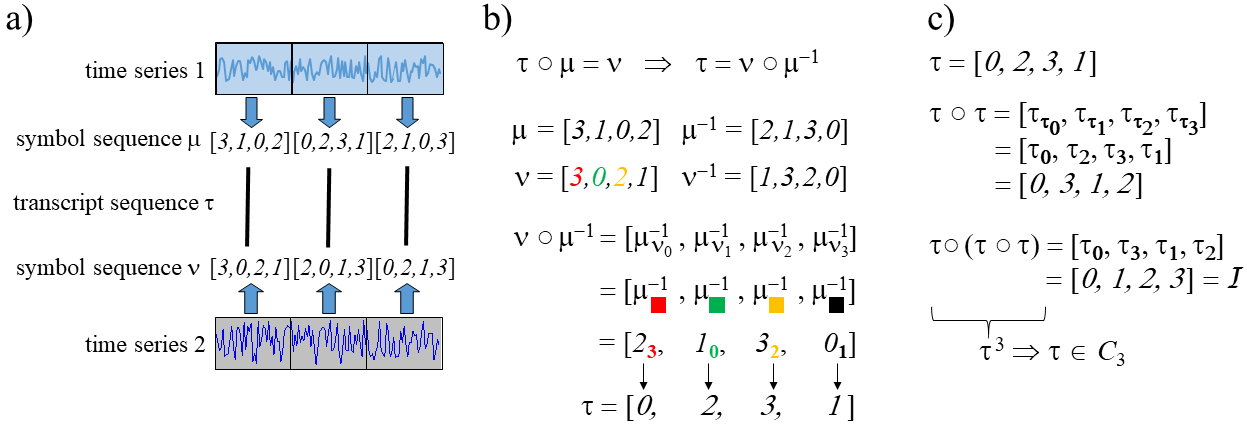
Figure 1: Schematic of the transcript calculation between time-series-derived ordinal patterns, including construction of order classes from algebraic compositions.
The framework supports analytic derivation of expected probability densities for transcript order classes, facilitating statistical hypothesis testing and interpretation of observed empirical values relative to theoretical baselines.
Application to Coupled Model Systems
The transcript-based estimators are first applied to unidirectionally coupled Hénon maps and Rössler oscillators, two paradigmatic nonlinear systems with well-characterized synchronization dynamics. Comprehensive simulations across coupling strengths reveal:
- Interaction strength estimator (DJSC): Remains null below critical coupling and sharply increases as systems phase lock, then saturates in the regime of full synchronization. Fluctuations in this regime reflect transitions between dynamical regimes rather than noise.
- Directionality index (TC): Correctly detects the driver in the Rössler scenario across all couplings but exhibits ambiguous or spurious signs at very weak coupling in Hénon maps, highlighting reduced sensitivity and robustness in the presence of minimal effective interactions.
- Complexity estimator: Peaks near transitions between desynchronized and synchronized states, corresponding to the highest heterogeneity in the transcript order distribution.
- Probability densities of order classes (PCn): Exhibit sharp transitions in dominant classes upon synchronization, with higher order complexity manifesting in intermediate regimes.
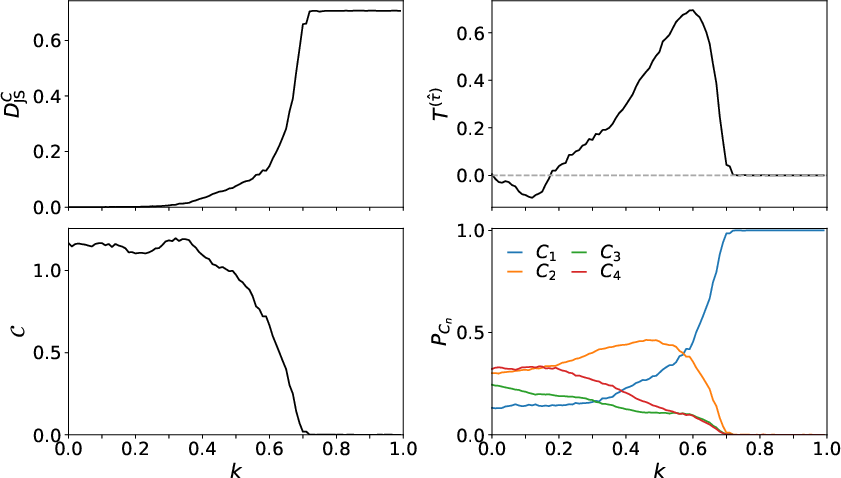
Figure 2: Dependence of strength, directionality, and complexity estimators on coupling strength for Hénon maps, highlighting a critical transition in both strength and complexity, and nontrivial directionality detection.
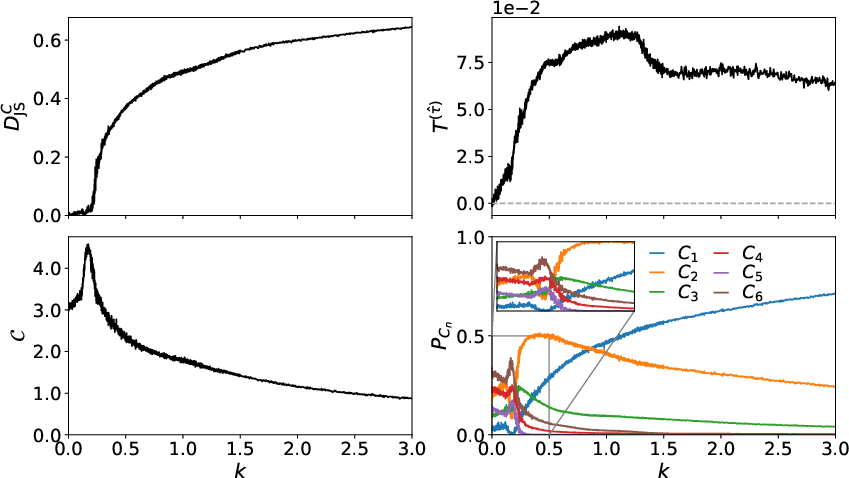
Figure 3: Analogous analysis for Rössler oscillators, revealing smooth increases in interaction strength and directionality until full synchronization.
These results emphasize the discriminative power of transcript-based measures in detecting both nonlinear coordination and the emergence of functional coupling, but also delineate their limits under low signal-to-noise or minimal interaction.
Application to Human EEG: Vigilance-State-Dependent Connectivity
Spatially and temporally resolved analyses of multiday, multichannel human EEG recordings, encompassing both wakefulness and sleep, illustrate the capacity of transcript-based estimators to parse time-resolved and spatially localized changes in brain connectivity patterns.
- Temporal Dynamics: Windowed analyses of both short-range and long-range interactions illustrate marked diurnal modulation in interaction strength and complexity: increased mean strength and complexity during daytime, stabilization at lower levels during night. Complexity measures, and particularly order class distributions, are notably more sensitive to state transitions than strength or directionality alone.
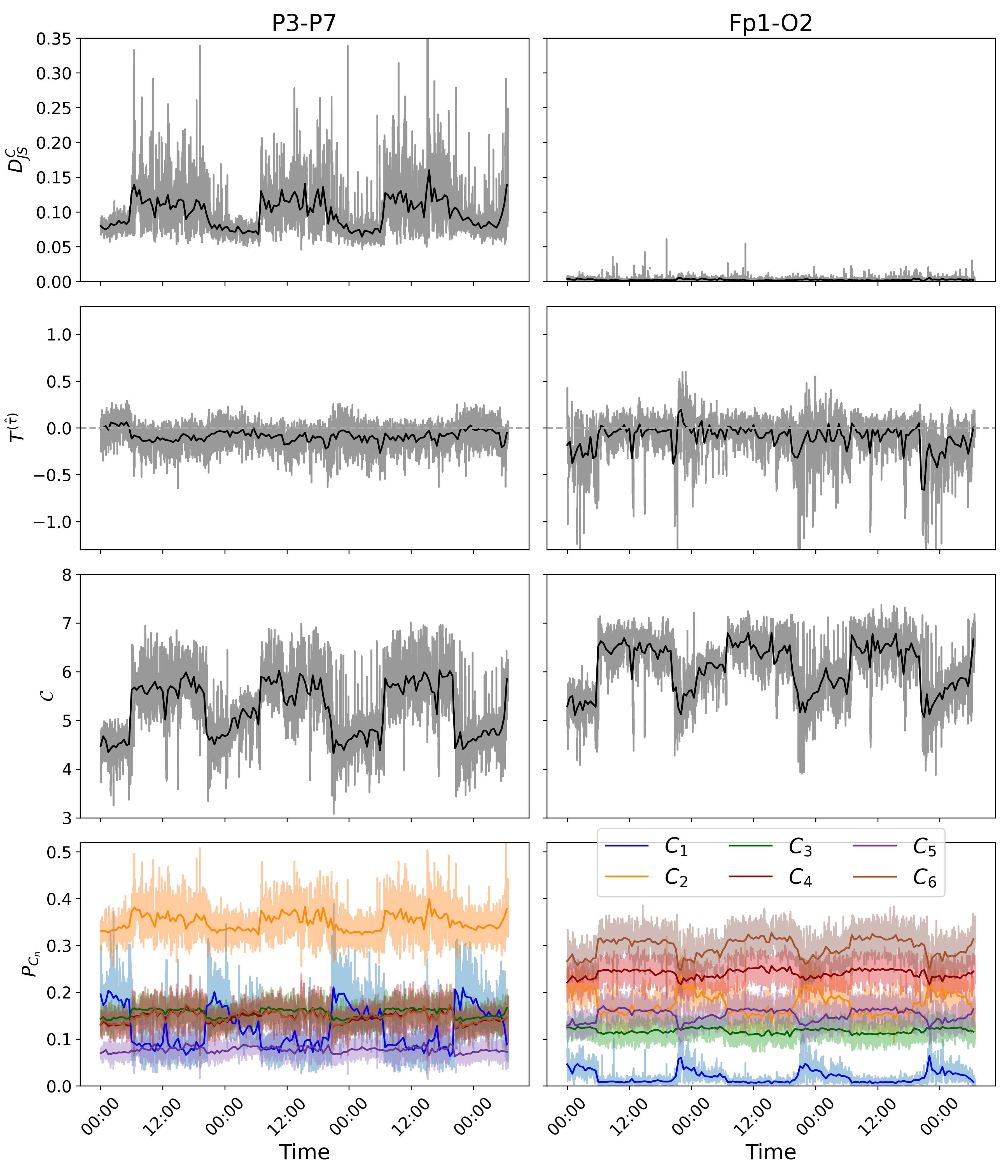
Figure 4: Time evolution of strength, direction, and complexity estimates for selected brain region pairs; sharp changes demarcate transitions between wakefulness and sleep.
- Spatial Patterns: Aggregated over all subjects, strength and directionality maps for both day and night show a posterior-anterior gradient, with posterior areas exhibiting stronger and more driving interactions during wakefulness, and a role shift to the temporal lobes during sleep, consistent with memory consolidation literature.
- Complexity Distribution: Complexity is maximized in fronto-temporo-central regions during wakefulness, co-localizing with circuits for executive function. Nighttime is characterized by globally decreased complexity, with posterior regions dominated by low-order classes.
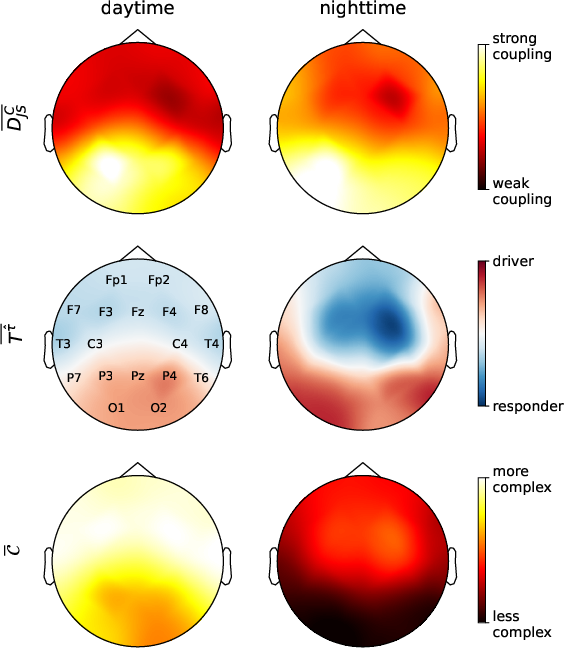
Figure 5: Head-surface mapping of strength, directionality, and complexity; reveals spatially structured changes across vigilance states.
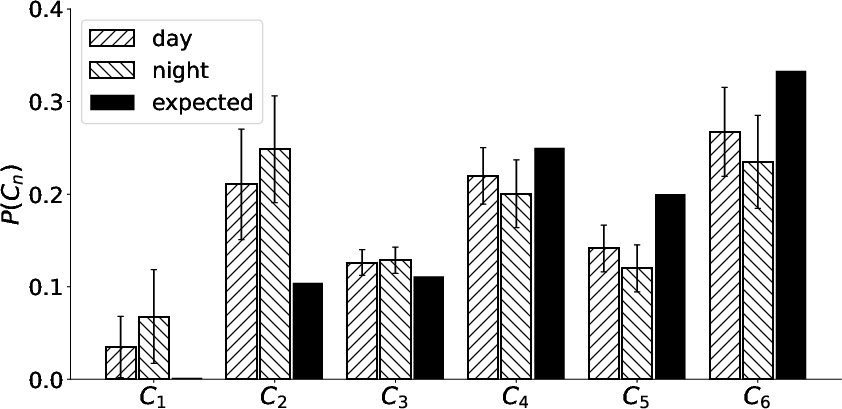
Figure 6: Grand averages of probability densities for order classes, showing predominance of lower even-order classes during sleep.
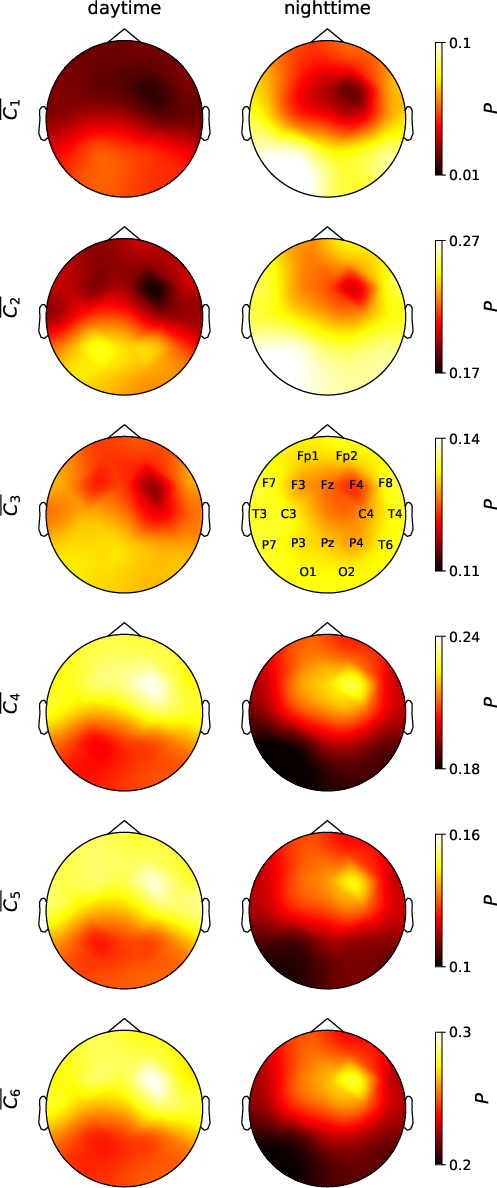
Figure 7: Detailed spatial distributions of order class probabilities, underscoring the fine-grained, state-dependent anatomical organization of complexity.
The probability distribution for order classes is further shown to have nontrivial structure, with even-order classes systematically more likely than odd, in both theory and data, facilitating nuanced differentiation of network states beyond the reach of standard strength-directional metrics.
Theoretical Insights and Implications
Transcript-based analysis, through its explicit algebraic underpinning and its ties to Kolmogorov complexity and permutation entropy, offers a highly compact yet discriminative window into interdependence structure in dynamical systems. Sensitivity to synchronization transitions, multiscale interactions, and the emergence of functional modules is manifest. For neurodynamic applications, particularly the analysis of nonstationary, large-scale brain recordings, these methods afford unique opportunities for tracking vigilance state changes, disease states, and modular reorganization.
Theoretical extensions are possible in several directions:
- Robustness and statistical inference: Further analysis under controlled noise, as noted by subsequent work, will clarify estimator stability.
- Comparison to alternative complexity measures: Benchmarking transcript-based complexity against other symbolic and topological measures could identify unique advantages or systematic limitations.
- Multivariate and network-level generalization: Moving beyond pairwise statistics to full interaction networks and their evolution, with transcript-derived weights and complexities, enables robust functional connectomics.
Conclusion
Transcript-based ordinal estimators present a principled class of information-theoretic tools for interaction analysis in complex systems. Their algebraic structure and interpretability—especially when applied to real-world systems such as multiday EEG—reveal state-dependent, spatially organized patterns in both connectivity strength and interaction complexity. While estimators of strength and directionality display limited detectability in weak coupling regimes, complexity-related measures based on transcript order class distributions can resolve finer modulations relevant to brain dynamics. These methods form a promising foundation for future quantitative analysis in neuroscience and complex systems science.