No Love for black holes: tightest constraints on tidal Love numbers of black holes from GW250114
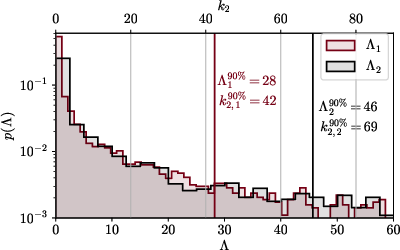
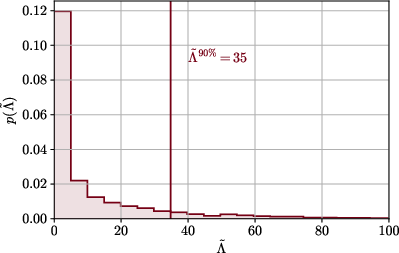
Abstract: Tidal Love numbers of black holes, zero in classical general relativity for Kerr black holes in vacuum, become non-vanishing in the presence of exotic matter or in alternative theories of gravity, making them a powerful probe of fundamental physics. The gravitational-wave event GW250114, observed with an unprecedented signal-to-noise ratio, provides a unique opportunity to test this prediction. By analyzing this event, we conclude that the data is consistent with the binary black hole hypothesis, and we place a 90\% upper limit on the effective tidal deformability of $\tildeΛ < 34.8$. These bounds imply that any environment surrounding the black holes must contribute less than $\sim 7\times 10{-3}$ of their mass, and they rule out some models of boson stars. Our findings provide the strongest observational constraints yet on black hole tidal deformability and show that the data remain fully consistent with the Kerr black hole prediction of vanishing tidal Love numbers.
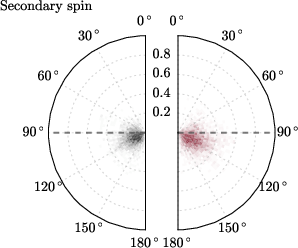
Paper Prompts
Sign up for free to create and run prompts on this paper using GPT-5.
Top Community Prompts
Explain it Like I'm 14
A simple guide to “No Love for black holes: tightest constraints on tidal Love numbers of black holes from GW250114”
What this paper is about
This paper asks a deceptively simple question: Are black holes “squishy” in any way when another massive object pulls on them? In Einstein’s theory (general relativity), perfectly clean, spinning black holes in empty space should not deform at all under tides from a companion. Scientists describe this “squishiness” using tidal Love numbers. For normal stars, these numbers are not zero; for black holes in empty space, they should be exactly zero.
The authors use a very loud gravitational‑wave signal, called GW250114, to check whether the black holes in that event behaved as theory predicts. Spoiler: they did.
What questions the researchers asked
They focused on three main questions:
- Do the data show any sign that the black holes were tidally deformed (i.e., had non-zero tidal Love numbers)?
- If not, how strong can we make the upper limits on this “squishiness”?
- What does that tell us about new physics, exotic objects (like boson stars), or matter that might have been around the black holes?
How they did the study (in everyday terms)
Gravitational waves are ripples in space-time made when massive objects like black holes spiral together and merge. The exact shape of these ripples carries information about the system—kind of like how the sound of a violin tells you about the shape and material of the instrument.
- The team used data from the LIGO detectors (in Hanford and Livingston). The event GW250114 was extremely clear, with a very high signal-to-noise ratio (about 80). Think of it as a very crisp recording with little background noise.
- They compared two computer models of the wave: 1) one where black holes behave exactly as Einstein’s theory predicts (no tidal “squishiness”), and 2) one where black holes are allowed to be a little squishy.
- The “squishiness” is captured by numbers called tidal Love numbers. A related quantity, the tidal deformability (often written as Λ, or tilde-Λ for an “effective” version), describes how much an object would bulge under a tidal pull.
- They used a careful statistical method (Bayesian analysis) to see which model the data prefer and to set limits on how big the tidal effects could be. They also set up the search so it wouldn’t accidentally favor large values just because the numbers could, in principle, be big.
In short: they listened to the “song” of GW250114, checked for tiny extra notes tidal effects would add to the melody, and asked whether those notes were really there.
What they found and why it matters
- The data fit the “not squishy” black hole model very well. There is no sign of extra tidal effects.
- They set the strongest limits so far on how big tidal deformability could be for these black holes:
- The effective tidal deformability is less than 34.8 (at 90% confidence).
- For the two black holes individually, Λ is less than 28.2 and 45.7 (90% confidence).
- A statistical comparison (the Bayes factor) showed no preference for adding tidal effects to the model. In plain words: the simpler, “no tides for black holes” picture works just fine.
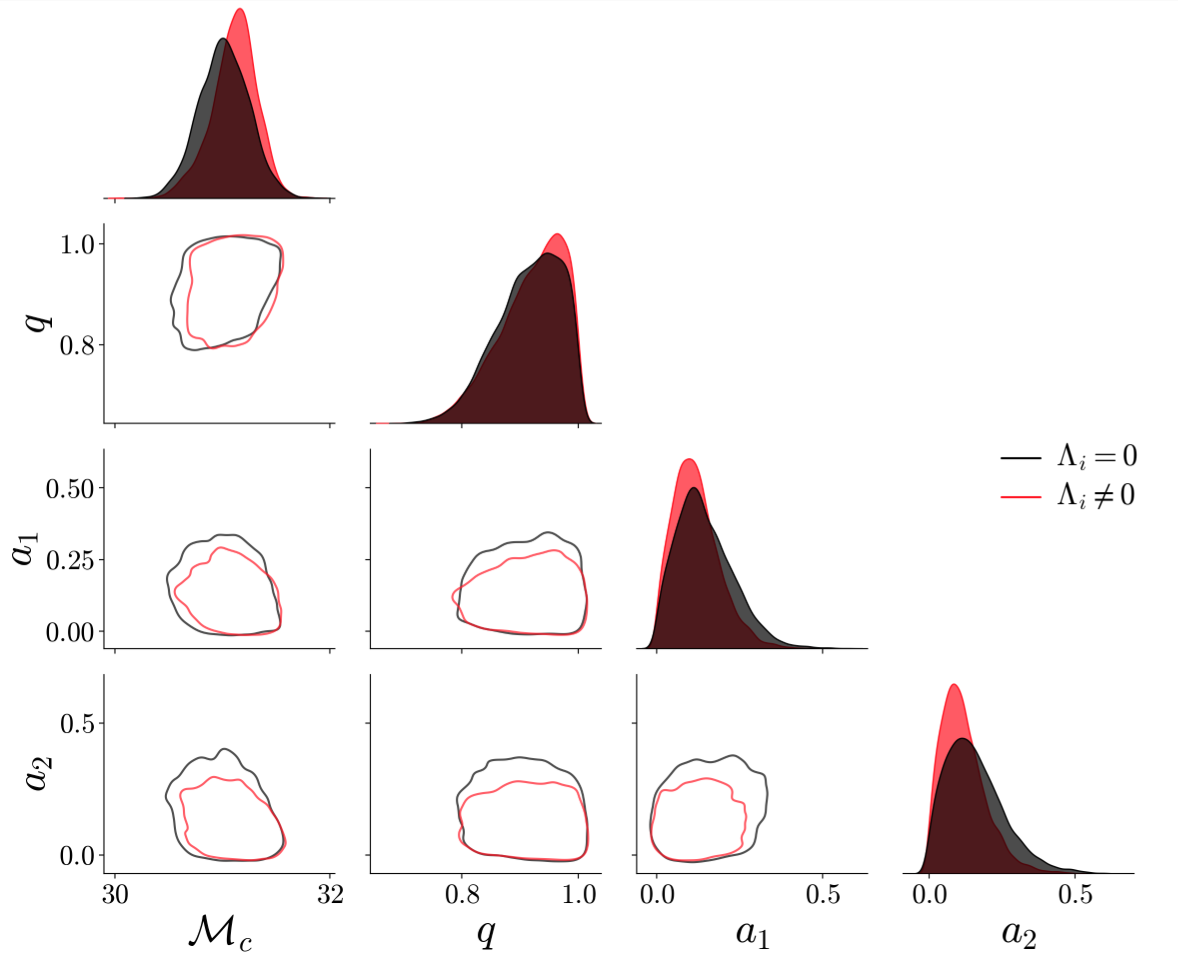
- Importantly, allowing for tidal effects did not shift the estimated masses or spins of the black holes. That means the basic astrophysical picture of the event is stable and trustworthy.
Why this matters:
- In standard general relativity, clean black holes have tidal Love numbers of zero. These results match that prediction better than ever.
- If something unusual were happening—like new physics, exotic compact objects, or lots of matter surrounding the black holes—tiny tidal signatures could show up. Not seeing them strongly limits those possibilities.
What this means for the universe (implications)
- Little to no extra matter around the black holes: If there were a lot of stuff (like a dense cloud or disk) around the black holes, it could make them appear tidally deformable. The new limit shows that any surrounding material must weigh less than about 0.7% of each black hole’s mass (at a conservative scale). That’s very little.
- Ruling out some exotic objects: Some “black hole alternatives,” such as certain kinds of boson stars, predict clear, positive tidal deformabilities. The new limits rule out several boson star scenarios and squeeze the remaining ones into very narrow corners of possibility.
- A strong win for Einstein’s theory: The best data so far continue to show black holes behaving exactly as general relativity predicts—no measurable tidal “Love” for black holes.
Bottom line
Using one of the clearest gravitational-wave signals ever recorded, the authors found that black holes still look like the “no-squish” objects Einstein’s theory says they should be. This tightens the leash on exotic ideas and on matter around black holes, and it gives us even more confidence that our current understanding of gravity works in the most extreme places in the universe.
Knowledge Gaps
Below is a concise list of knowledge gaps, limitations, and open questions that remain unresolved in the paper. These items are intended to be concrete and actionable for future research.
- Waveform systematics: the analysis uses IMRPhenomPv2 without higher harmonics and does not cross-validate results with alternative families (e.g., SEOBNR, IMRPhenomXPHM, EOB-based models), leaving model-dependence and potential waveform biases at high PN orders unquantified.
- PN truncation and missing physics: only the leading electric quadrupole tidal terms at 5PN and 6PN are included; higher PN orders, amplitude corrections, spin–tidal couplings, tail terms, and tidal contributions from higher multipoles (l ≥ 3) are neglected, with no systematic error budget provided.
- Magnetic TLNs are ignored: the analysis omits current-multipole (magnetic) tidal Love numbers entirely, providing no constraints or robustness checks for these degrees of freedom.
- Inspiral-only constraints: merger and ringdown are left unmodified; the work does not test for or constrain tidal/environmental imprints beyond the PN inspiral (e.g., ringdown spectroscopy in environments, mode mixing, or frequency-domain perturbation effects).
- Adiabatic and frequency-independent tides: TLNs are modeled as adiabatic and constant; dynamical tides and frequency-dependent tidal responses predicted for environmental BH binaries are not implemented or constrained.
- Environmental modeling is generic and coarse: the environment constraint relies on a single scaling with an order-unity fudge factor ; there is no mapping to concrete astrophysical models (e.g., thin/thick accretion disks, scalar clouds, DM halos), geometry, thermodynamics, or profile-dependent predictions.
- Time-dependent environments and disruption: the potential tidal disruption and evolution of the environment during inspiral (acknowledged as a source of ∼10% bias) are not modeled, nor are constraints re-derived within a time-dependent TLN framework.
- Eccentricity is excluded: a quasi-circular assumption is imposed; the degeneracy between mild eccentricity and high-PN tidal phase corrections—and the impact on TLN limits—is not explored.
- Explicit constraints on subleading tidal parameters: is said to be suppressed for near-symmetric mass ratios, but no quantitative bound is reported; the sensitivity to mass ratio and spin configurations remains uncharacterized.
- Prior dependence not fully assessed: although log-uniform priors are motivated, the impact of the lower bound (10{-3}), alternative physically motivated priors, and hierarchical/population-informed priors on the inferred upper limits is not systematically quantified.
- Frequency band and data selection robustness: the choice of [20, 896] Hz and an 8 s analysis segment is fixed; sensitivity of TLN constraints to f_low/f_high, segment length, windowing, and PSD estimation choices is not tested.
- Calibration and noise systematics: only a cubic-spline marginalization is applied; robustness to non-Gaussian noise, residual glitches, different calibration models, and alternative PSDs at very high SNR (~80) is not evaluated.
- Single-event focus: constraints are based on GW250114 alone; no stacking across the catalog, hierarchical inference, or projections for multi-event combined limits are provided.
- ECO coverage is incomplete: the analysis restricts TLNs to positive values and thus cannot test or constrain ECO models with negative TLNs (e.g., wormholes, gravastars, perfect mirrors); mixed-sign component TLNs are excluded by prior choice.
- Boson star modeling scope: constraints target a limited set of nonspinning BS models/potentials; the impact of spin, rotation-induced structure, excited states, different self-interactions, and mixed BH–BS binaries is not considered.
- Modified gravity mapping: the paper does not translate TLN upper limits into bounds on couplings/parameters of specific alternative theories of gravity (e.g., scalar–tensor, Einstein–Gauss–Bonnet, vector-tensor), so theory-space constraints remain absent.
- Degeneracy studies are narrow: while mass and spin stability is shown for this event, broader degeneracy maps (e.g., with higher harmonics, precession, eccentricity, spin-induced quadrupoles, and calibration) through injections and recovery are not performed.
- Reproducibility and code availability: LALSuite modifications for tidal dephasing are described but not explicitly released or benchmarked; end-to-end reproducibility, cross-code comparisons, and validation on synthetic datasets are left for future work.
- Future detector implications: TLN sensitivity forecasts for next-generation detectors (ET/CE) and lower f_low starts are not quantified, nor are strategies for joint inspiral–ringdown analyses to close current gaps.
Practical Applications
Overview
The paper reports the tightest observational constraints to date on tidal Love numbers (TLNs) of black holes, using the high–signal-to-noise ratio (SNR) event GW250114. The analysis finds no evidence for tidal deformability, setting a 90% upper limit of (and , ), consistent with Kerr black holes in vacuum. It constrains environmental mass fractions to below ~0.7% at a conservative scale and rules out several boson-star models. Methodologically, the work introduces tidal dephasing at 5PN/6PN into IMRPhenomPv2, uses log-uniform priors to avoid high-SNR bias, and delivers a reproducible Bayesian pipeline (bilby/dynesty) with calibration-marginalization. Below are actionable applications arising from these findings and methods.
Immediate Applications
- Black-hole and exotic-compact-object (ECO) model exclusion in theory and data analysis (academia)
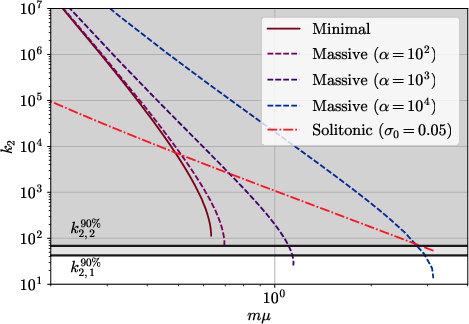
- Use the published bounds to prune parameter space for boson star models (e.g., exclude minimally coupled BS, massive BS with α=100, solitonic BS with σ0=0.05; restrict α≥103 to high-compactness windows and associated boson masses).
- Integrate the constraints into population studies and hierarchical analyses to update priors on ECO occurrence rates.
- Tools/workflows: scripts/notebooks that map posterior samples to TLN bounds and then to (mμ, α) and boson mass intervals; cross-referencing with the Cardoso et al. TLN tables.
- Assumptions/dependencies: TLN interpretation assumes positive electric quadrupolar TLNs; magnetic and higher multipole TLNs neglected; vacuum-GR ringdown left unchanged.
- Environmental constraints for astrophysical modeling (astrophysics)
- Translate bounds into limits on environmental mass fraction ε and scale via , providing benchmarks for models of accretion disks, boson clouds, and dark-matter halos surrounding BBHs.
- Use bounds to update priors in simulations of BBHs in AGN disks or dense nuclear star clusters and to inform seeding/feedback models in galaxy evolution.
- Tools/products: a lightweight Python package or function that takes and outputs constraints on ε with uncertainty propagation; plotting utilities for ε– exclusion curves.
- Assumptions/dependencies: minimal equilibrium scale; frequency-independent effective TLN in inspiral; not modeling tidal disruption, which can produce O(10%) systematic shifts at large .
- Improved GW parameter estimation practices for high-SNR events (software, academia)
- Adopt log-uniform priors for scale-like high-PN parameters (TLNs) to mitigate prior-induced biases in masses/spins for loud signals.
- Include tidal dephasing terms at 5PN/6PN in inspiral for parameterized GR tests even when expecting zero TLN.
- Tools/workflows: LALSuite patch or plugin adding 5PN/6PN tidal dephasing to IMRPhenomPv2; bilby configuration templates with dynesty settings and calibration-spline marginalization; CI tests comparing uniform vs log-uniform priors.
- Assumptions/dependencies: PN framework validity in the analyzed frequency band; inspiral-dominated information content for TLNs; calibration model adequacy (10×10 spline control points).
- Event-vetting and detector-characterization standards (detector operations, policy for collaborations)
- Use Bayes factor reporting conventions (with uncertainties) for complex vs simpler models in high-SNR events.
- Standardize inclusion of calibration-marginalization and PN-order choices for strong-field tests beyond 3.5PN.
- Tools/products: checklists for high-SNR analyses; pipeline templates incorporating spline calibration; QA dashboards highlighting the stability of mass/spin posteriors with/without TLNs.
- Assumptions/dependencies: access to cleaned/calibrated strain; governance for analysis variants and reporting.
- Benchmark datasets for Bayesian samplers and waveform systematics (software/HPC)
- Use the released GW250114 datasets and posterior products as benchmarks for nested samplers (dynesty vs alternatives), likelihood implementations, and waveform systematics studies.
- Tools/products: reproducible Jupyter notebooks; containerized environments (e.g., Docker) for fair sampler comparisons; performance metrics (ESS, evidence error bars).
- Assumptions/dependencies: community adoption; availability of compute resources.
- Curricular and training materials in data analysis and GR tests (education)
- Build lab modules that walk students through adding tidal terms, choosing priors, running nested sampling, and interpreting Bayes factors with the supplied data.
- Tools/products: annotated notebooks; short assignments on prior choice effects; visualization apps for TLN-to-environment translation.
- Assumptions/dependencies: access to bilby/LALSuite and open data; instructor familiarity with Bayesian inference.
- Cross-domain statistical guidance on priors for scale parameters (data science in industry/academia)
- Promote log-uniform (Jeffreys-like) priors for parameters spanning orders of magnitude with weak data support—reducing bias in high-SNR but high-model-complexity regimes (e.g., some metrology, geophysics, or radar/sonar analyses).
- Tools/products: best-practice notes; small example repositories demonstrating bias from uniform vs log-uniform priors.
- Assumptions/dependencies: relevance to problem structure; stakeholder comfort with Bayesian methods.
Long-Term Applications
- Science-case and requirements for next-generation detectors (instrumentation, policy)
- Use sensitivity of 5PN/6PN tidal terms to set frequency-band and noise-floor targets for Einstein Telescope and Cosmic Explorer aimed at sub-10 bounds on .
- Prioritize commissioning tasks that most improve inspiral phase fidelity (calibration, low-frequency sensitivity), directly boosting TLN constraints.
- Tools/products: forecasting tools that propagate projected PSDs to expected TLN posteriors; trade-study reports linking hardware improvements to science return.
- Assumptions/dependencies: realistic detector noise models; waveform-systematics control at required precision.
- Real-time or low-latency “physics-constraints-as-a-service” (software/cloud)
- Develop APIs that, upon event detection, output updated constraints on TLNs, environmental mass fractions, and ECO parameter spaces; feed public dashboards and alert streams.
- Tools/products: serverless pipelines integrating bilby with low-latency configuration; curated event-by-event constraint archives; visualization dashboards.
- Assumptions/dependencies: robust, fast likelihoods; stable calibration in low-latency mode; governance for public release.
- Environmental tomography of BBH surroundings (astrophysics, multi-messenger)
- Combine TLN-based ε– limits across events with EM surveys of AGN/galactic environments to map where environmental effects are absent or tightly constrained.
- Tools/products: joint GW–EM catalogs and likelihoods; hierarchical models aggregating constraints across populations; cross-correlation studies with galaxy/AGN catalogs.
- Assumptions/dependencies: accurate host-galaxy association (often challenging for BBHs); improved environmental modeling (frequency-dependent, time-varying TLNs, disruption).
- Refined waveform models including environmental and merger-ringdown imprints (academia, software)
- Extend beyond adiabatic, positive electric TLNs to include frequency-dependent and time-evolving tidal response, magnetic TLNs, and ringdown modifications from matter distributions.
- Tools/products: next-gen IMRPhenom/EOB models incorporating environmental terms; validation against numerical relativity in matter backgrounds; surrogate models for speed.
- Assumptions/dependencies: theoretical development and numerical relativity support; quantification of systematics to not overfit noise.
- Dark-sector and particle-physics constraints from GW data (academia, policy)
- Translate cumulative TLN bounds into global constraints on bosonic field masses and self-interactions; coordinate with laboratory/astroparticle searches for complementary parameter-space coverage.
- Tools/products: joint-likelihood frameworks; white papers aligning GW constraints with particle-physics roadmaps.
- Assumptions/dependencies: model mapping fidelity (BS structures, self-interactions); community coordination; multiple high-SNR events.
- Methodological exports to other sensing domains (industry, government labs)
- Apply high-order phase-correction detection and prior-robust Bayesian model selection to high-SNR but faint-effect detection problems in seismology, radar/sonar, and metrology.
- Tools/products: domain-adapted libraries demonstrating nested sampling with prior sensitivity analysis; training for analysts.
- Assumptions/dependencies: analogous signal models exist; stakeholders accept Bayesian decision metrics.
- Public engagement and advanced coursework (education, outreach)
- Build interactive apps letting users vary TLNs, environments, and see waveform impacts; advanced GR and data-science coursework leveraging real data and cutting-edge methods.
- Tools/products: web apps; MOOCs; educator guides.
- Assumptions/dependencies: sustained funding and maintenance; partnerships with observatories and universities.
Key Cross-Cutting Assumptions and Dependencies
- Physical modeling: PN expansion accuracy in analysis band; neglect of magnetic and higher multipole TLNs; inspiral-only tidal modeling; positive TLNs only in this analysis.
- Data and instrumentation: availability of high-SNR events; precise calibration and data-quality procedures; reproducible open data.
- Computation: access to HPC/cloud resources for nested sampling; fast, accurate waveform implementations; tooling (bilby, LALSuite) maintained.
- Governance and standards: community agreement on prior choices for high-PN tests; consistent reporting of Bayes factors and credible limits; open-data policies.
Glossary
- Accretion disks: Dense rotating structures of matter around compact objects that can affect gravitational-wave signals. "For example, accretion disks, boson clouds, or dark-matter halos can imprint tidal signatures on the waveform~\cite{Baumann:2018vus,DeLuca:2021ite,Brito:2023pyl,Capuano:2024qhv,Cardoso:2019upw,Cardoso:2021wlq,Katagiri:2023yzm,DeLuca:2024uju,Roy:2025qaa}."
- Adiabatic limit: Regime where external changes occur slowly enough that the object's tidal response is effectively instantaneous. "In the adiabatic limit, an external tidal field induces a quadrupole moment in a compact object given by~\cite{Flanagan:2007ix,Hinderer:2007mb,Binnington:2009bb,Hinderer:2009ca}"
- Alternative theories of gravity: Modifications of general relativity that can change compact-object properties and gravitational-wave signals. "Tidal Love numbers of black holes, zero in classical general relativity for Kerr black holes in vacuum, become non-vanishing in the presence of exotic matter or in alternative theories of gravity"
- Bayesian framework: Statistical approach for inference and model comparison using probabilities for hypotheses. "We use a Bayesian framework to achieve two goals."
- Bayes factor: The ratio of evidences comparing two models or hypotheses. "by computing the Bayes factor, ."
- bilby library: A software package for Bayesian inference in gravitational-wave astronomy. "We compute the posterior distributions and the Bayes factor using the bilby library~\cite{Ashton:2018jfp,Romero-Shaw:2020owr} with the dynesty nested sampler~\cite{Speagle:2019ivv}."
- Binary black hole (BBH): A system of two black holes in orbit that merge and emit gravitational waves. "we conclude that the data is consistent with the binary black hole hypothesis"
- Boson cloud: An accumulation of bosonic fields around a black hole that can modify its tidal response. "For example, accretion disks, boson clouds, or dark-matter halos can imprint tidal signatures on the waveform"
- Boson star (BS): A hypothetical compact object composed of self-gravitating bosonic fields. "and they rule out some models of boson stars."
- Calibration uncertainties: Errors in the measured detector response affecting amplitude and phase of the strain data. "We also marginalize over calibration uncertainties using a cubic-spline model with 10 amplitude and 10 phase control points~\cite{CalUncer}."
- Chirp mass: A key mass combination, , controlling the inspiral phase evolution of gravitational waves. "chirp mass "
- Comoving volume: Cosmological volume element that factors out cosmic expansion, used in priors over source distances. "uniform in comoving volume with isotropic sky position."
- Compactness: A measure of how concentrated an object's mass is relative to its size, affecting its tidal response. "We adopt the convention of Ref.~\cite{Cardoso:2017cfl}, where the object's compactness is absorbed into the definition of "
- Cubic-spline model: A piecewise cubic interpolation method used to model calibration errors smoothly. "using a cubic-spline model with 10 amplitude and 10 phase control points"
- Dark-matter halo: A diffuse, massive distribution of dark matter around astrophysical objects. "For example, accretion disks, boson clouds, or dark-matter halos can imprint tidal signatures on the waveform"
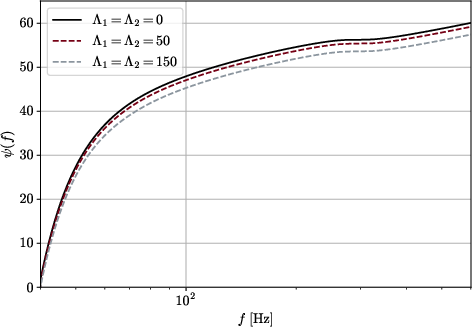
- Dephasing: A phase shift in the gravitational-wave signal relative to the vacuum prediction. "The waveform is modified by adding two generic absolute dephasing corrections to the inspiral phase,"
- dynesty nested sampler: An algorithm implementing nested sampling for Bayesian evidence and posterior estimation. "with the dynesty nested sampler~\cite{Speagle:2019ivv}."
- Electric tidal Love numbers: TLNs associated with the mass (as opposed to current) multipole response to tidal fields. "These expressions account only for the electric TLNs associated with the mass quadrupole in Eq.~\eqref{eq:Qij}."
- Effective tidal deformability (tilde Lambda): The leading-order combination of component deformabilities entering the GW phase. "we place a 90\% upper limit on the effective tidal deformability of ."
- Environmental mass fraction: The ratio of the environment’s mass to the black hole’s mass in a binary system. "translates to an environmental mass fraction of at ."
- Exotic compact objects (ECOs): Non-standard compact objects predicted by beyond-GR or exotic matter scenarios. "such as modified gravity, exotic compact objects (ECOs), or the presence of matter surrounding the binary"
- Geometrical units: A unit system setting to simplify relativistic equations. "Throughout this work we use geometrical units ()."
- Gravastar: A hypothetical compact object alternative to black holes with different interior structure. "Other ECOs, such as wormholes, perfect mirrors or gravastars, would have negative TLNs"
- Gravitational-wave phase: The phase evolution of the measured gravitational-wave signal. "tidal interactions appear as high-order corrections to the GW phase."
- GWTC-4: The fourth LIGO–Virgo–KAGRA gravitational-wave transient catalog. "has expanded the catalog to GWTC-4, containing hundreds of compact-binary coalescences~\cite{LIGOScientific:2018mvr,LIGOScientific:2020ibl,KAGRA:2021vkt,LIGOScientific:2025slb,LIGOScientific:2025hdt,LIGOScientific:2025yae}."
- Hawking’s area theorem: A prediction that the total black hole horizon area does not decrease after merger. "Indeed, GW250114 has already been used to confirm Hawkingâs area theorem~\cite{KAGRA:2025oiz}"
- Horizons: Black hole boundaries from which nothing, not even light, can escape. "reflecting the fact that their horizons cannot sustain static tidal deformations."
- IMRPhenomPv2: A phenomenological inspiral–merger–ringdown waveform model including spin precession effects. "We incorporate the tidal phase correction into the phenomenological inspiralâmergerâringdown waveform IMRPhenomPv2~\cite{Husa:2015iqa,Khan:2015jqa,Hannam:2013oca}."
- Isotropic: Uniform over all directions; used for prior assumptions on orientations and sky. "isotropic in spin and orbital orientations; and uniform in comoving volume with isotropic sky position."
- LALSuite: The LIGO Algorithm Library suite used for waveform generation and data analysis. "and we implement this dephasing by modifying the standard LALSuite library~\cite{Wette:2020air,lalsuite}."
- Log-Bayes factor: The natural logarithm of the Bayes factor, used for model comparison. "This null result is corroborated by the log-Bayes factor comparing the tidal and non-tidal hypotheses, which we compute to be ."
- Log-uniform prior: A prior distribution uniform in the logarithm of a parameter, favoring scale invariance. "For the tidal deformabilities , we employ log-uniform priors on the range ."
- Magnetic tidal Love numbers: TLNs associated with current (gravitomagnetic) multipoles rather than mass multipoles. "We neglect the magnetic TLNs, which correspond to current multipoles~\cite{Abdelsalhin:2018reg,Cardoso:2017cfl}"
- Marginalized posteriors: Posterior distributions integrated over other parameters to focus on a subset. "The left panel shows the marginalized posteriors for the individual component deformabilities, and "
- Mass quadrupole: The second-order mass moment describing tidal distortion in a gravitational field. "associated with the mass quadrupole in Eq.~\eqref{eq:Qij}."
- Mass ratio (q): The ratio of component masses in a binary, defined as . "mass ratio "
- Multipolar response: The expansion of an object's tidal response in multipole moments. "which measure the multipolar response of a body to an external tidal field."
- Null hypothesis: The baseline model assumed to have zero tidal Love numbers. "to test the null hypothesis of vanishing Love numbers ()"
- Orbital angular momentum: The angular momentum associated with the binary’s orbit. "A spin angle of zero corresponds to perfect alignment with the orbital angular momentum."
- Parameterized tests of GR: Model-agnostic analyses introducing controlled deviations from GR predictions. "This approach follows the model-agnostic framework of parameterized tests of GR~\cite{Agathos:2013upa,Roy:2025gzv,Li:2011cg,Meidam:2017dgf}"
- Post-Newtonian (PN): An expansion in powers of to approximate relativistic dynamics of binaries. "Within the post-Newtonian (PN) description of the inspiral, tidal interactions appear as high-order corrections to the GW phase."
- Posterior distributions: Probability distributions of parameters after incorporating data via Bayes’ theorem. "We compute the posterior distributions and the Bayes factor"
- Ringdown phase: The late-time, damped oscillation stage of a merger signal as the remnant settles. "may also appear at other PN orders or during the ringdown phase"
- Scale-invariant choice: A prior strategy that treats all orders of magnitude equally. "This scale-invariant choice avoids the prior-volume preference for large inherent in uniform priors when the data are only weakly informative at high PN order."
- Signal-to-noise ratio (SNR): A measure of signal strength relative to detector noise. "was detected with a significantly higher signal-to-noise ratio (SNR), of approximately 80"
- Symmetric mass ratio (η): Dimensionless parameter capturing mass symmetry in a binary. "and the symmetric mass ratio,"
- Tidal deformability (Λ): Dimensionless measure of how easily an object’s shape changes under an external tidal field. "where is the dimensionless tidal deformability"
- Tidal disruption: The process by which an environment is torn apart by tidal forces from the binary. "we are not modeling the potential tidal disruption of the environment"
- Tidal Love numbers (TLNs): Parameters characterizing the induced multipole moments due to tidal fields. "Their strength is quantified by the tidal Love numbers (TLNs)~\cite{Flanagan:2007ix,Vines:2011ud,Blanchet:2013haa}"
- Tukey window: A tapering function applied to time-series data to reduce spectral leakage. "and apply a Tukey window with a 1~s roll-off."
- Vacuum GR: General relativity in the absence of matter fields. "In vacuum GR, BHs have vanishing TLNs"
- Wormholes: Hypothetical topological features of spacetime providing shortcuts between regions. "Other ECOs, such as wormholes, perfect mirrors or gravastars, would have negative TLNs"
Collections
Sign up for free to add this paper to one or more collections.