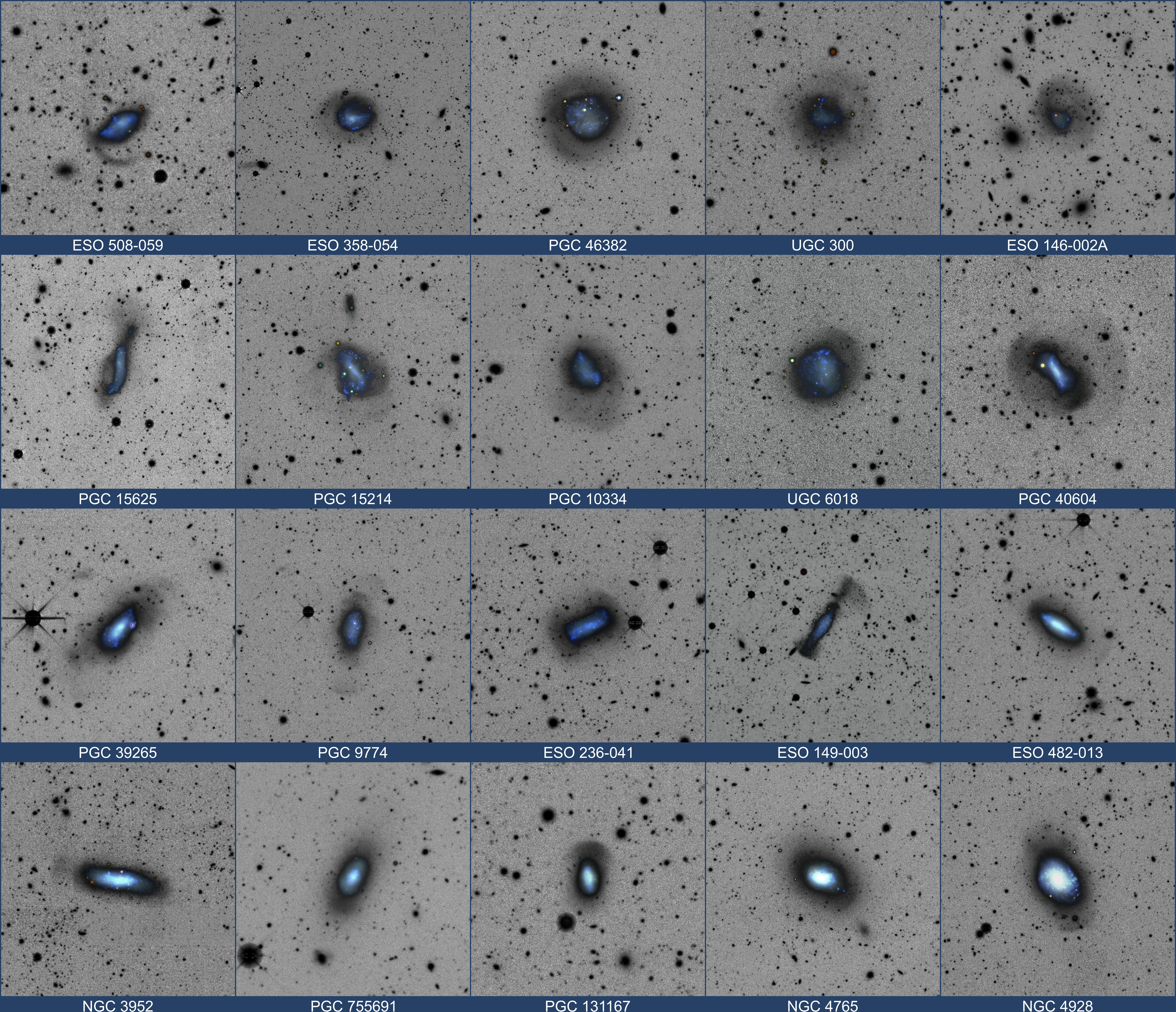
- The paper presents that dwarf galaxies show a ≤5.07% occurrence of accretion features, suggesting lower merger rates relative to massive systems.
- It employs deep r-band imaging and a new morphological classification to detect streams, shells, and asymmetric haloes despite low luminosity challenges.
- Findings reveal a predominance of shell-like debris, implying distinct merger dynamics at low masses and raising questions on dark matter and galaxy evolution models.
Stellar Streams and Accretion Features Around Dwarf Galaxies: Insights from the Stellar Stream Legacy Survey
Background and Motivation
The ΛCDM paradigm posits hierarchical galaxy assembly, predicting that both massive and dwarf galaxies grow via accretion of smaller stellar systems. While the manifestation of satellite accretion (tidal streams, shells, and diffuse haloes) around massive galaxies is well characterized, the corresponding phenomena around dwarf galaxies remain poorly constrained due to observational challenges and the very low luminosities of resultant debris. Identifying and quantifying these features in the low-mass regime is critical for constraining both small-scale galaxy formation and the microphysical properties of dark matter, as dwarfs are known to be highly dark matter dominated and their assembly histories sensitive to both merger dynamics and the nature of the dark sector (2511.23314).
Survey Design and Visual Classification Methodology
This study presents an initial release from the Stellar Stream Legacy Survey (SSLS) focusing on dwarf galaxies within 4–35 Mpc, leveraging deep r-band imaging from the DESI Legacy Imaging Surveys (DES and DECaLS). A visually curated sample of 730 isolated dwarf galaxies (M⋆<109.5 M⊙) was constructed from the 50 Mpc Galaxy Catalog, applying strict isolation and contamination removal criteria. The authors developed a morphological classification metric for accretion debris—distinguishing between streams, shells, and asymmetric stellar haloes—based on the visual appearance and geometric context of low surface brightness structures.
The classification scheme is illustrated in (Figure 1):
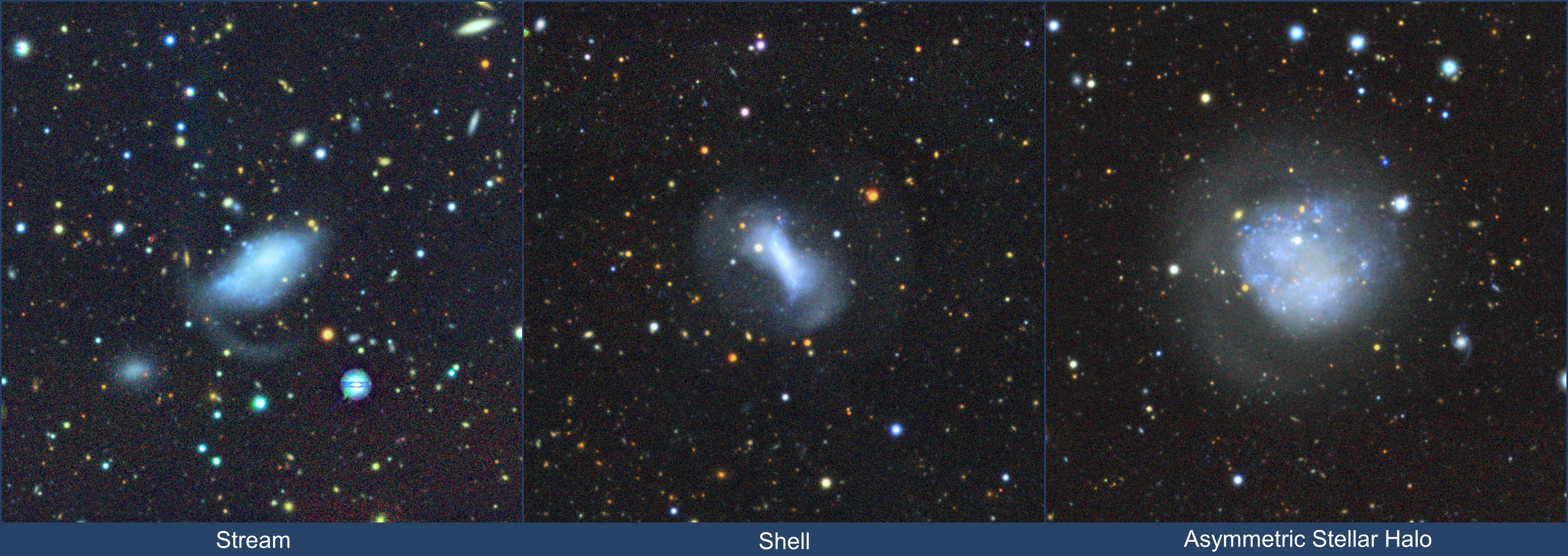
Figure 1: Morphological classification of satellite accretion in dwarfs, distinguishing stream, shell, and asymmetric stellar halo features as observed in DES and DECaLS imaging.
In the adopted framework, "streams" refer to narrow, coherent structures detached from the main body; "shells" are symmetric, arc-like features, generally associated with radial mergers; "asymmetric haloes" indicate diffuse and often lopsided distributions suggestive of extensive phase-mixing or advanced merger remnants.
Discovery Rate, Morphological Outcomes, and Detection Bias
Applying this scheme, only one clear stellar stream, 11 shells, and 8 asymmetric stellar haloes were found around the 730 dwarfs inspected. Of these, 17 features are newly identified in this work. The accretion feature frequency is thus ≤5.07% for the dwarf galaxy sample. In contrast, a comparable analysis of Milky Way-mass systems within the same data and surface brightness thresholds yielded a substantially higher frequency (9.1%±1.1%) [MC2024]. This discrepancy, though potentially indicative of a mass-dependent merger/accretion rate or debris survivability, is complicated by several factors:
Theoretical and Observational Implications
These results provide the first statistical baseline for low-mass accretion debris frequency outside the Local Group, serving as an empirical constraint for cosmological simulations of hierarchical formation and for theoretical models of dark matter microphysics. The low observed frequency places tension on some ΛCDM expectations for dwarf–dwarf fusion and satellite retention [Deason2022, Dooley2017b], though these numbers remain subject to significant systematic uncertainty owing to detection limits and the incomplete mapping of the full merger remnant sequence in dwarfs.
Furthermore, the strong preference for shell-like debris morphologies over classical streams may reflect a fundamental shift in merger dynamics at low masses and merits in-depth simulation-based exploration. N-body and hydrodynamical modeling tailored for dwarf–dwarf interactions (e.g., [Pascale2022]) are required to establish selection functions and correct the observed frequencies for both dynamical lifetime and geometric observability.
Prospects and Future Work
In the immediate future, the primary needs identified by the study are (i) deeper and higher-resolution wide-field imaging to capture fainter and more extended debris, (ii) an expanded suite of controlled merger simulations to calibrate feature detectability and lifetime, and (iii) kinematic or multi-wavelength follow-up to disambiguate between accretion and internal morphological features. The anticipated arrival of Euclid, LSST, and the Roman Space Telescope will dramatically expand the sample and depth for such work.
On the theoretical front, statistical measurements of accretion debris—when cross-matched with predictions for alternative dark matter models and cosmological substructure (e.g., [Rose2025], [Despali2025])—will increasingly act as precision probes of both the small-scale clustering properties of dark matter and of star formation/feedback processes in the faintest systems. Extragalactic streams in the dwarf regime therefore represent a critical next frontier for constraining both galaxy evolution and the fundamental physics of structure formation.
Conclusion
The SSLS pilot analysis demonstrates that visually identifiable accretion features are rarer in dwarf galaxies (≤5.07%) than in their massive counterparts, with a notable prevalence of shell morphologies and only a single clear stellar stream detected. While these findings lend preliminary empirical support for lower merger rates or debris survivability at low masses, robust conclusions await further sensitivity improvements and simulation calibration. The program sets a foundational observational benchmark and will guide both future observational surveys and theoretical models of dwarf galaxy assembly and dark matter physics (2511.23314).