Edge-based reputation promotes cooperation in simplicial complexes
Published 27 Nov 2025 in physics.soc-ph | (2511.22234v1)
Abstract: Understanding how cooperation emerges and persists is a central challenge in the evolutionary dynamics of social and biological systems. Most prior studies have examined cooperation through pairwise interactions, yet real-world interactions often involve groups and higher-order structures. Reputation is a key mechanism for guiding strategic behavior in such contexts, but its role in higher-order networks remains underexplored. In this study, we introduce an edge-based reputation mechanism, incorporating both direct and indirect reputation, to investigate the evolution of cooperation in simplicial complexes. Our results show that coupling reputation mechanisms with higher-order network structures strongly promotes cooperation, with direct reputation exerting a stronger influence than indirect reputation. Moreover, we reveal a nonlinear interplay between network topology and reputation mechanisms, highlighting how multi-level structures shape collective outcomes. These findings provide a novel theoretical framework for understanding cooperation in complex social systems.
The paper introduces an edge-based reputation framework that integrates both direct and indirect assessments to capture nuanced group interactions.
It demonstrates that direct reputation, providing immediate feedback, robustly sustains cooperation in challenging social dilemma scenarios.
The study finds that higher-order interactions in simplicial complexes amplify cooperation through dynamic clustering, informing adaptive trust system designs.
Edge-Based Reputation and Its Impact on Cooperation in Simplicial Complexes
Introduction
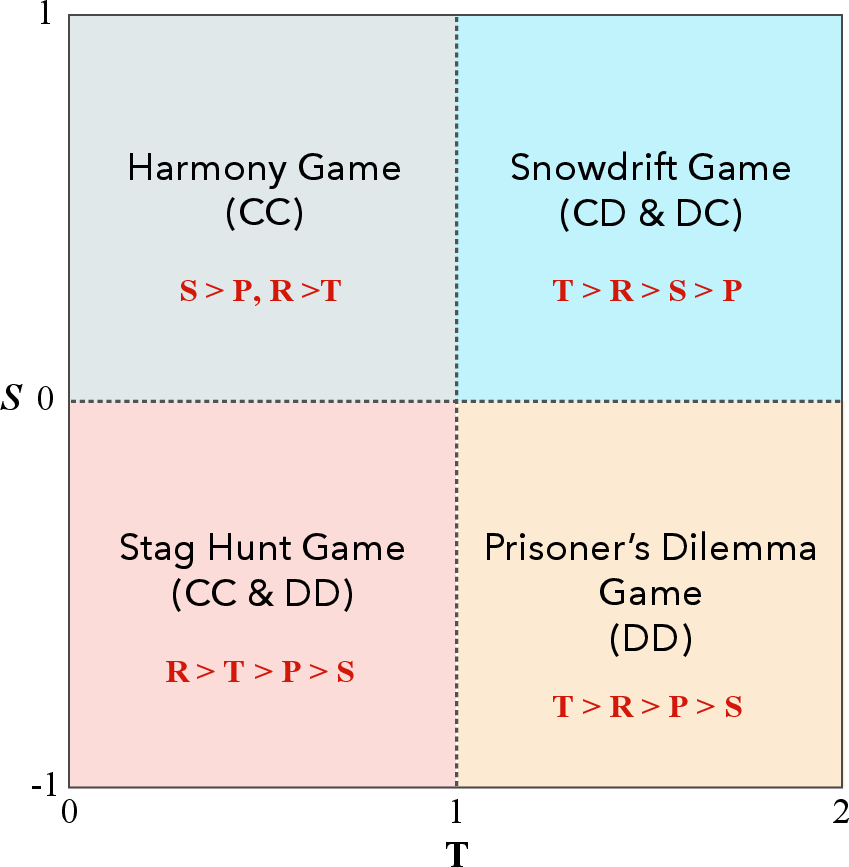
This paper investigates the evolutionary dynamics of cooperation within structured populations, emphasizing the role of reputation mechanisms in networks characterized by higher-order interactions. The authors present an edge-based reputation framework which couples both direct and indirect reputation assessments to individuals' behavior within simplicial complexes—a mathematical structure naturally representing group interactions beyond pairwise encounters. Departing from traditional node-based reputation schemes, this approach evaluates reputation per edge, allowing for finer granularity and bidirectional assessments. The modeling is situated in the context of classic social dilemma games—Prisoner's Dilemma (PD), Stag Hunt (SH), Snowdrift (SD), and Harmony Game (HG)—with payoff parameters embedded into multiple interaction regimes.
Figure 1: Parametric diagram of social dilemma games in (T,S) space, partitioning the Harmony game, Snowdrift, Stag Hunt, and Prisoner’s Dilemma with Nash equilibrium strategy annotation.
Simplicial complex-based population structures support higher-order interactions by introducing k-simplices. The proportion of filled triangles (2-simplices), controlled by a parameter ρ, modulates the degree of higher-order complexity, influencing evolutionary trajectories in these population games. The edge-based reputation is dynamic, updating according to recent interactions, and decays with time, simulating realistic memory effects.
Model Framework
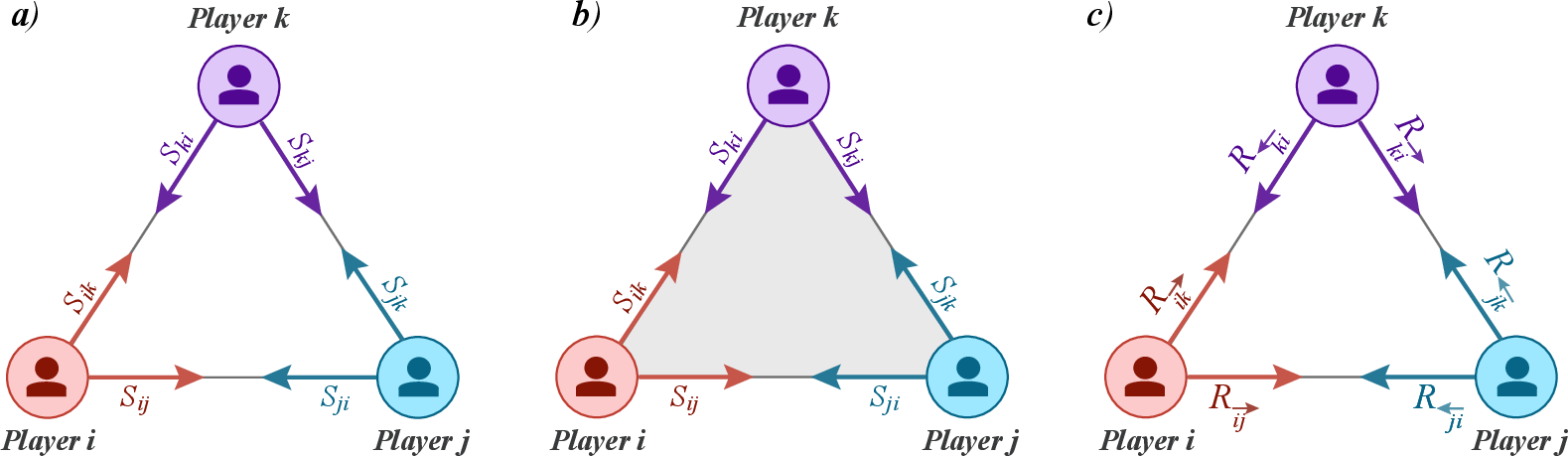
The model assumes individuals play two-strategy games (C for cooperation, D for defection) across networks generated with preferential attachment rules. Strategies are represented as edge-dependent values in a matrix S, enabling agents to adopt distinct strategies toward each neighbor. Payoff calculations incorporate both pairwise and triadic interactions, determined by a tensorial extension of classical game matrices.
Figure 2: Schematics of interaction topology. (a) Dyadic closure, (b) triadic (2-simplex) interaction, and (c) bidirectional edge-based reputation vectors.
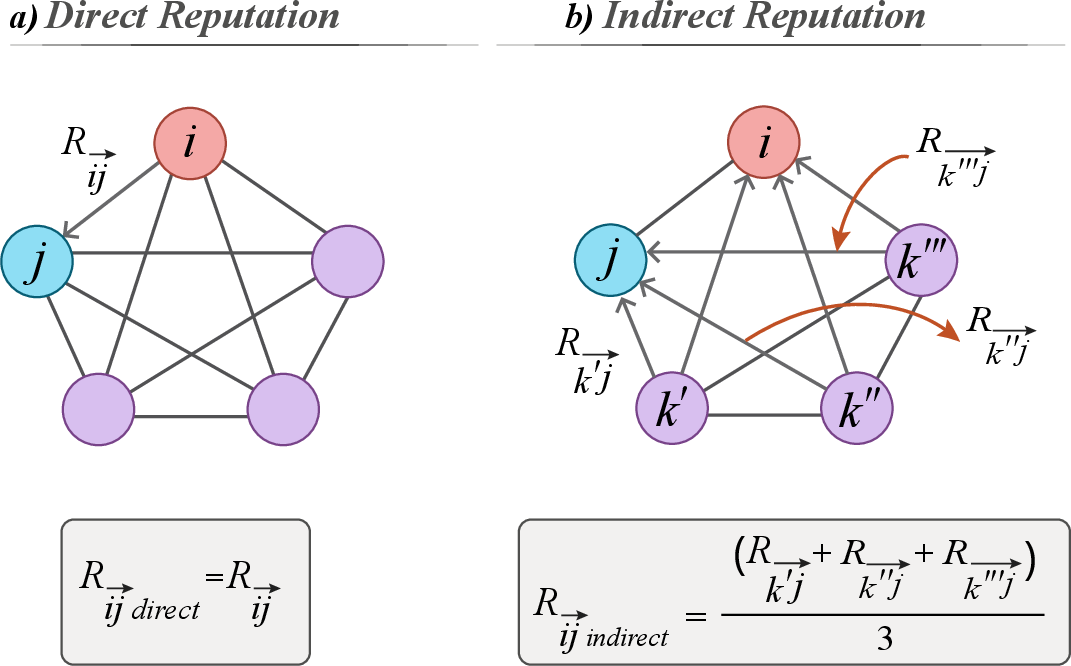
The reputation dynamics involve both direct assessments (from personal interactions) and indirect assessments (aggregated from common neighbors). The direct reputation Rij(t) responds immediately to j’s behavior toward i, while indirect reputation Rijindirect(t) is a mean of evaluations from shared neighbors, introducing information lag but integrating broader social feedback.
Figure 3: Depiction of direct versus indirect reputation assessment mechanisms for edge (i,j).
Each agent updates their strategies based on the reputation of neighbors, imitating the behavior of the neighbor with the highest reputation score via a Fermi update rule. The entire process is simulated over 2×10⁴ Monte Carlo steps, allowing for spontaneous mutations, and statistical properties are extracted from the stationary regime.
Results: Cooperation Dynamics Across Interaction and Reputation Regimes
The investigation focuses on how the coupling of edge-based reputation and higher-order interactions modulates cooperative outcomes in social dilemma games. Specifically, the manipulation of γ, the reputation weight parameter (balancing direct vs. indirect reputation), and ρ, the proportion of triadic interactions, delineates distinct evolutionary regimes.
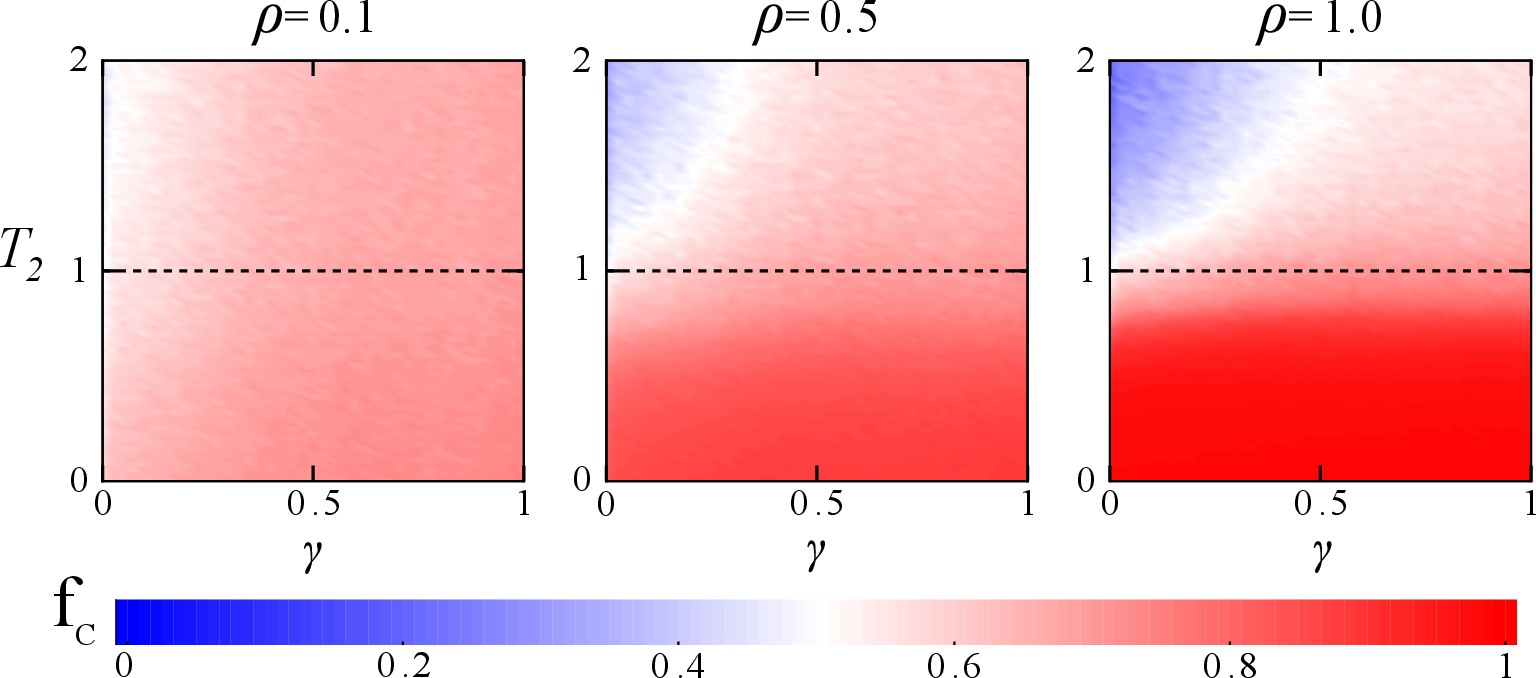
Figure 4: Phase diagrams of steady-state average cooperation fraction fC in (γ,T2) space for varying higher-order interaction ratio ρ.
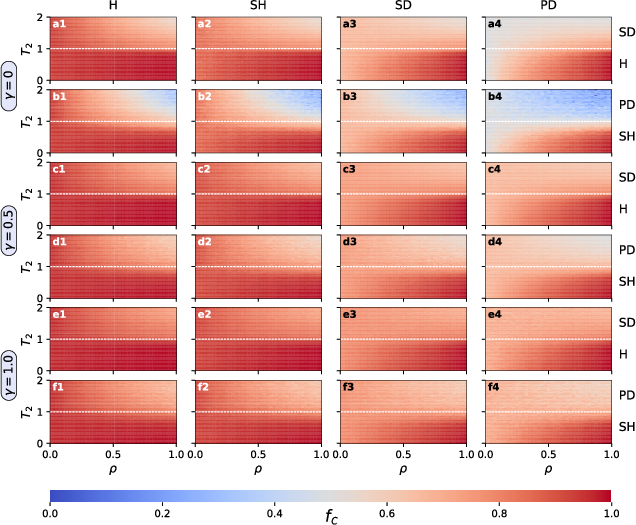
When Game~2 is configured as a Stag Hunt, the fraction of cooperation is robust, relatively insensitive to γ, and maintains CC equilibrium due to intrinsic game stability. However, in PD regimes—heightened temptation to defect—cooperation collapses at low γ, signaling the ineffectiveness of indirect reputation in rapidly shifting environments. Notably, direct reputation strongly sustains cooperation, evident by elevated fC for large γ.
The effect of higher-order interactions (ρ) is context-dependent. In cooperative games, increasing ρ fosters cluster formation, reinforcing cooperative equilibria. Contrarily, in competitive or defection-prone games, high ρ amplifies the destructive spread of negative reputation, precipitating rapid breakdowns of cooperation.
Figure 5: Contour plots of cooperation fraction fC in (ρ,T2) space under indirect, hybrid, and direct reputation regimes; columns correspond to distinct base-game pairings.
Extended analyses reveal a clear hierarchy among reputation mechanisms. Indirect reputation is only effective in environments with stable cooperative Nash equilibria; its delayed information propagation curtails its adaptability. Hybrid mechanisms (γ=0.5) offer moderate resilience, while full direct reputation (γ=1) robustly sustains cooperation even in adverse (PD) game contexts and under high levels of higher-order structure.
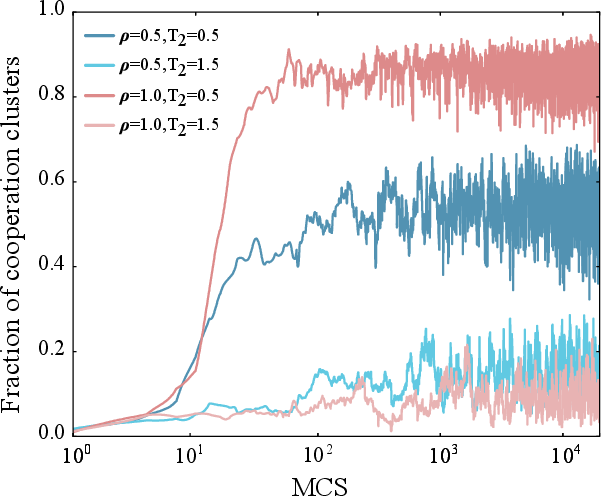
Microscale analysis of clustering dynamics further elucidates this coupling. The emergence and stability of cooperator clusters (fully cooperative triangles) are strongly regulated by both temptation to defect and structural complexity.
Figure 6: Temporal dynamics of cooperator cluster proportions under varying ρ and T2, indicating amplification or erosion of clustering depending on interaction regime.
Low T2 values enable higher ρ to bolster cooperative clusters, whereas high T2 triggers rapid dissolution, demonstrating the dual role of network topology: amplifying either positive or negative reputation feedbacks, contingent on underlying strategic tension.
Implications and Future Directions
Theoretical implications include the demonstration that edge-based reputation provides more nuanced, bidirectional feedback than node-based systems, offering increased responsiveness and stability in evolutionary settings. The nonlinear interplay between direct reputation and higher-order interactions enables both the construction and destruction of cooperative clusters, revealing new dynamic regimes for strategy evolution not captured by pairwise models.
Practically, these results highlight the significance of designing reputation systems that prioritize immediate feedback in complex organizational or online environments, especially where group dynamics and coalition formation are essential. The findings recommend emphasis on direct reputation mechanisms in adaptive trust systems, suggesting indirect reputation may only augment outcomes under conditions of strategic stability.
For future research, the study recommends exploring dynamic coevolution of topology and reputation, overcoming the current limitation of static networks. Incorporating noise, delays, or strategic misrepresentation of reputation signals would more accurately reflect real-world social systems. Extensions to multiplex and heterogeneous networks—where individuals participate in multiple, layered interaction contexts—could yield richer models for the emergence and resilience of cooperation.
Conclusion
The analysis presented in this work advances the understanding of how cooperation is shaped by reputation within complex, higher-order social structures. Edge-based, bidirectional reputation mechanisms substantially enhance cooperation by amplifying immediate behavioral feedback and enabling fine-grained strategic adaptation. The nonlinear coupling of reputation and network topology produces rich dynamical phenomena, including phase transitions in cooperative clustering. Direct reputation is indispensable for maintaining cooperation in environments characterized by high temptation to defect, while indirect reputation is limited to stable contexts.
A promising direction for further research is the endogenization of both network structure and reputation dynamics, capturing the full adaptive complexity of real social systems. This would extend explanatory power beyond what is achievable with static or overly simplified models, providing new theoretical and practical insights into the emergence and persistence of cooperation.