- The paper introduces a novel high‐mass cataclysmic variable with a B1 V(e) companion whose decretion disk transfers mass to a white dwarf via Roche‐lobe overflow.
- The paper employs TESS photometry and spectroscopy to confirm a 2.04-day orbital period and constrain the stellar parameters, revealing distinct ellipsoidal variability and emission features.
- The paper discusses evolutionary implications, suggesting that the observed mass transfer mechanism may lead to accretion-induced collapse rather than a traditional Type Ia supernova.
FQ Circini: A High-Mass Cataclysmic Variable with Disk-to-Disk Mass Transfer
Introduction and Context
FQ Circini (FQ Cir), identified as Nova Cir 2022, exhibits a configuration not previously observed in the class of cataclysmic variables (CVs): a high-mass B1 V(n)(e) star as a companion to a classical nova system, with mass transfer occurring from the decretion disk of the Be star to an accretion disk around the white dwarf (WD) by Roche-lobe overflow (RLOF) (2511.16594). This "High Mass Cataclysmic Variable" (HMCV) subclass fundamentally expands the parameter space of interacting binaries, bridging previously empty regions in the taxonomy of collapsed-star binaries.
Photometric History and Quiescent Counterpart
The amplitude of the nova eruption is exceptionally low (ΔV = 3.1 mag), a consequence of a highly luminous and massive B-type companion dominating the photometric signature in both quiescence and eruption. The identification of the 14th-magnitude B-star as the quiescent counterpart is confirmed by astrometric coincidence (≤0.034") and unique flickering/trends in the light curve—rare for classical B stars but characteristic of Be stars. The historic light curve (Figure 1) reveals variability at all timescales, from hours to decades, consistent with Be star phenomenology.
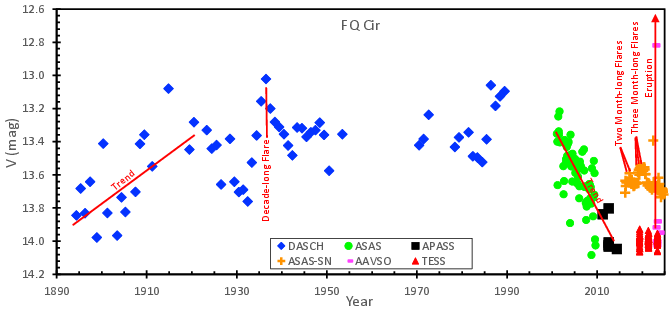
Figure 1: Photometric history (1894–2025) for FQ Cir, showing long-term trends and multi-timescale flickering indicative of Be star activity.
Space-based photometry from TESS further reveals coherent, persistent periodic modulation consistent with ellipsoidal variability at an orbital period of 2.041738 days (Figure 2), with the periodicity confirmed via Fourier analysis (Figure 3) and phase-folding (Figure 4).
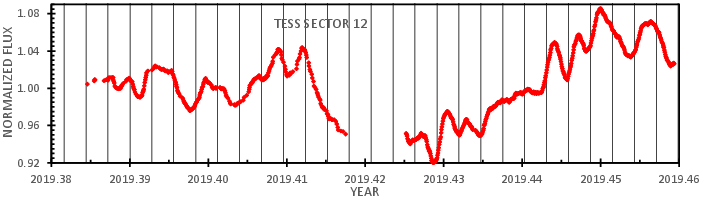
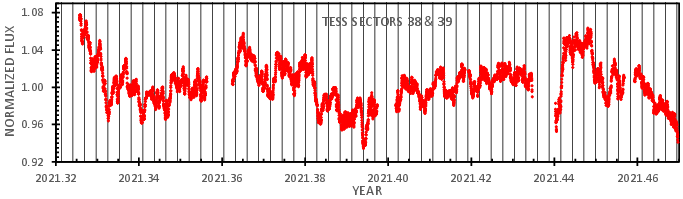
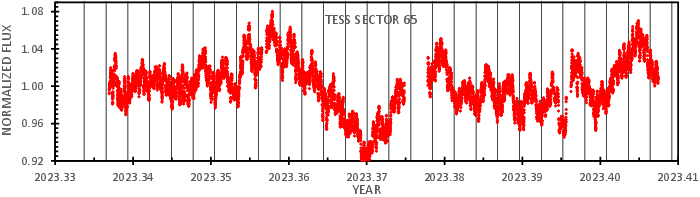
Figure 2: TESS light curves for FQ Cir showing persistent flickering and photometric periodicity at 1.02 days (modulation due to ellipsoidal variation).
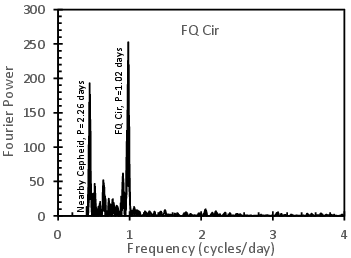
Figure 3: Fourier transform of TESS photometry, with a significant isolated peak at 1.02 days, corresponding to the orbital modulation signature.
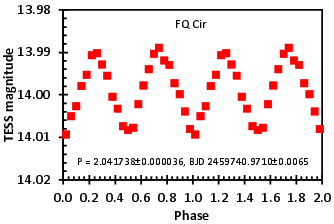
Figure 4: Folded light curve for the 2.04-day orbital period, demonstrating robust ellipsoidal variability.
Stellar Parameters: White Dwarf and Be Companion
Spectroscopic and photometric synthesis yields constrained stellar properties:
- White Dwarf: MWD=1.25±0.10 M⊙, fast He/N nova classification, with t2=2 days and t3≤11 days. The rapid decline and broad emission lines are signatures of a high-mass WD accretor.
- Companion: B1 V(n)(e), Mcomp=13.0−0.5+0.2 M⊙, Rcomp=6.2±0.2 R⊙, Teff=22,000±1,000 K. The star's radius is significantly below its Roche lobe (RRoche≈9.5 R⊙), supporting the absence of classical RLOF from the stellar photosphere; mass transfer occurs instead from a truncated decretion disk.
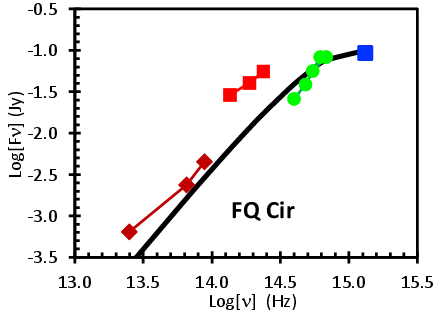
Figure 5: Spectral energy distribution for the FQ Cir quiescent system, exhibiting a Rayleigh-Jeans slope with a UV turnover, consistent with an early B-type main sequence star.
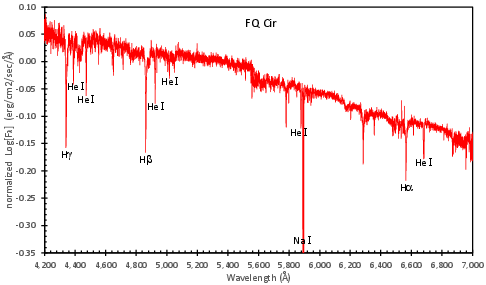
Figure 6: Composite optical spectrum in quiescence showing hydrogen Balmer and He I absorption typical of a B1 V star, with shallow Hα absorption due to infilling by emission.
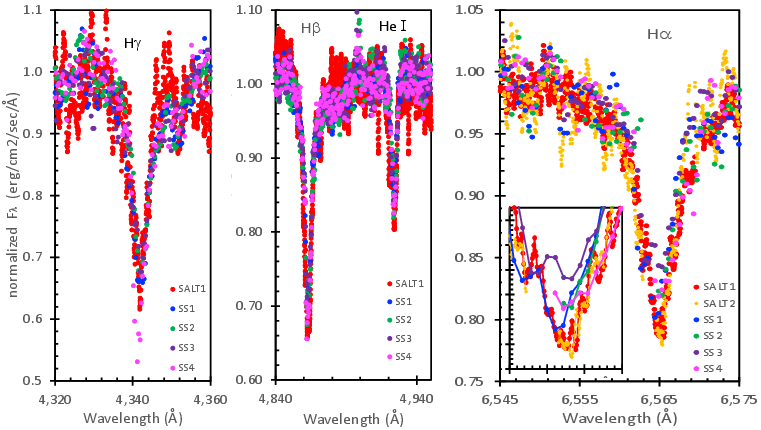
Figure 7: Balmer and He I line profiles for FQ Cir. Hα emission fill-in (shallower absorption and profile variability) signifies the presence of a Be decretion disk truncated by the Roche lobe.
Novel Accretion Channel: Disk-to-Disk Mass Transfer
Unlike canonical CVs (mass transfer via RLOF from a low-mass main sequence star) or HMXBs (typically wind accretion or Be disks with neutron stars), FQ Cir operates a "disk-RLOF" mechanism. The decretion disk, confined between Rcomp and RRoche, continuously feeds the accretion disk around the white dwarf. This structure is supported by both spectroscopic evidence (Balmer emission infill) and the observed photometric variability.
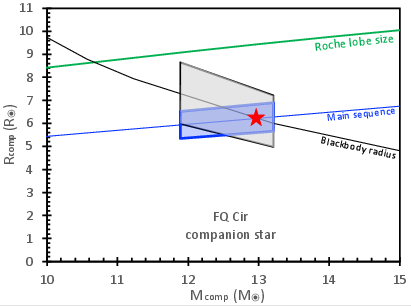
Figure 8: Constraints on the companion's mass and radius, comparing main sequence calibrations, blackbody radius from photometry, and the Roche lobe. The decretion disk is confined between the stellar radius (6.2 R⊙) and Roche lobe (~9.5 R⊙).
Astrophysical Implications and Classification
FQ Cir fills a previously theoretical box among interacting binaries: high-mass companion to a WD primary (HMCV). The system's parameter space is distinct from LMXBs, IMXBs, and HMXBs, as detailed in the classification diagram (Figure 9).
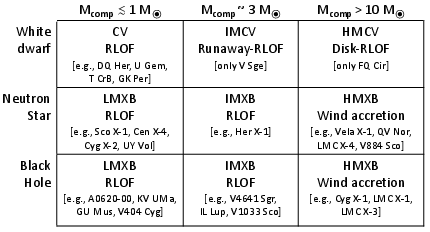
Figure 9: Taxonomy of interacting binaries as a function of compact object (WD, NS, BH) and companion mass range. FQ Cir uniquely occupies the high-mass CV (HMCV) regime previously devoid of known members.
This configuration has several direct implications:
- Evolutionary Pathways: The presence of high-mass companions implies a sequence involving mass reversal, common-envelope phases, and substantial mass loss/transfers, as detailed in population synthesis models. The rarity of HMCVs relative to HMXBs suggests more restrictive conditions for successful binary evolution leading to these systems.
- Accretion Physics: The disk-to-disk mass transfer mode represents an astrophysically distinct regime—mass originating in a rotationally supported, truncated Be decretion disk, not from a Roche-lobe-filling stellar photosphere. This has analogs in Be/neutron star binaries but with substantially different orbital separations and compact object types.
- Spectral and Variability Properties: The presence of flickering, trends, and emission infill in Balmer lines, superimposed on a main sequence B1 star, is a robust phenomenological indicator of similar systems.
Theoretical and Supernova Progenitor Implications
Strong compositional considerations and mass budget arguments indicate that the WD in FQ Cir must be ONe, originating from a progenitor exceeding 7.6M⊙. This composition precludes progression to a Type Ia supernova; instead, the end fate is likely either accretion-induced collapse (AIC) into a neutron star or further binary-driven phenomena. Recurrent nova analogs in this class (e.g., M31N 2017-01e) share similar constraints, implying AIC endpoints for HMCVs.
Prospects for Future Work
Key directions for future research include:
- Obtaining radial velocity curves and high S/N, high-dispersion spectroscopy to improve constraints on inclination, component masses, and accretion rates.
- Extensive X-ray spectroscopy to potentially detect the accretion signature of the WD.
- Population studies of archival variable stars and transients to identify additional HMCVs.
- Detailed binary evolution modelling tailored specifically to FQ Cir's parameters to account for mass transfer, orbital decay, and common envelope efficiency.
- Theoretical modelling of disk-disk interaction and decretion-to-accretion disk transfer, both analytically and via hydrodynamic simulations.
Conclusion
FQ Cir is empirically established as the prototype of high-mass cataclysmic variables, with a 13 M⊙ Be companion and a high-mass ONe WD. The decretion disk of the Be star, truncated by the Roche lobe, serves as the mass reservoir for the WD's accretion disk, inaugurating a novel disk-to-disk accretion regime. This class bridges an important gap in the taxonomy of interacting binaries and offers uniquely stringent tests for both binary stellar evolution theory and accretion physics, with far-reaching implications for the occurrence rates and life cycles of massive binaries in galactic stellar populations.