- The paper introduces a non-perturbative framework using minimization of the string geometry potential to identify phenomenologically viable heterotic compactifications.
- The analysis reveals a critical constraint between the compactification scale and flux quantization numbers, impacting the number of fermion generations.
- The methodology circumvents naturalness arguments by employing energy minimization, offering a principled approach to vacuum selection in string theory.
String Geometry Phenomenology: Non-Perturbative Constraints on Heterotic Compactifications
Overview
This paper develops a framework for determining phenomenologically relevant parameters in string theory compactifications using the potential derived from string geometry theory, a candidate for a non-perturbative formulation of string theory. By substituting a heterotic, non-supersymmetric model with free parameters into the string geometry potential, the authors obtain a potential for these parameters whose minimum determines the ground state within the model. The analysis yields a nontrivial constraint between the compactification scale and the flux quantization numbers, with direct implications for the number of fermion generations and the structure of the string theory landscape.
String Geometry Theory and the Potential for String Backgrounds
String geometry theory generalizes the notion of spacetime in string theory, positing that both matter and spacetime emerge from fundamentally string-theoretic degrees of freedom. The theory is constructed on a string manifold, defined by patching open sets in the string model space, and is characterized by maximal diffeomorphism invariance mixing string geometry time, embedding coordinates, and worldsheet fermions.
A key feature is the "classical" action, uniquely determined by T-symmetry (a generalization of T-duality), and the absence of "loop" corrections due to a non-renormalization theorem. The path integral over the string geometry fields yields the partition function, and the "classical" potential restricted to perturbative vacua represents the string theory landscape. The minimum of this potential is conjectured to correspond to the true vacuum of string theory.
The potential for string backgrounds in the Einstein frame, under warped compactification and in the particle limit, is given by an explicit functional involving the metric, dilaton, B-field, and gauge field strength. The minimization of this potential with respect to free parameters in a phenomenological model provides a mechanism for selecting physically relevant compactifications.

Figure 1: Various string states. The red and blue lines represent one string and two strings, respectively.
Heterotic Non-Supersymmetric Compactification Model
The model under consideration is a heterotic, non-supersymmetric compactification where the ten-dimensional spacetime is a product of Minkowski space and three two-dimensional internal manifolds of constant curvature. The bosonic sector of the heterotic supergravity Lagrangian is used, with the dilaton taken as constant and H-flux set to zero. The internal spaces can be spheres, tori, or compact hyperbolic manifolds, depending on the sign of the curvature.
The gauge field strength is assumed to follow a Freund-Rubin configuration, and flux quantization is imposed. The equations of motion and anomaly cancellation conditions reduce to integer constraints on the curvature and flux quantization numbers. The number of massless fermion generations is determined by the index theorem and depends on the flux quantization numbers.
Evaluation and Minimization of the String Geometry Potential
The potential for string backgrounds is evaluated by substituting the compactification model into the general expression from string geometry theory. The analysis proceeds by solving the condition for the dilaton field ϕ via a formal power series, using Green's functions to express the solution recursively. The potential is then rewritten in terms of the free parameters, notably the flux quantization numbers and the compactification scale.
Numerical minimization of the potential reveals that the minimum occurs for a specific combination of these parameters, leading to a constraint between the compactification scale Mc and the flux quantization number. The analysis shows that for three generations of fermions, the compactification scale must satisfy Mc<Ms, where Ms is the string scale.

Figure 2: The minimum of the potential, showing the location of the global minimum as a function of the parameter combination bΛˉ.
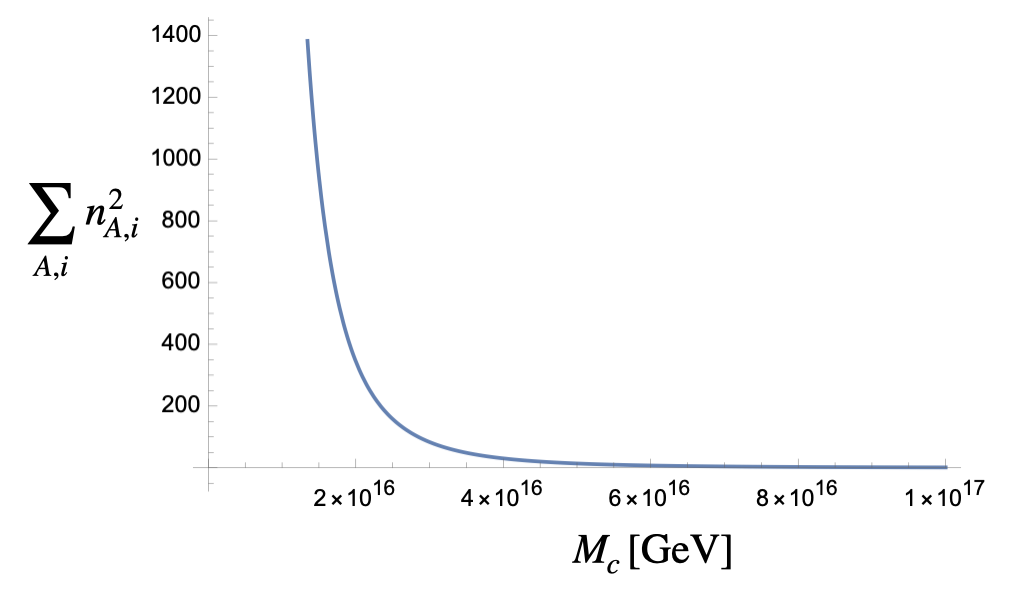
Figure 3: Constraint between the compactification scale and the flux quantization number, illustrating the allowed region for three-generation models.
Implications and Future Directions
The results provide a concrete method for selecting phenomenologically viable compactifications in string theory by minimizing the non-perturbative potential derived from string geometry theory. The constraint between the compactification scale and the flux quantization number directly impacts the possible number of fermion generations and the structure of the low-energy effective theory.
The approach circumvents the need for naturalness arguments, relying instead on the fundamental principle of energy minimization. This allows for a systematic exploration of the string theory landscape, potentially identifying the true vacuum by comparing the energies of different compactification models.
Relaxing the assumption of a constant dilaton or including nonzero H-flux would allow for independent determination of additional parameters, further refining the selection of viable vacua. The methodology can be extended to other string phenomenological models, providing a general framework for non-perturbative vacuum selection in string theory.
Conclusion
This work demonstrates that the minimization of the string geometry potential provides a powerful tool for constraining the parameters of heterotic compactifications, yielding direct relations between the compactification scale and flux quantization numbers. The approach offers a principled method for vacuum selection in the string theory landscape, with significant implications for phenomenology and the search for the true vacuum of string theory. Future developments may include relaxing simplifying assumptions and applying the framework to a broader class of models, further elucidating the structure of non-perturbative string theory.

