- The paper presents the first secure CH3OD detection in prestellar cores L1448 and B213-C6, enabling direct measurement of CH2DOH/CH3OD ratios.
- LTE-based analyses reveal deuteration levels of 3.6–6.8% for CH2DOH and 1.4–4.4% for CH3OD, highlighting efficient cold-chemistry processes.
- Abstraction-addition processes appear dominant in establishing elevated CH2DOH/CH3OD ratios, supporting early chemical inheritance in star formation.
First Detection of CH3OD in Prestellar Cores: Implications for Methanol Deuteration Chemistry
Introduction
The detection and analysis of deuterated methanol isotopologues in star-forming regions provide critical constraints on the chemical evolution from prestellar cores to protostars. The paper presents the first secure detection of CH3OD (hydroxyl-deuterated methanol) in a low-mass prestellar core (L1448 in Perseus) and a tentative detection in B213-C6 (Taurus), using IRAM 30m observations. This result enables, for the first time, a direct measurement of the CH2DOH/CH3OD ratio and D/H ratios for both singly deuterated methanol isotopologues at the prestellar stage, addressing a longstanding gap in the astrochemical record.
Observational Results and Data Analysis
The study targets two well-characterized prestellar cores, L1448 and B213-C6, with deep integrations at multiple frequencies covering transitions of both CH2DOH and CH3OD. The detection of CH3OD in L1448 is robust, with three transitions identified (two secure, one tentative), while B213-C6 yields a tentative detection based on a single line. The analysis employs LTE-based column density calculations, constrained by the lack of collisional data for deuterated methanol, and explores a range of plausible excitation temperatures (6–10 K).
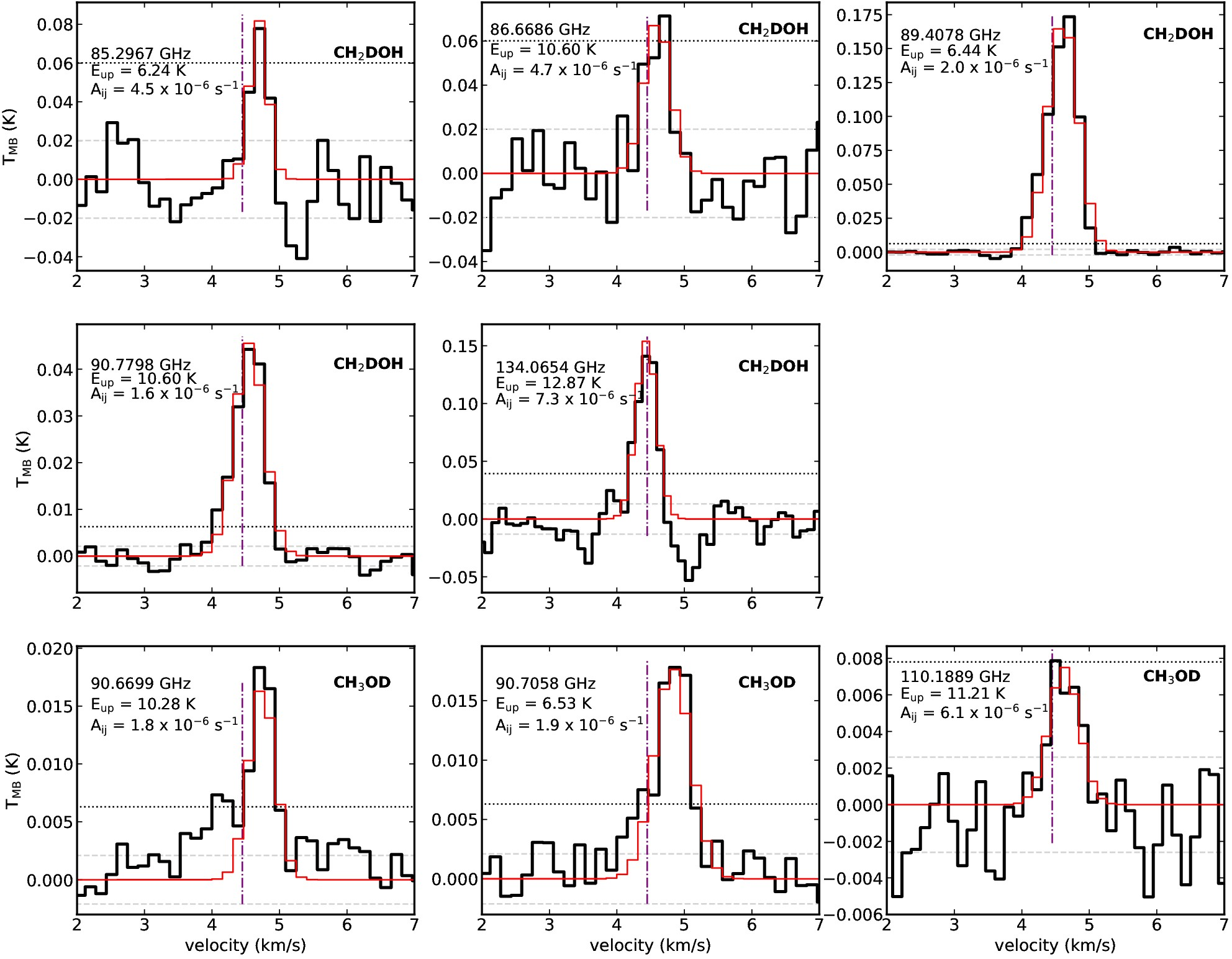
Figure 1: Detected transitions of CH2DOH (top two rows) and CH3OD (bottom row) towards L1448. The line at 110~GHz is a tentative detection.
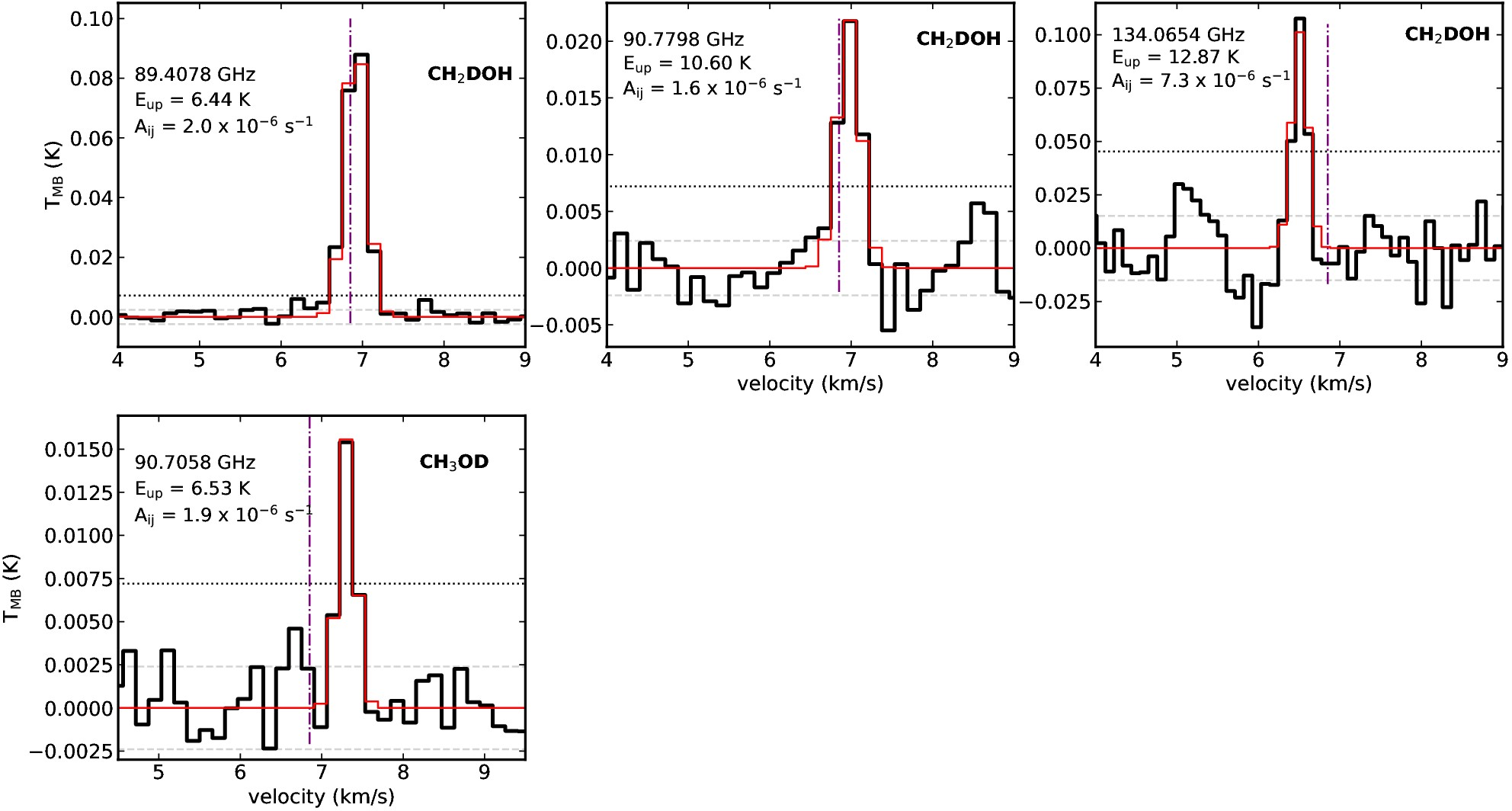
Figure 2: Detected transitions of CH2DOH (top row) and CH3OD (bottom left panel) towards B213-C6.
The derived column densities for L1448 are (0.9–1.5)×1013 cm−2 for CH2DOH and (1.2–3.5)×1012 cm−2 for CH3OD, depending on Tex. For B213-C6, CH2DOH is (2.5–5.9)×1012 cm−2 and CH3OD ≤1.3×1012 cm−2. The D/H ratios, after statistical correction, are 3.6–6.8% (CH2DOH) and 1.4–4.4% (CH3OD) in L1448, and 2.4–5.8% (CH2DOH) and ≤3.8% (CH3OD) in B213-C6.
The CH2DOH/CH3OD ratio is a key diagnostic of methanol deuteration chemistry. Statistically, a value of 3 is expected if deuteration occurs randomly, but previous observations in protostars have shown significant deviations, with low-mass protostars often exhibiting ratios ≫3 and high-mass protostars showing ratios ∼1 or lower. The present work finds CH2DOH/CH3OD = 2.8–8.5 in L1448 and ≤5.7 in B213-C6, values that are marginally consistent with the statistical expectation but generally elevated, in line with low-mass protostellar measurements.
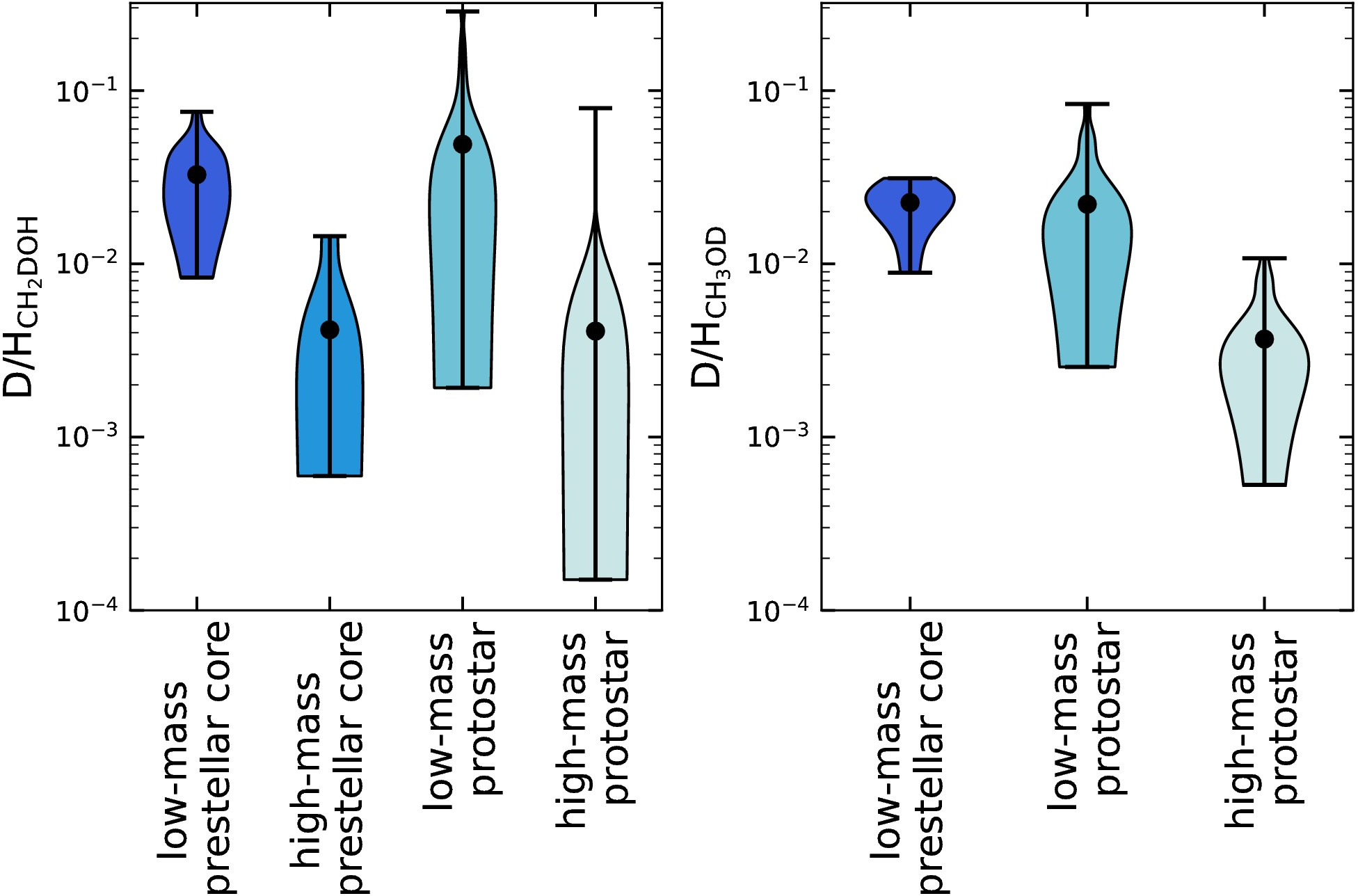
Figure 3: D/H ratios for CH2DOH (left panel) and CH3OD (right panel) across the star-forming sequence. The spread per source type was calculated using all column densities listed in the compiled literature.
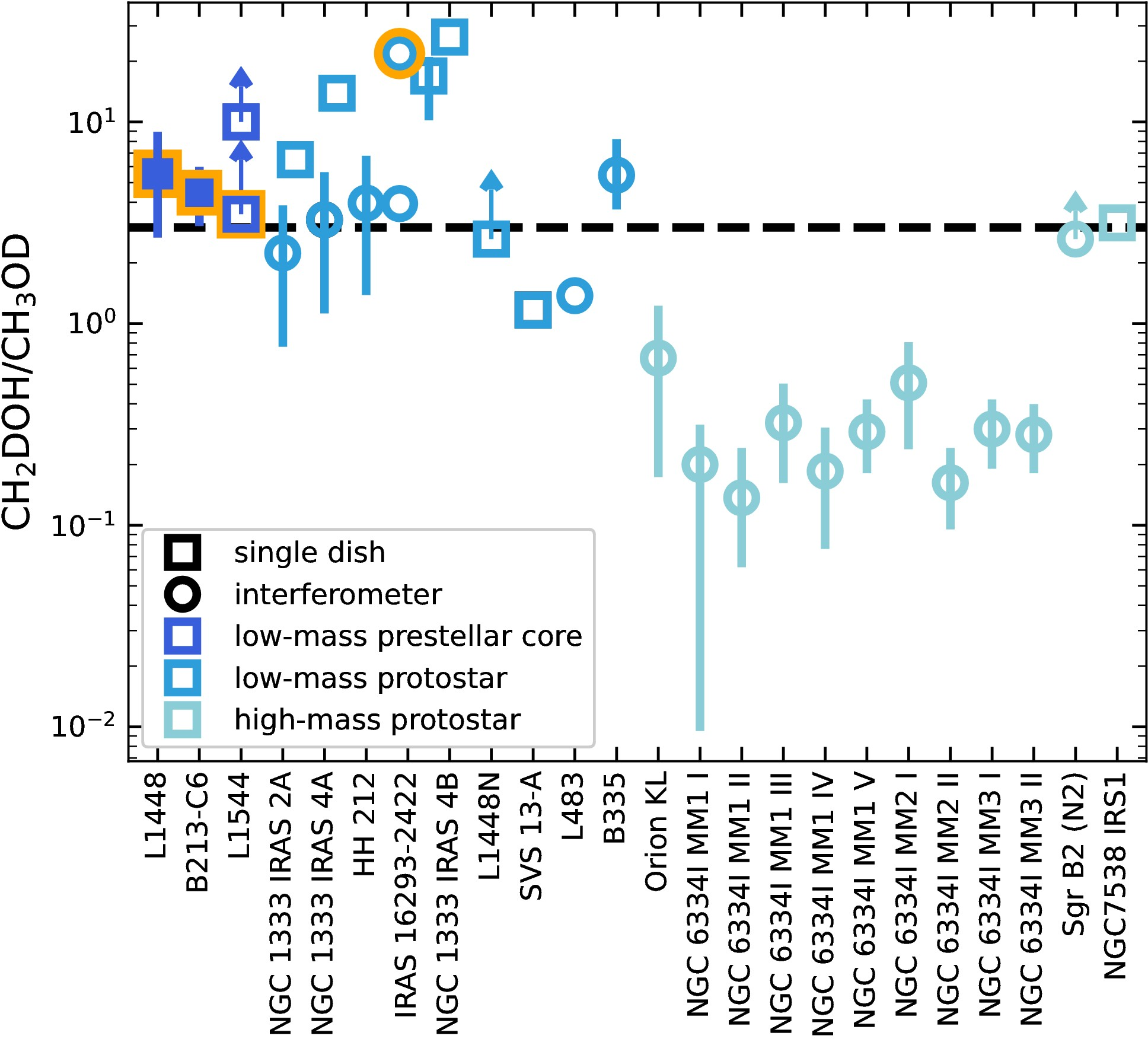
Figure 4: CH2DOH/CH3OD ratio across the star-forming sequence. Dark blue: prestellar cores; sky blue: low-mass protostars; light blue: high-mass protostars. Filled points are new values from this work.
The D/H ratios in both isotopologues are elevated by several orders of magnitude above the ISM average (∼10−5), confirming efficient deuteration in cold, dense prestellar environments. The CH2DOH/CH3OD ratio in prestellar cores matches the range observed in low-mass protostars, supporting the hypothesis that the isotopic fingerprint is set at the prestellar stage and largely inherited by subsequent evolutionary phases, at least for low-mass star formation.
Chemical Pathways and Theoretical Implications
The observed isotopic ratios are interpreted in the context of grain-surface chemistry. Three main mechanisms are considered:
- Sequential Hydrogenation of CO: Deuteration occurs via random substitution during the CO → CH3OH hydrogenation sequence. Models show that this alone cannot account for the elevated CH2DOH/CH3OD ratios observed in cold cores.
- Abstraction-Addition Mechanism: Laboratory and modeling work indicate that H/D abstraction-addition cycles on the methyl group of methanol are highly efficient at low temperatures, leading to preferential deuteration of the CH3 group and thus elevated CH2DOH/CH3OD ratios. This mechanism is strongly favored by the present data.
- Alternative Pathways (e.g., Methane Oxidation, O-insertion): These may contribute, but their impact on the isotopic ratios is not yet well constrained.
The data also suggest that the D/H ratio in CH2DOH is consistently higher than in CH3OD, a pattern reproduced by models including abstraction chemistry and consistent with the inefficiency of H/D exchange on the methyl group at low temperatures.
Survival and Modification of Isotopic Ratios
The comparison of D/H ratios and CH2DOH/CH3OD across evolutionary stages reveals that, for low-mass sources, the ratios are largely preserved from the prestellar to the protostellar phase. In high-mass protostars, the ratios are lower, likely reflecting higher formation temperatures that suppress abstraction efficiency. The possibility of post-formation modification via H-D exchange with water ice or gas-phase ion-molecule reactions is discussed, but current evidence suggests these processes are secondary for low-mass sources.
Methodological Considerations and Limitations
The analysis is limited by the assumption of LTE, necessitated by the lack of collisional data for deuterated methanol. Non-LTE effects may bias the derived column densities, particularly for transitions with anomalous line ratios. The partition function for CH3OD has only recently become available, and previous literature values may require revision. The sample size of prestellar cores with CH3OD detections remains small, precluding robust statistical conclusions.
Implications and Future Directions
The detection of CH3OD in prestellar cores provides a critical benchmark for astrochemical models of deuteration. The results support the scenario in which the bulk of deuterated methanol is formed and its isotopic ratios set during the cold prestellar phase, with abstraction chemistry playing a dominant role. The findings have implications for the chemical inheritance paradigm in star and planet formation, suggesting that at least for low-mass systems, the isotopic composition of complex organics is established early and survives subsequent evolution with limited alteration.
Future work should focus on:
- Expanding the sample of prestellar cores with sensitive CH3OD observations, including high-mass cores.
- Laboratory and theoretical studies of alternative formation pathways and their isotopic selectivity.
- Direct observations of deuterated methanol in ices, to test the assumption of gas-ice isotopic equivalence.
- Non-LTE radiative transfer modeling as collisional data become available.
Conclusion
This work presents the first secure detection of CH3OD in a prestellar core, enabling the first direct measurement of the CH2DOH/CH3OD ratio at this evolutionary stage. The observed ratios are elevated above the statistical expectation and consistent with those found in low-mass protostars, supporting the inheritance of isotopic fingerprints from the prestellar phase. The results strongly favor abstraction-addition chemistry as the dominant deuteration mechanism in cold cores. The study highlights the need for further observational, laboratory, and modeling efforts to fully elucidate the chemical evolution of deuterated organics in star-forming regions.