- The paper presents a novel simulation system that models internal psychological agents to generate realistic, context-sensitive human behaviors.
- Its multi-round internal deliberation mechanism enhances transparency, allowing users to trace the impact of cognitive-affective factors on behavior.
- The system is extensible and applicable in teacher training, psychological research, and professional skills development, aligning with established learning theories.
Multi-Agent Psychological Simulation for Human Behavior Modeling
Overview and Motivation
This paper introduces a multi-agent psychological simulation system designed to generate realistic, context-sensitive human behaviors by explicitly modeling internal cognitive-affective processes. Unlike black-box neural models, the system is grounded in established psychological theories—such as self-efficacy, mindset, and social constructivism—and operationalizes these constructs as interacting internal agents within a simulated persona. The architecture enables transparent, interpretable simulations of human-like behavior, with direct applications in teacher training, psychological research, and professional skills development.
Multi-Agent Internal Architecture
The core innovation is the simulation of an "inner parliament" of agents, each representing a distinct psychological factor (e.g., anxiety, self-efficacy, motivation). These agents deliberate internally to determine the simulated individual's behavior in response to external stimuli. This approach diverges from traditional multi-agent AI systems, which typically model multiple external actors; here, the agents are facets of a single mind, and their interactions produce nuanced, sometimes contradictory, behaviors that mirror real human responses.
Each agent is parametrized according to psychological theory and empirical findings. For example, a Math-Anxiety agent is highly sensitive to algebraic contexts but less so to geometry, while a Self-Efficacy agent modulates confidence and persistence. The architecture is extensible, allowing for the inclusion of additional agents to model domain-specific or clinical factors as needed.
Deliberation Mechanism and Behavioral Generation
Upon encountering a scenario, each internal agent independently evaluates the situation and proposes an initial response. The system then proceeds through multiple rounds of internal debate, during which agents can adjust their positions, form coalitions, and influence each other's stances. The final behavior emerges from this deliberative process, reflecting the dynamic interplay of psychological factors rather than deterministic or scripted logic.
This mechanism yields context-dependent variability: the same simulated student may respond with avoidance and self-doubt in an algebra scenario but display confidence and competence in geometry, purely as a function of the internal agent configuration and the scenario context.

Figure 1: A screenshot of the simulation interface during an algebra problem scenario. The teacher (user) has posed an algebra question, and the simulated student responds with hesitation and self-doubt, reflecting high Math-Anxiety and low Self-Efficacy in this context.
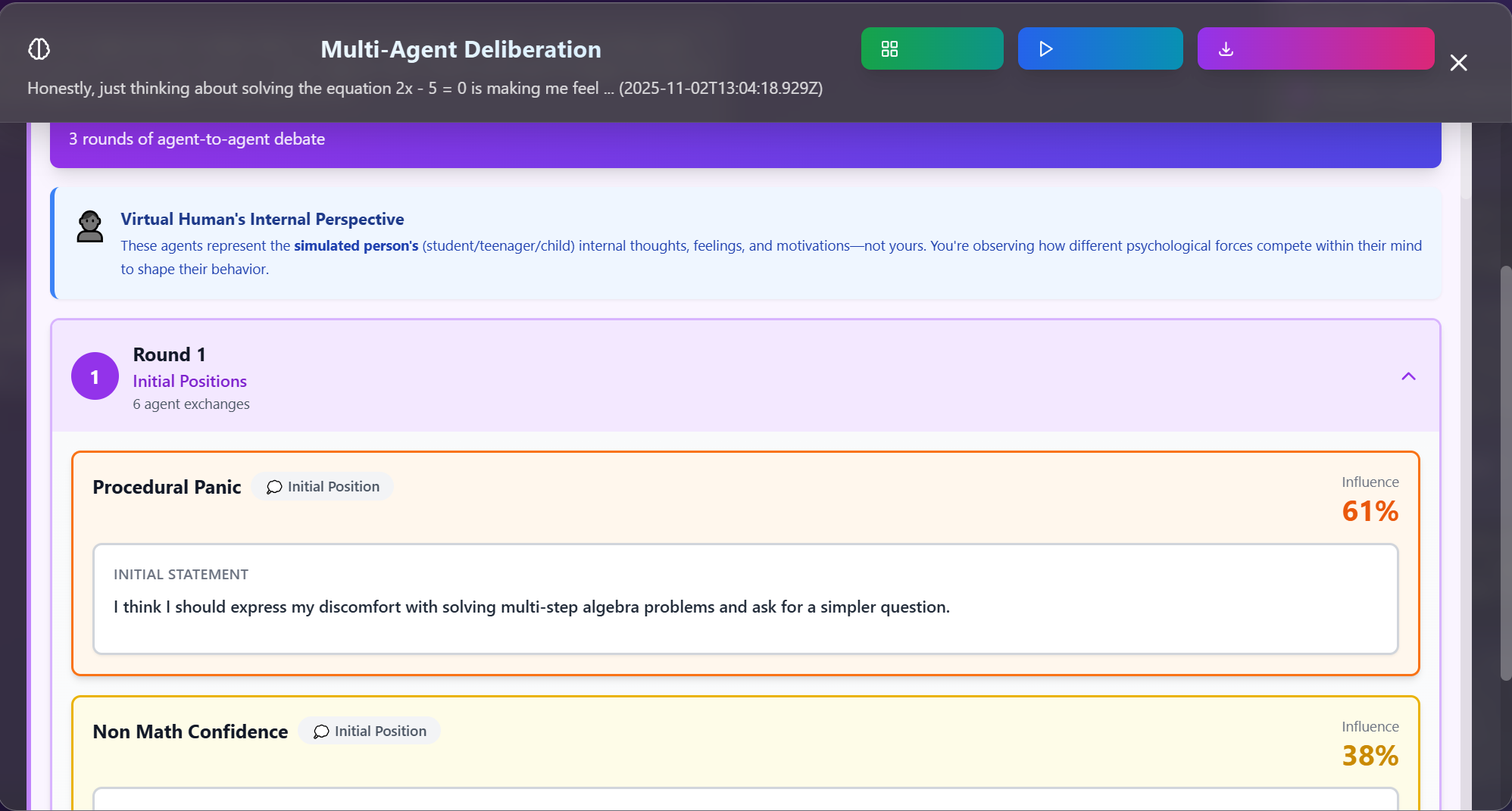
Figure 2: The "Peek Into the Brain" view showing the internal deliberation among agents corresponding to the interaction in Figure 1. Each agent's utterances are shown, illustrating which psychological factors led to the student's behavior.
The system provides a "Peek Into the Brain" feature, exposing the internal transcript of agent deliberations for each behavioral output. This transparency enables users to trace the causal chain from psychological state to observable behavior, a capability rarely available in black-box AI systems.
Application Domains
Teacher Education and Training
The simulation system is particularly well-suited for teacher training, where authentic practice with realistic student behaviors is critical. Trainees can interact with virtual students exhibiting domain-specific anxieties, motivational fluctuations, and maladaptive responses. The ability to inspect the internal agent deliberations after each exchange provides immediate, theory-aligned feedback, supporting cognitive apprenticeship and deliberate practice paradigms.
Psychological Research and Theory Testing
For researchers, the system serves as an in silico experimental platform. By manipulating agent parameters, researchers can test hypotheses about the interplay of psychological constructs (e.g., the interaction of anxiety and self-efficacy) and generate predictions for empirical validation. The interpretability of the agent-based deliberation process facilitates theory refinement and the identification of critical factors underlying complex behaviors.
Professional Skills Training
Beyond education, the architecture generalizes to any domain requiring realistic human interaction modeling, such as healthcare communication, customer service, and counseling. Scenario creation is modular: new roles are instantiated by defining relevant agents and tuning their parameters, enabling rapid development of psychologically plausible training simulations.
Theoretical Alignment
The system operationalizes principles from several foundational learning and psychological theories:
- Social Constructivism and Cognitive Apprenticeship: By making internal deliberations visible, the system supports the modeling of thinking processes, aligning with Vygotskian and cognitive apprenticeship frameworks.
- Observational Learning: Users can observe the consequences of interventions on internal psychological states, reinforcing theoretical lessons through concrete, observable dynamics.
- Deliberate Practice: The simulation enables repeated, feedback-rich practice in handling complex human behaviors, accelerating skill acquisition.
- Metacognitive Skill Development: The explicit modeling of psychological constructs fosters metacognitive awareness in both trainees and instructors, supporting reflective practice and pedagogical content knowledge development.
Implementation Considerations
The architecture is modular and extensible, supporting the addition of new psychological agents and the customization of agent sensitivities and activation functions. The deliberation process is configurable in terms of the number of rounds and the influence aggregation mechanism (e.g., weighted voting, coalition formation). The system is designed for transparency and interpretability, with all internal agent interactions logged and accessible for analysis.
Resource requirements are moderate, as the deliberation process is discrete and the number of agents per simulation is typically small (on the order of 5–10). The system can be deployed as a standalone application or integrated into existing training platforms via API. Scaling to large numbers of concurrent simulations is feasible, given the lightweight nature of the agent deliberation logic.
Implications and Future Directions
The explicit modeling of internal psychological dynamics represents a significant advance in the fidelity and interpretability of human behavior simulations. Practically, this enables more effective training and research tools, bridging the gap between theoretical knowledge and real-world practice. Theoretically, the system provides a testbed for exploring the causal mechanisms underlying complex behaviors and for refining psychological theories based on simulated outcomes.
Future developments may include the integration of learning mechanisms within agents (e.g., updating self-efficacy based on simulated experiences), the modeling of social interactions between multiple simulated individuals, and the application of the architecture to clinical and affective computing domains. The approach also opens avenues for hybrid systems that combine data-driven neural models with interpretable, theory-driven agent architectures.
Conclusion
This multi-agent psychological simulation system offers a transparent, theory-aligned approach to modeling human behavior, with demonstrated utility in education, research, and professional training. By decomposing behavior into the deliberation of interacting psychological agents, the system achieves a level of realism and interpretability that supports both practical skill development and theoretical inquiry. The architecture's extensibility and modularity position it as a foundational tool for advancing the simulation of human-like behavior in AI systems.