- The paper introduces DAWP, a novel framework that combines data assimilation and weather prediction using direct satellite observations to enhance forecasting.
- It employs a multi-modal masked autoencoder to transform irregular satellite data into a uniform observation space, improving spatiotemporal modeling.
- The framework outperforms baseline models in 0-36h lead time forecasts and enhances global precipitation prediction accuracy and continuity.
DAWP: A Framework for Global Observation Forecasting
Introduction
The paper introduces DAWP, a novel framework paving the way for AIWP systems to transition from relying on reanalysis data to using direct satellite observations. This transition addresses key limitations such as data assimilation biases and temporal discrepancies that affect AIWP models trained with reanalysis data. DAWP effectively combines data assimilation and weather prediction within the satellite observation space by leveraging a mask multi-modality autoencoder (MMAE) for assimilating satellite data encoded with mask ViT-VAEs. The approach aims to achieve high-resolution global observation forecasting while bypassing the constraints associated with traditional reanalysis-dependent models.
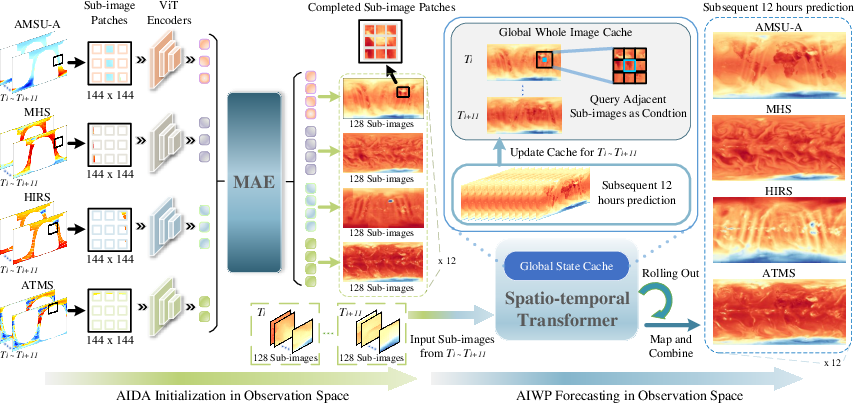
Figure 1: The framework of our DAWP. There are two stages in our DAWP: (1) Initialization and (2) Forecasting.
Methodology
Observation Space Assimilation
A key innovation in DAWP is the AIDA module, which applies a multi-modal masked autoencoder to transform irregular satellite observations into a uniform observation space. By tokenizing high-resolution time window observations, the MMAE assimilates these tokens, tackling spatiotemporal dynamics across disparate data sources. This initialization step is crucial for enhancing the rollout prediction capabilities of AIWP models.
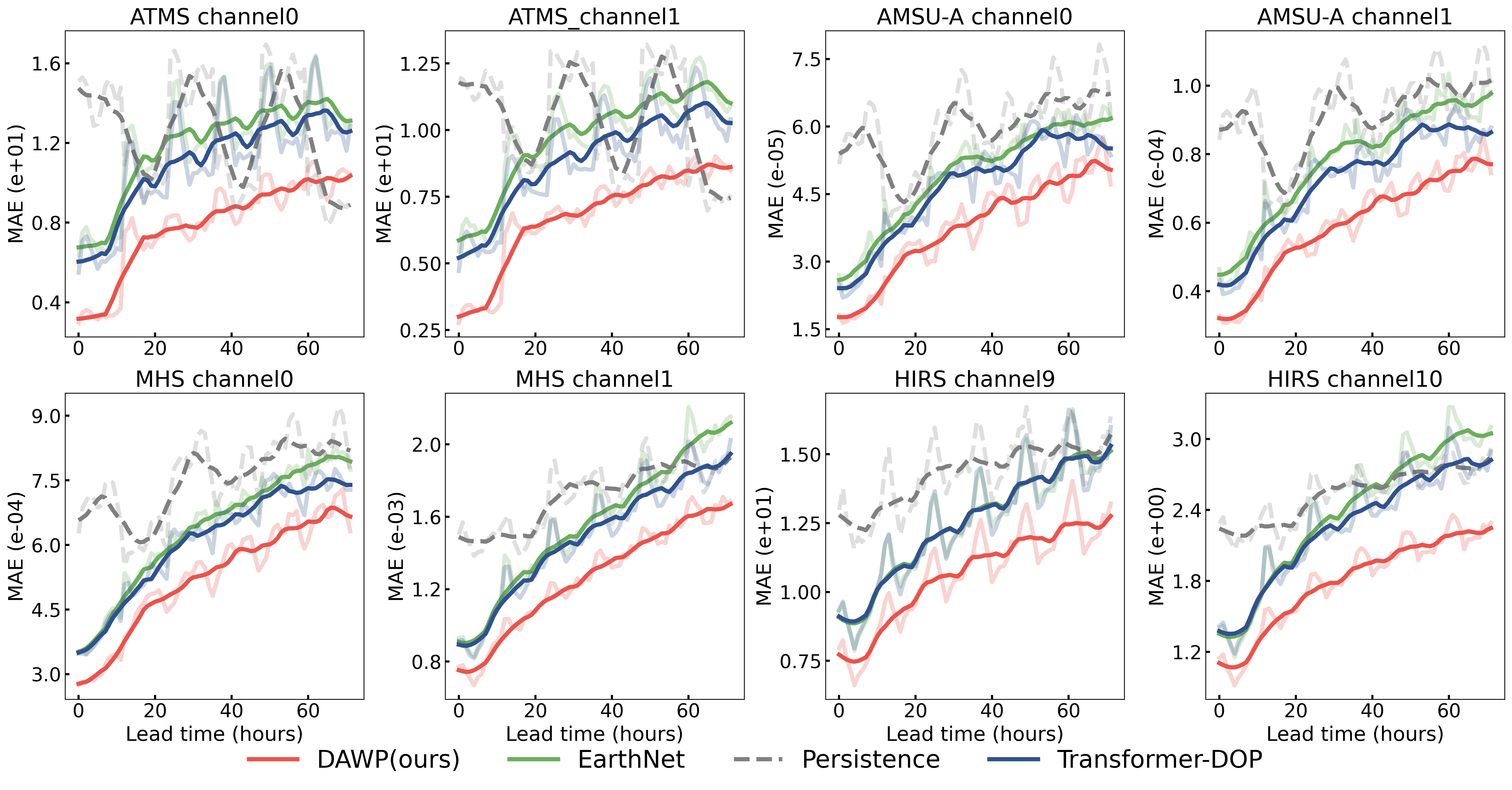
Figure 2: Curves of MAE for the prediction of different modalities. The max lead time is 72h with a 1h temporal resolution.
AIWP with Cross-regional Boundary Conditioning
Post-assimilation, the AIWP module employs a spatiotemporal decoupling transformer conditioned on cross-regional boundaries. This enables comprehensive modeling of global observations by facilitating local prediction through neighboring data points, preserving continuous spatiotemporal dynamics crucial for forecasting. The mapper predicts precipitation variables and updates the globally cached state information for effective rollout predictions.
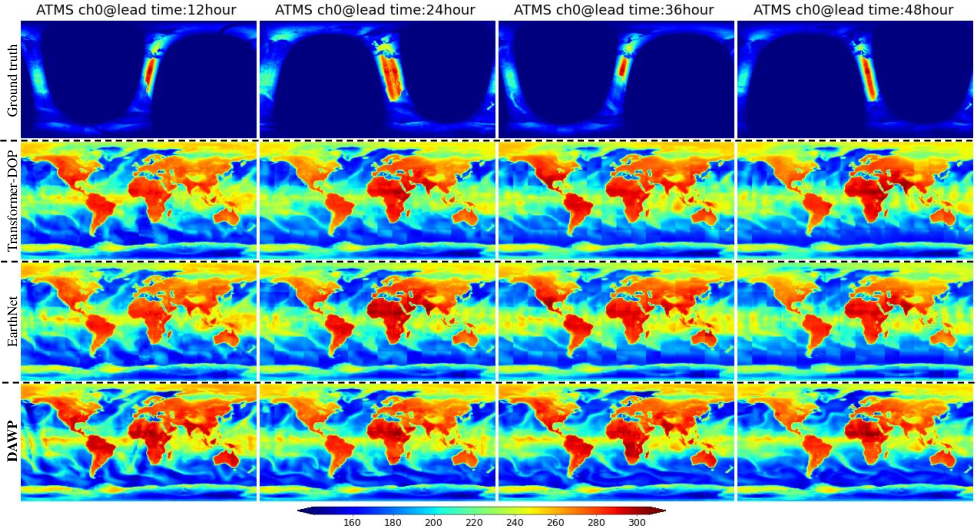
Figure 3: A visualization of rollout predictions for global satellite observation forecasting.
Experimental Evaluation
Experiments illustrate significant improvements in multi-modality prediction accuracy and efficiency over baseline models, including EarthNet and Transformer-DOP. DAWP achieves substantial advancements in 0-36 hour prediction horizons regarding MAE rates across all tested modalities, outperforming traditional baselines, as shown in Figure 4.
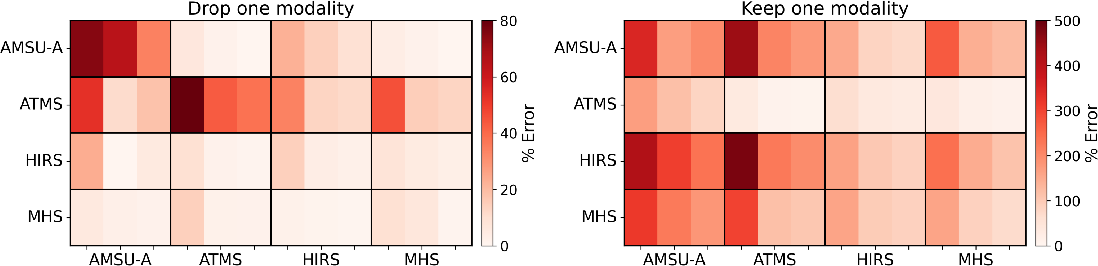
Figure 4: Matrix of relative errors under the setting of dropping one modality and keeping one modality. The three columns in a black rectangle represent the relative MAE error ratios of 0-12h, 12-24h, and 24-36h lead times, respectively.
Additionally, the framework exhibits robust performance in global precipitation forecasting, achieving higher CSI and lower FAR scores, particularly in high-intensity thresholds.
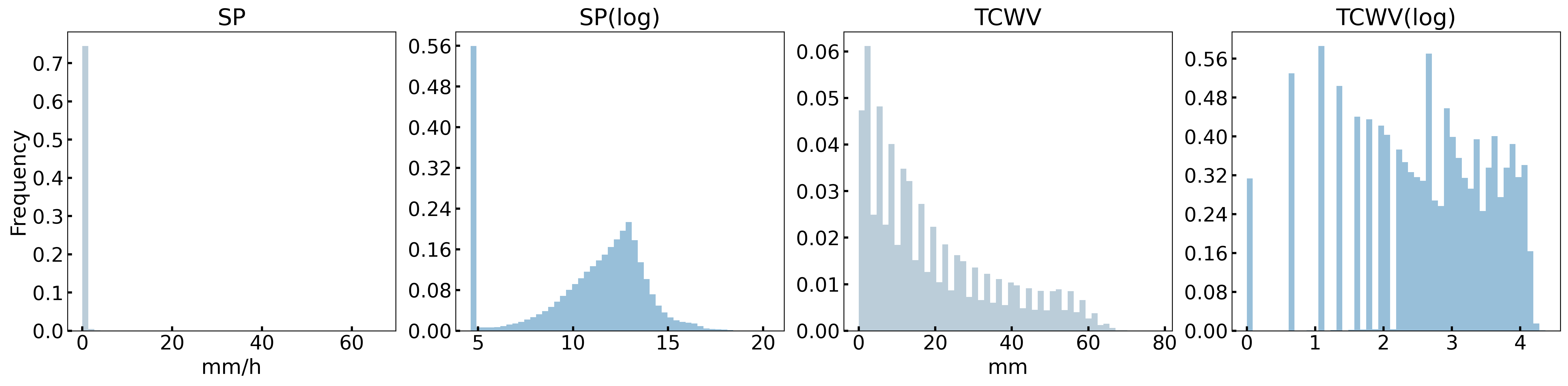
Figure 5: Distribution of ATMS precipitation productions. SP(log) indicates applying a log-transform on SP. It is the same for TCWV(log).
Ablation Studies
Ablation studies highlight the pivotal roles of AIDA and cross-regional boundary conditioning. Removing AIDA leads to unstable training, showcasing its necessity for efficient spatiotemporal modeling and roll-out prediction. Furthermore, cross-regional conditioning not only improves accuracy but also ensures prediction continuity, as visualized across different lead times in Figures 6 and 7.
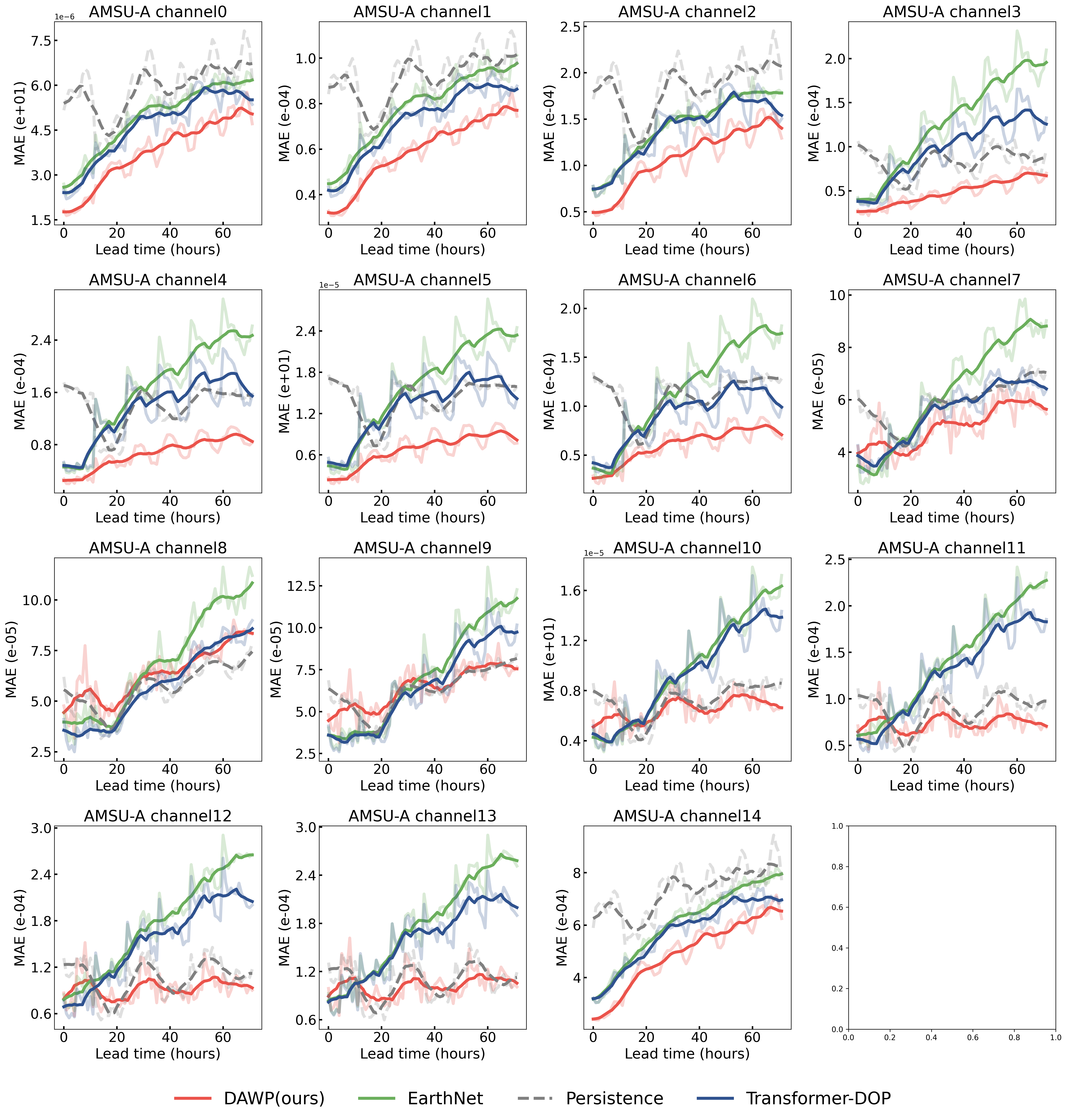
Figure 6: Curves of MAE for the prediction of different channels in sensor AMSU-A. The max lead time is 72h with a 1h temporal resolution.
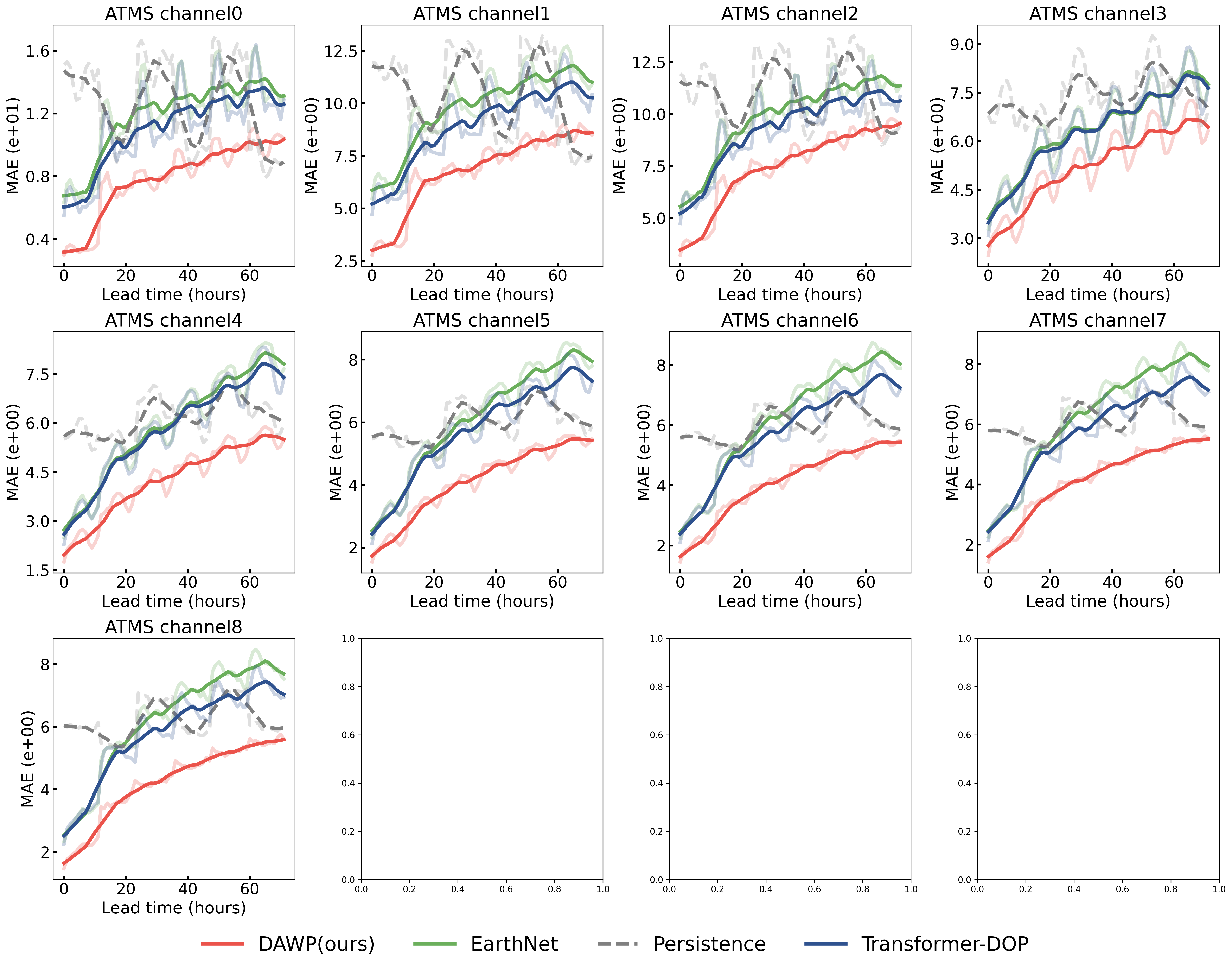
Figure 7: Curves of MAE for the prediction of different channels in sensor ATMS. The max lead time is 72h with a 1h temporal resolution.
Conclusion
DAWP stands as a promising framework capable of transforming global weather predictions that rely on direct satellite observations, eliminating the reanalysis data constraints while showing potential for enhanced real-time weather forecasting tasks. The devised AIDA module and cross-regional predictive capabilities mark significant strides in AIWP methodologies, showcasing substantial operational forecasting improvements. Future research might focus on integrating more diverse observational data sources and fine-tuning the prediction of physical variables alongside atmospheric observations.