- The paper introduces FlowMorph, a framework that leverages implicit neural representations to achieve structure-preserving, temporally coherent morphing in both 2D and 3D domains.
- It adapts Neural ODEs and Neural Conjugate Flows with SIREN activations and thin-plate regularization to ensure unique, invertible, and smooth feature alignments.
- Experimental results demonstrate FlowMorph's superior performance in landmark alignment, perceptual quality, and training efficiency compared to traditional and other INR-based methods.
FlowMorph: Implicit Neural Flows for Structure-Preserving Morphing
Introduction and Motivation
The paper introduces FlowMorph, a flow-based morphing framework leveraging implicit neural representations (INRs) to achieve structure-preserving, temporally coherent morphing in both 2D and 3D domains. Traditional morphing approaches, such as thin-plate splines and mesh-based warping, often struggle with complex deformations and require explicit regularization to maintain feature alignment and invertibility. Recent INR-based methods, notably those using multilayer perceptrons (MLPs), suffer from unstable training and artifacts due to the lack of structural priors. FlowMorph addresses these limitations by recasting morphing as the construction of a differential vector flow, ensuring continuity, invertibility, and temporal coherence by design.
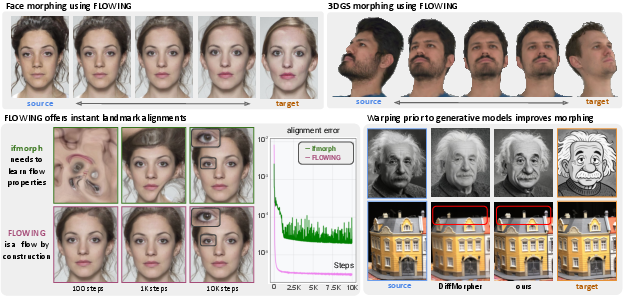
Figure 1: FlowMorph enables smooth, temporally consistent morphs in both 2D and 3D, instantly aligning landmarks and outperforming prior methods in visual quality and convergence speed.
FlowMorph formalizes morphing as the construction of a time-dependent warping Φ:Ω×[0,1]→Rn that smoothly interpolates between source and target features. The framework enforces three key properties:
- Uniqueness: Each feature follows a unique trajectory, preventing overlap and incoherence.
- Invertibility: Forward and backward mappings remain symmetric, avoiding artifacts during blending.
- Energy Minimization: Feature paths are regularized for smoothness via thin-plate energy minimization.
The warping is parameterized as a flow operator, Φθ, and trained to align sparse landmark correspondences while minimizing curvature. The loss function combines a data constraint for feature matching and a thin-plate regularization term, efficiently computed using a custom forward-mode differentiation scheme.
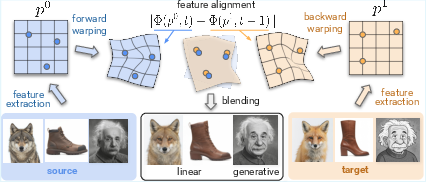
Figure 2: FlowMorph pipeline: extract landmark pairs, train a flow to align features, and blend warped images using linear or generative methods.
Flow-Based Architectures: NODEs and NCFs
FlowMorph adapts two flow-based neural architectures for morphing:
- Neural ODEs (NODEs): Model the time derivative of the warping as a neural vector field, integrated via numerical methods (e.g., Runge-Kutta). SIREN activations are used to capture high-frequency deformations, and Jacobian regularization stabilizes the dynamics.
- Neural Conjugate Flows (NCFs): Use invertible neural networks (coupling layers) to deform affine flows, guaranteeing invertibility and continuity by construction. NCFs offer efficient parallelism and topological simplicity.
Both architectures enforce flow properties intrinsically, enabling near-instant training and robust feature alignment. Ablation studies show that SIREN activations are critical for accurate high-frequency morphing, and thin-plate regularization further improves smoothness.
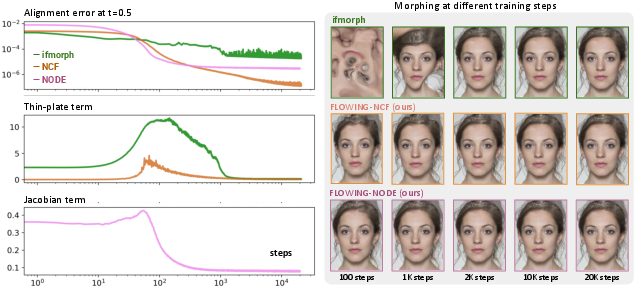
Figure 3: Convergence analysis: NCF and NODE achieve accurate alignment with fewer training steps compared to MLP-based ifmorph.
Blending Strategies and Integration with Generative Models
After warping, FlowMorph supports multiple blending strategies:
- Linear Blending: Directly interpolate between warped images for smooth transitions.
- Generative Blending: Warp images prior to encoding into a generative model's latent space, then blend latents and decode. This approach combines explicit spatial alignment with perceptual quality, outperforming naive latent blending.
For 3D morphing, FlowMorph extends to Gaussian Splatting (3DGS), aligning Gaussian centers via flow and blending opacity parameters for photorealistic transitions. The union-based 3DGS blending preserves geometric and appearance consistency across poses and viewpoints.
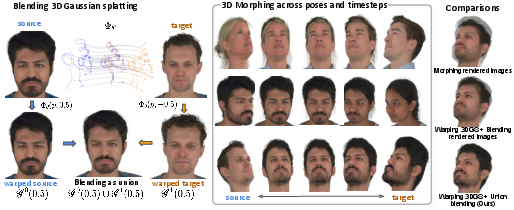
Figure 4: FlowMorph for 3D face morphing: warping enforces 3D landmark alignment, and union-based 3DGS blending yields consistent morphs.
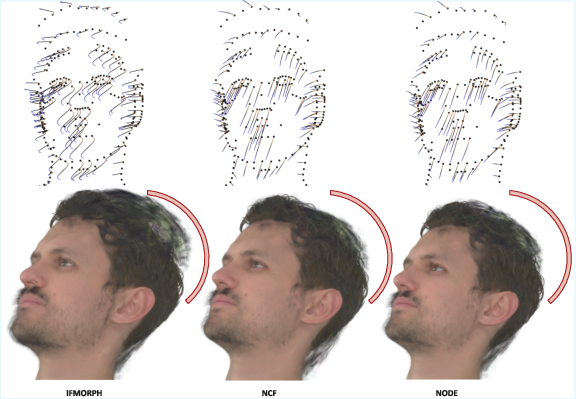
Figure 5: Visualization of 3D flow fields: FlowMorph (NCF, NODE) produces smoother, more coherent flows than MLP-based methods.
Experimental Results
FlowMorph is evaluated on face morphing (FRLL), general image morphing (MegaDepth), and 3DGS morphing (NeRSemble, GaussianAvatars). Key findings include:
- Landmark Alignment: NCF and NODE (with SIREN) outperform ifmorph and classical methods by 1–3 orders of magnitude in MSE across datasets.
- Blending Quality: NODE achieves the lowest LPIPS and FID scores, indicating superior perceptual quality and realism.
- Training and Inference Efficiency: NODE converges in as few as 2,000 steps, with training times under 3 minutes for high-resolution images. Forward-mode differentiation accelerates thin-plate loss computation by 23× over autograd.
- 3D Morphing: FlowMorph produces smooth, coherent transitions between diverse subjects, handling complex regions (e.g., hair) and maintaining structural integrity.

Figure 6: Qualitative results on in-the-wild faces: FlowMorph yields visually coherent, realistic morphs even for non-aligned images.
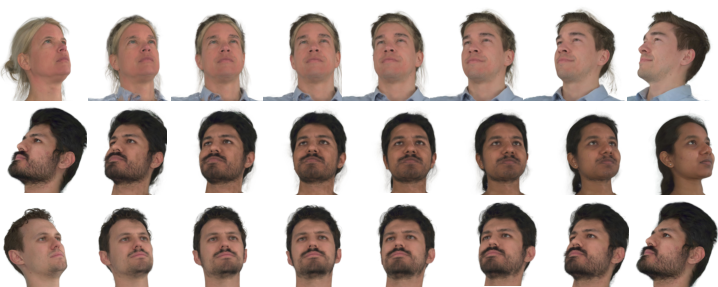
Figure 7: Gaussian morphing across timesteps: FlowMorph preserves structure and appearance in transitions between diverse subjects.
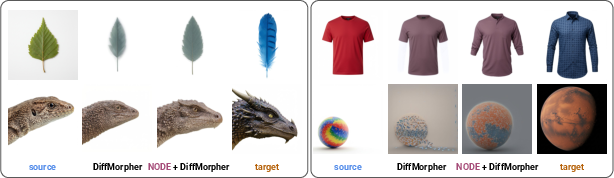
Figure 8: Generative blending with FlowMorph as a warping prior yields superior structural preservation and smoother transitions compared to DiffMorpher alone.
Implementation Considerations
- Landmark Extraction: Quality of morphing depends on accurate landmark correspondences; automated detectors (dlib, Xfeat) are supported.
- Regularization: Thin-plate regularization is essential for smooth deformations, especially in unconstrained regions.
- Architecture Selection: NODEs offer faster training, while NCFs provide better feature alignment at the cost of longer training times for large landmark sets.
- Integration: FlowMorph can be seamlessly integrated into generative pipelines, replacing traditional alignment procedures.
Limitations and Future Directions
FlowMorph's flow-based formulation enforces invertibility, limiting its ability to model occlusions or topological changes (e.g., open/closed mouths). Generative models can complement FlowMorph during blending to recover missing structures. The framework's reliance on landmark quality remains a bottleneck for fully automated morphing.
Future work includes extending FlowMorph to point cloud alignment, registration, and further refinement of Gaussian morphing techniques.
Conclusion
FlowMorph establishes a robust, theoretically grounded framework for structure-preserving morphing in both 2D and 3D domains. By encoding flow properties directly into neural architectures, it achieves fast, stable training and superior morphing quality, outperforming prior INR-based and classical methods. Its integration with generative models and applicability to Gaussian Splatting highlight its versatility. While limitations remain in handling topological changes, FlowMorph sets a new standard for morphing tasks and opens avenues for future research in neural flow-based alignment and interpolation.

