- The paper introduces an advanced Text-to-SQL framework that leverages expert schema linking and schema understanding for accurate SQL generation.
- It uses supervised fine-tuning to improve schema linking accuracy, achieving up to 7% gains over traditional methods.
- The multi-LLMs strategy integrates tailored LLMs to address self-bias and enhances performance on the Spider dataset benchmarks.
X-SQL: Expert Schema Linking and Understanding of Text-to-SQL with Multi-LLMs
The paper "X-SQL: Expert Schema Linking and Understanding of Text-to-SQL with Multi-LLMs" introduces a novel approach to the Text-to-SQL task using LLMs. X-SQL addresses significant gaps in the utilization of database schema information which other approaches have often overlooked.
Introduction and Background
Text-to-SQL tasks involve generating SQL code directly from natural language queries, making substantial use of emergent abilities of LLMs. However, the success of this task heavily relies on accurately understanding and utilizing database schemas. The challenge arises from the complexity of databases, where schemas can contain numerous tables, posing a barrier to efficient LLM-based solutions due to resource consumption and potential for generating erroneous queries.
X-SQL Framework Overview
The X-SQL framework consists of three main components: X-Linking for Schema Linking, X-Admin for Schema Understanding, and a SQL Generation and Debugging component.
- X-Linking (Schema Linking): This component uses Supervised Fine-Tuning (SFT) on LLMs to improve their ability to link relevant database tables with natural language queries. X-Linking addresses the conventional oversight that LLMs do not naturally excel in schema linking due to their pre-training limitations.
- X-Admin (Schema Understanding): This component translates abstract database schema definitions into natural language to bridge the gap between the database's structural information and the user's natural language queries. This process serves a function akin to a human data administrator, enhancing the overall contextual understanding of the system.
- Multi-LLMs Strategy: X-SQL leverages multiple LLMs tailored for different tasks within the system, thereby improving performance. This approach addresses the self-bias issue in LLMs by utilizing diverse models for tasks like debugging.
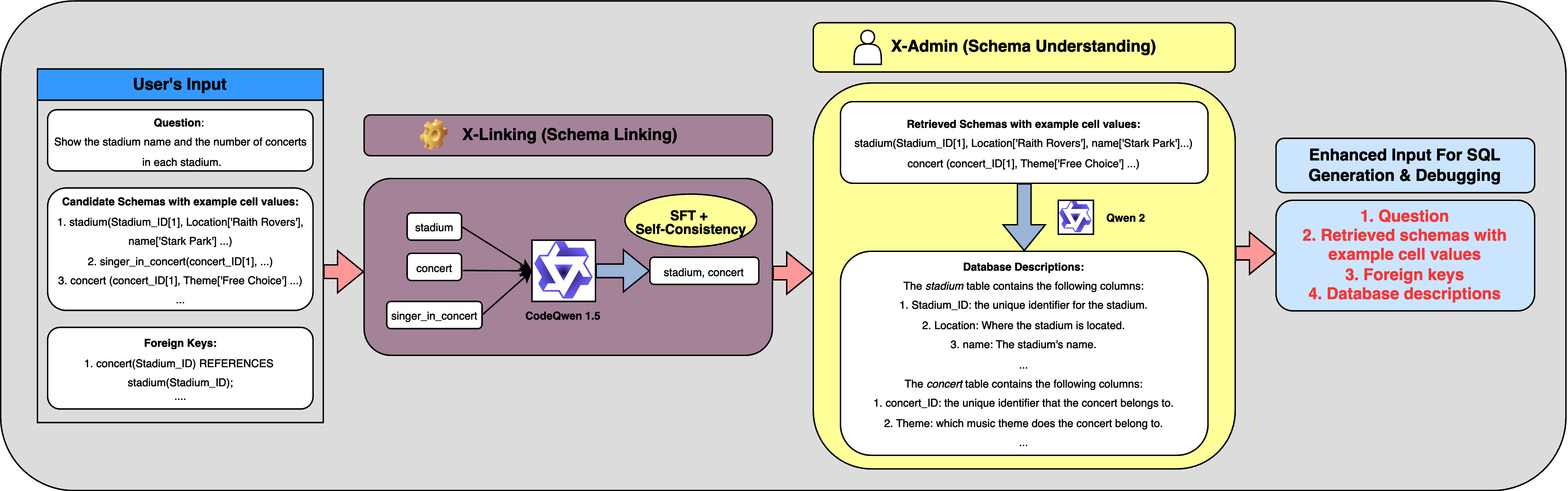
Figure 1: X-SQL's architecture. The candidate database schema is first filtered by X-linking. After that, X-Admin adds natural language descriptions to the linked table schema. Finally, we generate SQL queries with all this information and attempt to fix the queries if they execute with errors. The LLMs setup is based on the best Spider-Test result.
Empirical Evaluation
X-SQL demonstrates substantial performance improvements over existing frameworks on the Spider dataset, which is a benchmark for Text-to-SQL tasks. On the Spider-Dev dataset, X-SQL achieves an execution accuracy of 84.9%, surpassing the previous state-of-the-art. On the Spider-Test dataset, X-SQL achieves 82.5%.
Impact of X-Linking
X-Linking significantly improves the schema linking task. Compared to existing schema linking modules, X-Linking's accuracy gains are 7% higher, showcasing the efficacy of its dedicated SFT approach. This improvement is crucial in simplifying schema inputs and reducing errors in SQL generation.
Role of X-Admin
X-Admin contributes an additional 1.7% higher performance, emphasizing the importance of schema understanding. By converting technical schema descriptions into natural language, X-Admin improves LLM's ability to generate accurate SQL queries by providing comprehensive schema context.
Multi-LLMs Implementation
The integration of Multi-LLMs within X-SQL not only achieves better results but does so by exploiting the strengths of diverse LLM architectures. This multi-agent approach enables improved collaboration among various system components, paving the way for advancements in complex AI systems that require varied expertise.
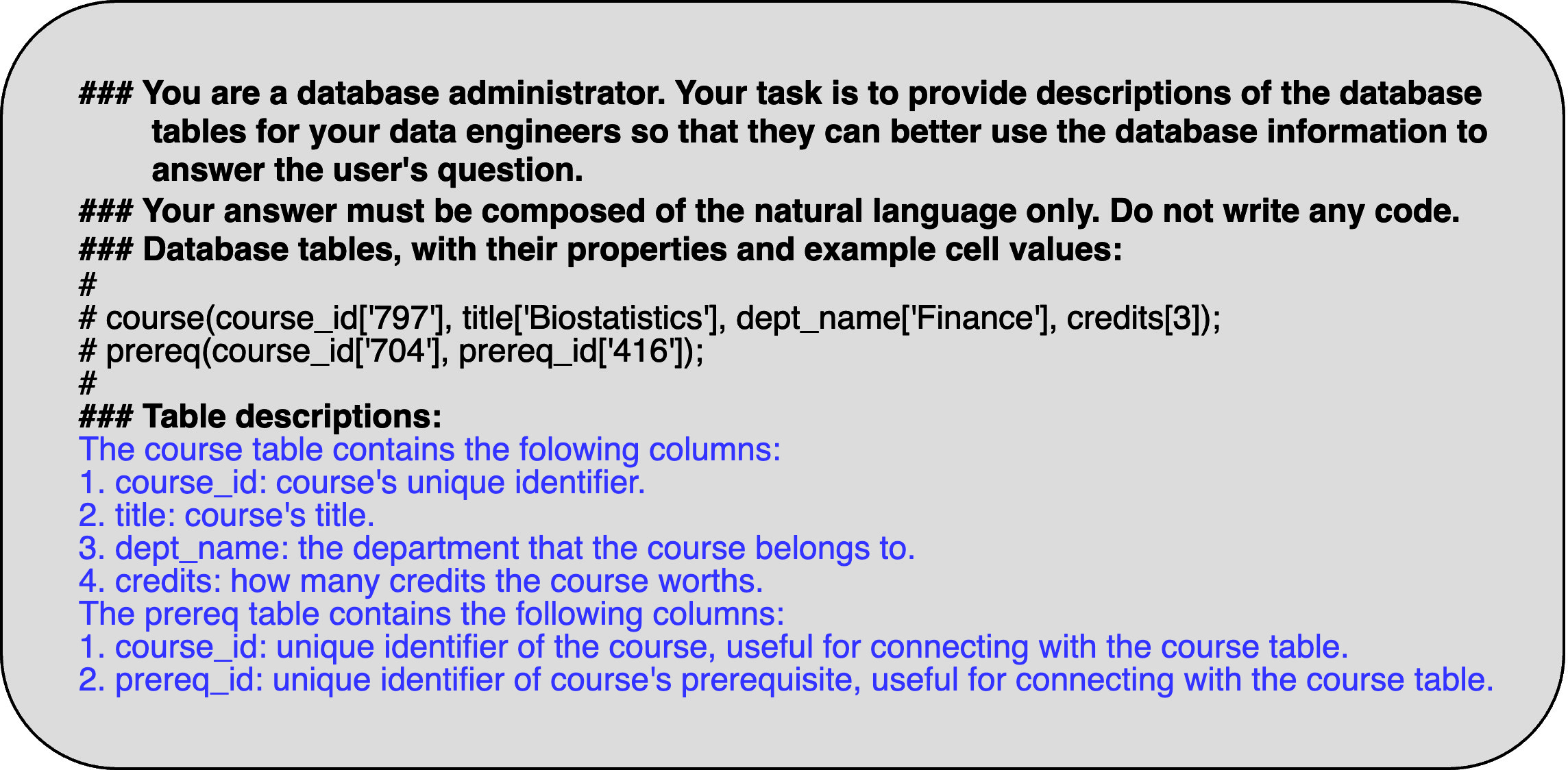
Figure 2: X-Admin (Schema Understanding) Prompt.
Conclusions and Future Work
X-SQL sets a new standard for open-source Text-to-SQL systems by effectively addressing schema linking and understanding challenges. Its use of SFT-trained schema linking and schema understanding, alongside a Multi-LLM strategy, significantly enhances system performance. Future research could explore extending the applicability of this framework to other code generation tasks or complex database scenarios, potentially further improving the robustness and adaptability of Text-to-SQL systems.

