- The paper demonstrates that dark decay processes, coupled with nuclear symmetry energy, modify neutron star composition and stability under extreme conditions.
- It employs the Tolman–Oppenheimer–Volkoff equations and EoS modeling to examine the impact of dark matter interactions on neutron star mass, radius, and tidal deformability.
- Findings reveal that tuning dark sector interactions can reconcile theoretical predictions with observed massive neutron stars and radius constraints.
Neutron Dark Decay in Neutron Stars: The Role of the Symmetry Energy
The paper "Neutron Dark Decay in Neutron Stars: The Role of the Symmetry Energy" (2508.21754) presents a detailed paper on the implications of neutron dark decay in neutron stars, emphasizing the influence of nuclear symmetry energy and interactions within the dark sector. The investigation extends prior work by incorporating interactions between dark matter and baryons, aiming to reconcile with recent observational data on neutron star properties.
Introduction
The research hinges on the discrepancy in neutron lifetime measurements from beam and bottle experiments, which suggests alternative decay channels, such as neutron dark decay involving dark matter particles. Within neutron stars, characterized by extreme conditions, the potential for such decay is amplified, posing significant implications for the equation of state (EoS) of dense matter.
Neutron Dark Decay Mechanism
The decay channel explored is n→χ+ϕ, where χ is a dark matter fermion and ϕ a light dark boson. This process is constrained by nuclear stability and leads to a modified composition in dense matter environments like neutron stars. The extreme conditions within neutron stars, including high pressure and density, significantly impact these decay channels, potentially altering our understanding of neutron star structures.
The paper constructs the EoS considering both neutron-proton-electron (β-stable) nuclear matter and additional contributions from dark sector interactions. The nuclear symmetry energy (NSE) is central to determining the proton-neutron ratio and thus influences the EoS and resultant mass-radius configurations of neutron stars.
The energy density is modeled as:
E(n,α)=E0+18n02K0(n−n0)2+S(n)α2
where K0 and L combine to affect the stiffness of the EoS through the parameter η=(K0L2)1/3. Self-interactions among dark particles and repulsive interactions with baryons are parametrized and varied to examine their impact on the EoS.
Impact on Neutron Star Properties
The paper utilizes the Tolman-Oppenheimer-Volkoff (TOV) equations to evaluate macroscopic properties, including the mass and radius of neutron stars. The tidal deformability Λ, sensitive to low-density EoS properties, is estimated to assess the sensitivity of predictions to dark sector parameters.
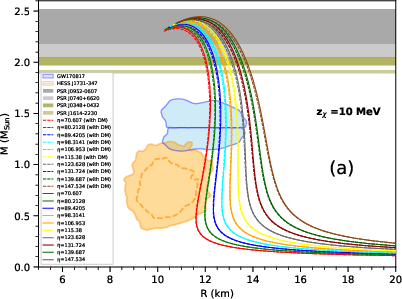
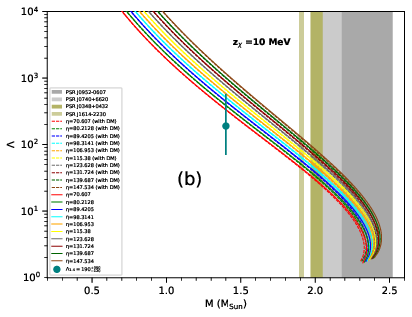
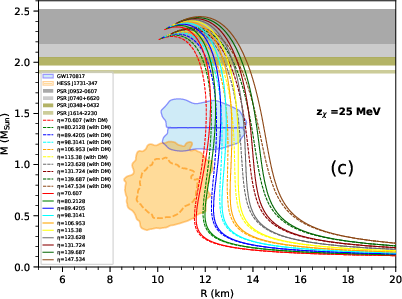
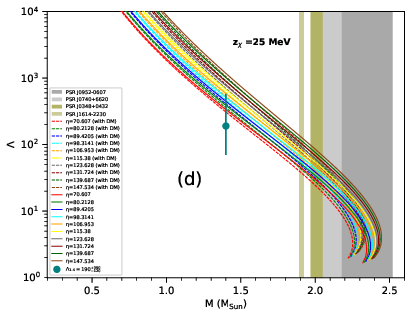
Figure 1: The M-R diagrams (left) and the tidal deformability Λ as a function of mass M (right) for interaction parameter zχ=10 MeV.
Dark matter's presence, particularly with repulsive baryon-dark matter interactions, leads to significant variations in predicted neutron star properties. The interaction strength parameters, especially when considering only baryon-dark matter interactions, can result in very stiff EoS capable of explaining the existence of massive neutron stars.
Results
The simulations reveal that dark decay does not inherently soften the EoS if dark sector interactions are tuned correctly. Interaction strengths significantly influence dark matter population, composition, and resulting neutron star properties. The paper confirms that similar masses are achievable with varying EoS stiffness, illustrating the complex interplay between NSE, interaction strengths, and neutron star mass and radius.
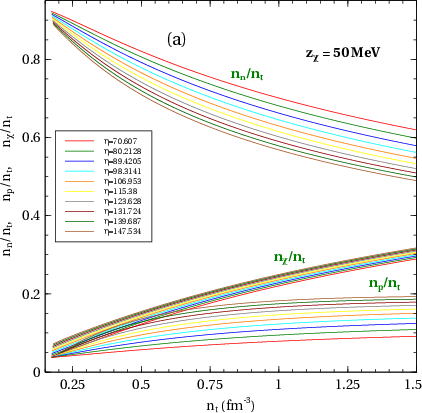
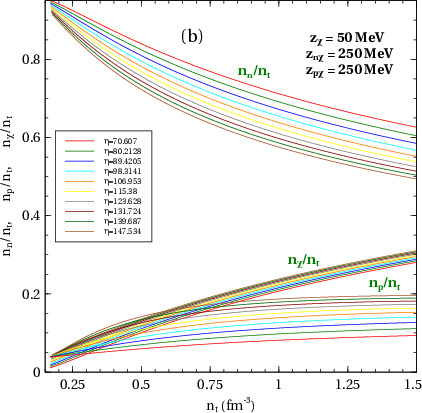
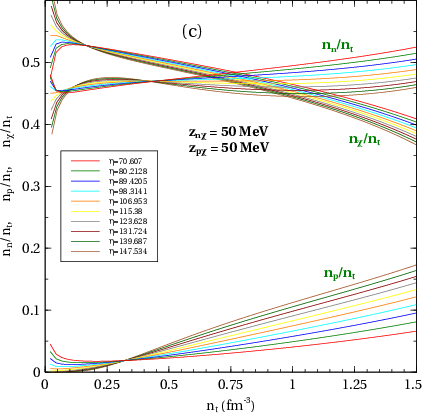
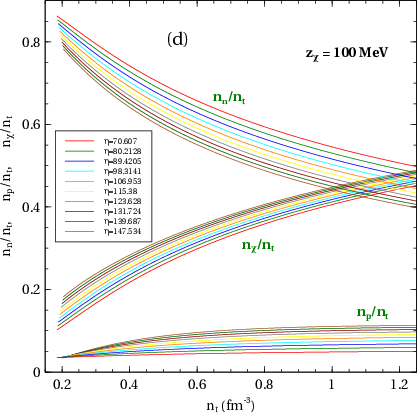
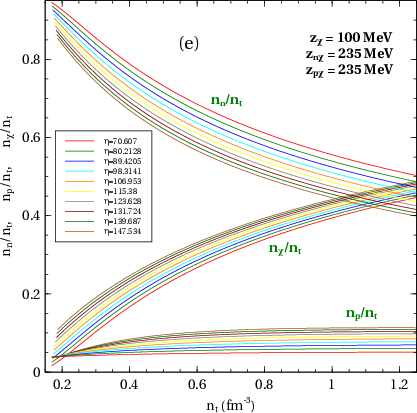
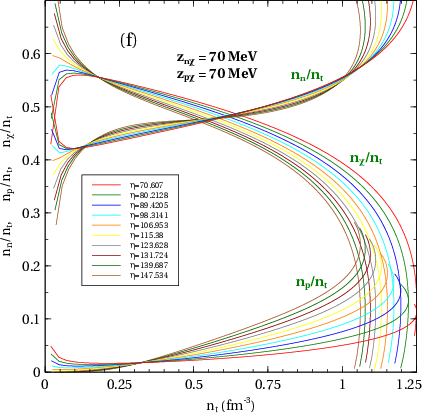
Figure 2: The fractions of neutrons, protons, and dark matter particles as a function of the total number density nt for various interaction parameters.
Notably, the presence of dark matter can eliminate certain observational uncertainties in neutron star radius predictions, showcasing dark matter's role in constraining theoretical models. High values of the interaction parameter zχ indicate stronger potentials, aligning observational constraints with theoretical expectations.
Conclusion
The paper outlines key findings where carefully adjusted dark sector interactions reconcile with observed neutron star properties without contradicting mass or radius constraints. This work highlights the importance of exploring dark matter interactions in extreme environments to validate theoretical models with astrophysical observations. Future research may expand into incorporating more complex baryonic states or detailed particle interactions to further refine neutron star models.