- The paper introduces a novel diffusion models framework that decomposes stimulus-specific neural information using rigorous axioms.
- It extends Fisher information to finite perturbations, ensuring additivity, positivity, and locality for robust feature attribution.
- Simulations validate the method by aligning neural sensitivity peaks with theoretical expectations and preserving the data processing inequality.
Introduction
The paper "Decomposing stimulus-specific sensory neural information via diffusion models" presents a novel framework to decompose neural information into stimulus-specific contributions. Traditional approaches to sensory coding and information theory, such as Shannon's framework, focus on quantifying the total information neurons encode but do not reveal which specific stimuli or stimulus features contribute most significantly. Previous decompositions lack principled methods to resolve this, often failing to meet criteria like locality, positivity, and additivity. This paper introduces a decomposition grounded in these axioms and scalable to high-dimensional stimuli via diffusion models.
Methodology
The authors propose a decomposition approach that adheres to three core axioms for meaningful stimulus-wise information attribution:
- Additivity: Information from repeated measurements should be additive.
- Positivity: The information attributed to each stimulus should be non-negative.
- Locality: The information attributed to a stimulus should be unaffected by distant stimuli.
The proposed method extends the concept of Fisher information, typically used for measuring neural response sensitivity to small stimulus perturbations, to account for both infinitesimal and finite perturbations. This allows a direct link between Fisher information and mutual information via a novel integration approach. The computational tractability of this method for high-dimensional stimuli is achieved through the use of diffusion models, which are capable of scaling complex neural models to naturalistic stimuli.
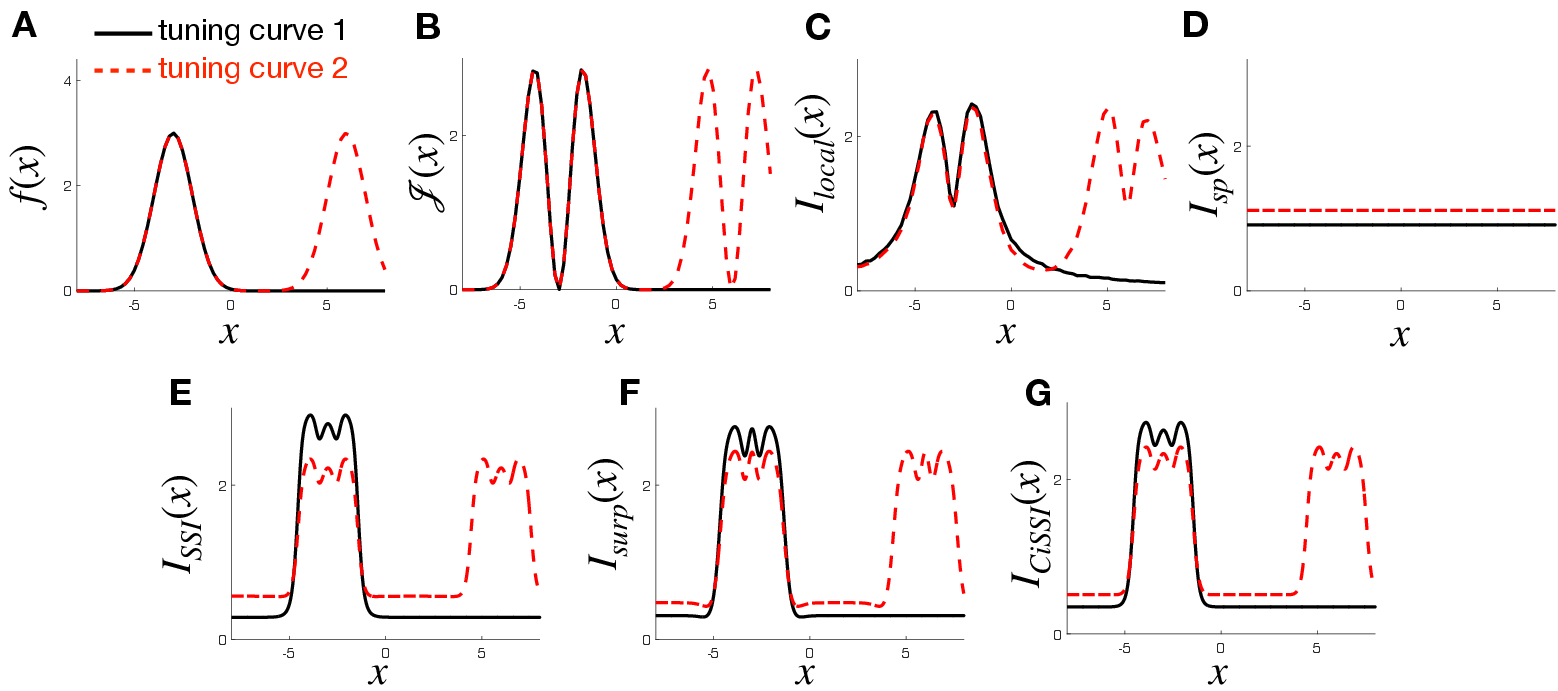
Figure 1: Demonstration of locality. (A) A neuron responds to a 1D stimulus x with tuning curve f(x). We compare two cases: (i) tuning changes only near x=−3 (black), and (ii) additional changes near x=6 (red dashed). (B--C) The Fisher information, J(x) and local information Ilocal(x) converge far from the differing regions.
Desired Properties and Implementation
The stimulus-specific decomposition aims to fulfill the completeness axiom, ensuring the total mutual information is the expected sum of local attributions. Furthermore, the locality axiom is explicitly enforced to ensure distant stimulus changes do not affect local information, enhancing interpretability in high-dimensional settings.
The integration of Fisher information with diffusion models results in a new stimulus-wise information measure, Ilocal(x). This measure respects the axioms and leverages the noise-corrupted stimulus model inherent in diffusion processes, offering a robust approach to feature-wise decomposition suitable for neural and artificial networks.
Results
The paper demonstrates through simulations that the introduced decomposition method holds true to the desired axioms where prior methods falter. The method is illustrated by applying it to neural encoding scenarios where traditional metrics like Fisher information are insufficient. The results highlight how the proposed decomposition aligns with biological expectations and theoretical requirements.
For example, when applying different priors, the method shows how the neural sensitivity varies in accordance with stimulus complexity, a feature elusive to other decomposition measures. Moreover, it is shown to maintain the data processing inequality on local levels, assuring its theoretic robustness.
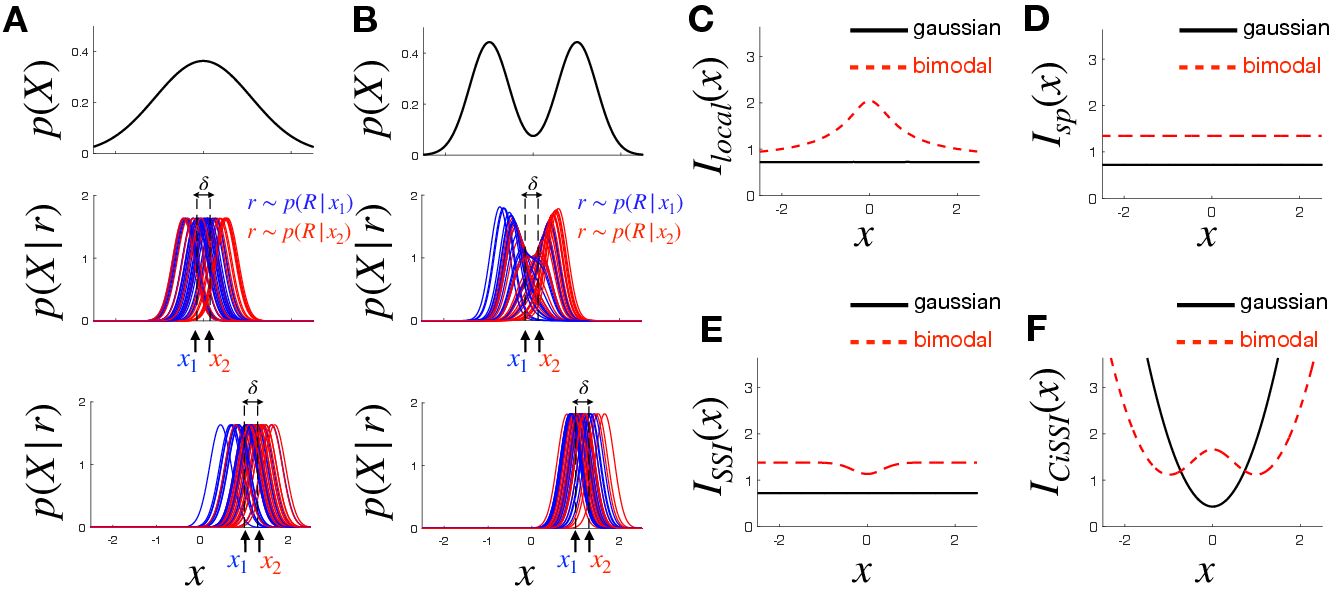
Figure 2: Effect of prior and information sensitivity. Local information peaks depending on the prior shape, aligning with theoretical expectations of sensitivity variation.
Practical Implications
The paper's approach opens avenues for applying neural coding principles to high-dimensional, noisily encoded stimuli while maintaining interpretability. This capability empowers neuroscience research to decipher complex neural codes in both biological and artificial systems. Future work could expand similar analyses to higher-order neural areas and deploy these methods within artificial neural network architectures for deeper insight into neural unit and layer sensitivities.
Conclusion
The proposed decomposition achieves a structured and interpretable division of stimulus-specific sensory neural information. Its grounding in information theory and practical compatibility with diffusion models makes it a potent tool for advancing our understanding of neural coding. The protocol’s successful validation through empirical results suggests broad applicability and potential to explore neural efficiency in coding further.
The paper exemplifies a significant step in bridging theoretical constructs with practical computational frameworks, paving the way for more advanced analytical techniques in sensory neuron research and AI-based neural analytics.