- The paper presents a unified framework integrating diverse changepoint detection algorithms, including PELT, Binary Segmentation, and genetic methods.
- It consolidates these techniques within a tidyverse-compliant interface, enabling straightforward comparative analysis and enhanced workflow consistency.
- Application to MLB data validates the package's effectiveness and highlights its potential for extension to multivariate and complex datasets.
"tidychangepoint": A Unified Framework for Analyzing Changepoint Detection
The paper presents the "tidychangepoint" package for R, a versatile framework designed for changepoint detection in univariate time series. The package consolidates existing algorithms and model-fitting procedures into a tidyverse-compliant toolset, providing a unified interface for intricate changepoint analysis, enhancing user experience and comparative algorithm analysis.
Introduction
Changepoint detection is crucial for understanding structural changes within time series data. It involves identifying points in time where statistical properties of the data sequence change. The paper introduces "tidychangepoint," an R package leveraging tidyverse principles to harmonize various algorithmic approaches to changepoint detection, including deterministic methods like PELT and flexible genetic algorithms.
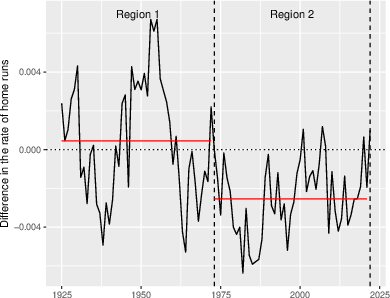
Figure 1: Difference in home runs per plate appearance between American and National Leagues in MLB.
The Framework of "tidychangepoint"
The package integrates well-known changepoint detection methods such as PELT, Binary Segmentation, and Wild Binary Segmentation, alongside genetic algorithm-based approaches. It supports various parametric models, penalized objective functions, and graphical diagnostics. This facilitates the comparison of different algorithms and models, providing insights into their efficiency and suitability for various datasets.
Changepoint Detection Algorithms
The paper elaborates on the efficient algorithms implemented within "tidychangepoint." PELT leverages dynamic programming for linear time complexity, making it optimal under specific conditions. Genetic algorithms offer flexibility in model specification, allowing for the exploration of large solution spaces through evolutionary principles, though at a higher computational cost.
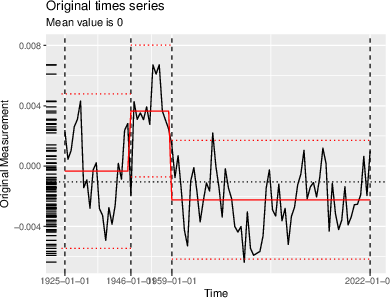
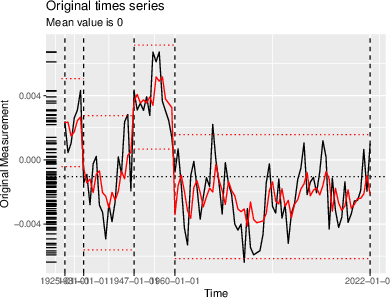
Figure 2: Comparison of changepoint sets returned by PELT and Shi's genetic algorithm.
Application to MLB Data
The package demonstrates its capability through analysis of MLB data, detecting known changepoints, such as rule changes affecting game dynamics. Through various algorithmic applications, the true structural changes in the data are discerned, even if not perfectly aligned, showcasing the nuance and power of the package's built-in algorithms.
Architecting "tidychangepoint"
"tidychangepoint" employs S3 object-oriented programming to structure its operations, seamlessly integrating with R's ecosystem. It extends functionality by incorporating methods for object manipulation, visualization, and detailed statistical summaries, ensuring comprehensive analytics and comparability across different algorithmic outputs and datasets.
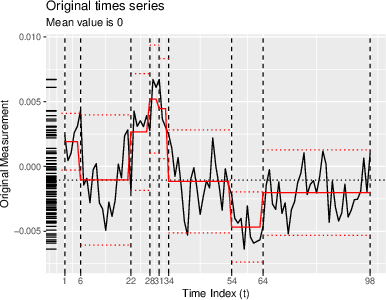
Figure 3: Diagnostic plot showing the time-series segmented by identified changepoints.
Implications and Future Work
Changepoint detection using "tidychangepoint" has significant implications for time series analysis across domains, such as climate studies, financial market analysis, and quality control in manufacturing. The package's design is conducive to extension, inviting contributions for additional algorithms, models, and performance optimizations through C integration.
Conclusion
The "tidychangepoint" package represents a substantial step forward in unifying changepoint detection methodologies within the R programming language. It facilitates robust comparative analysis and model fitting across diverse datasets, offering a powerful toolset for researchers engaged in time series analysis.
Future work aims to further extend the package's capabilities, incorporating more changepoint detection algorithms, improving computational efficiency, and exploring multivariate time series analysis to broaden its applicability and precision across complex datasets.