Papers
Topics
Authors
Recent
Search
2000 character limit reached

Intelligent Control in 6G Open RAN: Security Risk or Opportunity?

Published 14 May 2024 in cs.NI, cs.CR, cs.PF, cs.SY, and eess.SY | (2405.08577v1)

Abstract: The Open Radio Access Network (Open RAN) framework, emerging as the cornerstone for AI-enabled Sixth-Generation (6G) mobile networks, heralds a transformative shift in radio access network architecture. As the adoption of Open RAN accelerates, ensuring its security becomes critical. The RAN Intelligent Controller (RIC) plays a central role in Open RAN by improving network efficiency and flexibility. Nevertheless, it also brings about potential security risks that need careful scrutiny. Therefore, it is imperative to evaluate the current state of RIC security comprehensively. This assessment is essential to gain a profound understanding of the security considerations associated with RIC. This survey combines a comprehensive analysis of RAN security, tracing its evolution from 2G to 5G, with an in-depth exploration of RIC security, marking the first comprehensive examination of its kind in the literature. Real-world security incidents involving RIC are vividly illustrated, providing practical insights. The study evaluates the security implications of the RIC within the 6G Open RAN context, addressing security vulnerabilities, mitigation strategies, and potential enhancements. It aims to guide stakeholders in the telecom industry toward a secure and dependable telecommunications infrastructure. The article serves as a valuable reference, shedding light on the RIC's crucial role within the broader network infrastructure and emphasizing security's paramount importance. This survey also explores the promising security opportunities that the RIC presents for enhancing network security and resilience in the context of 6G mobile networks. It outlines open issues, lessons learned, and future research directions in the domain of intelligent control in 6G open RAN, facilitating a comprehensive understanding of this dynamic landscape.
Summary

  • The paper identifies the primary security risks associated with the centralized RAN Intelligent Controller in 6G Open RAN networks.
  • It employs threat analysis methodologies, including vulnerability assessment of xApps and API interactions, to propose mitigation measures.
  • The study highlights that despite inherent risks, dynamic security protocols offer opportunities for resilient network management in 6G.

Intelligent Control in 6G Open RAN: Security Challenges

The paper "Intelligent Control in 6G Open RAN: Security Risk or Opportunity?" explores the complexities of incorporating intelligent control mechanisms within the context of 6G Open RAN networks. As the telecommunications sector braces for the 6G revolution, integrating Open RAN architectures has become imperative. These architectures promise to disaggregate the traditional RAN and usher in an era of enhanced flexibility and programmability across cellular networks. The RAN Intelligent Controller (RIC), a pivotal component within the Open RAN ecosystem, is designated as the epicenter of management and optimization for 6G networks. This paper explores the security challenges posed by this integration and evaluates potential mitigation strategies.

Security Analysis and Threat Landscape

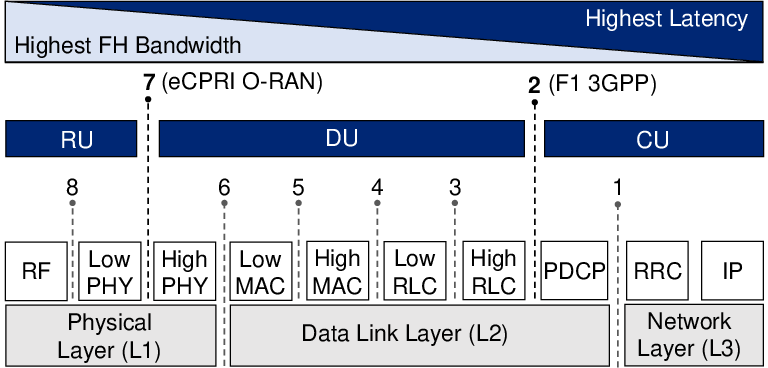
Open RAN architectures are intrinsically decentralized, aiming for greater vendor interoperability. However, this decentralization opens up previously non-existent vectors of attack as disparate vendors integrate their components. The RIC, instrumental in managing radio resources in near-real-time, emerges as a potential target for exploitation due to its centralized control over these distributed nodes. Attackers aiming for resource mismanagement could exploit its architecture. Vulnerabilities in application interactions (xApps) deployed on the RIC platform are particularly concerning, offering attack vectors through insecure software components and APIs. Figure 1

Figure 1: BS protocol stack and different functional splits illustrate the complexity and integration points in the evolving RAN architecture.

Security Enhancements: Mitigation Measures

To safeguard these architectures, this research underscores the necessity of robust security measures:

  • Authentication and Authorization: Implementing end-to-end security protocols to ensure only authenticated entities communicate with the RIC.
  • ML/AI Security Frameworks: Guarding ML components against data poisoning and adversarial attacks that aim to skew intelligent control algorithms.
  • Anomaly Detection: Leveraging pattern recognition to detect abnormal traffic and command requests indicative of potential breaches.

Additional layers of security protocols, specifically for API interactions, are recommended to mitigate unauthorized data access and ensure secure data exchanges between RAN components.

Security Opportunities in 6G

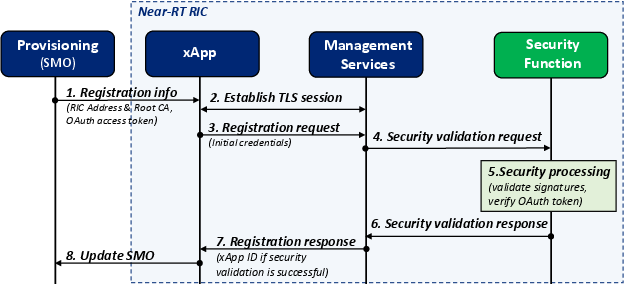
Despite the risks, RIC's integration presents several opportunities for improving overall network security. The inherent programmability facilitates the continuous integration of cutting-edge security solutions as threats evolve. Moreover, the dynamic nature of the RIC can help adapt security protocols in real-time, a critical feature for 6G's anticipated ultra-reliable low-latency communications. Figure 2

Figure 2: Secure xApp registration on nRT RIC demonstrates layers of security implemented to control and regulate xApp behavior within the RAN ecosystem.

Conclusion

The advent of 6G networks leans heavily on the promise of Open RAN's flexibility. However, as these networks become more complex and integrated, safeguarding their components, especially the RIC, becomes paramount. The research provides a foundational understanding of the security challenges and opportunities within this context, proposing measures that stakeholders can adopt to navigate the risks. Enhanced security frameworks, backed by real-time intelligence, will be pivotal in maintaining the integrity and resilience of future 6G networks. As these protocols mature, they will likely serve as the blueprint for securing further generations of telecommunication networks.

Paper to Video (Beta)

Whiteboard

No one has generated a whiteboard explanation for this paper yet.

Collections

Sign up for free to add this paper to one or more collections.

Tweets

Sign up for free to view the 2 tweets with 4 likes about this paper.