Revealing the spatial nature of sublattice symmetry
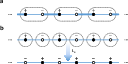
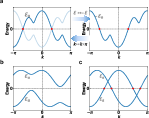
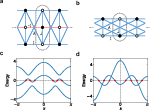
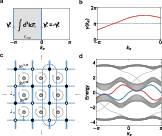
Abstract: The sublattice symmetry on a bipartite lattice is commonly regarded as the chiral symmetry in the AIII class of the tenfold Altland-Zirnbauer classification. Here, we reveal the spatial nature of sublattice symmetry, and show that this assertion holds only if the periodicity of primitive unit cells agrees with that of the sublattice labeling. In cases where the periodicity does not agree, sublattice symmetry is represented as a glide reflection in energy-momentum space, which inverts energy and simultaneously translates some $k$ by $π$, leading to substantially different physics. Particularly, it introduces novel constraints on zero modes in semimetals and completely alters the classification table of topological insulators compared to class AIII. Notably, the dimensions corresponding to trivial and nontrivial classifications are switched, and the nontrivial classification becomes $\mathbb{Z}_2$ instead of $\mathbb{Z}$. We have applied these results to several models, including the Hofstadter model both with and without dimerization.
- Colloquium: Topological insulators. Rev. Mod. Phys. 82, 3045–3067 (2010).
- Topological insulators and superconductors. Rev. Mod. Phys. 83, 1057–1110 (2011).
- Classification of topological quantum matter with symmetries. Rev. Mod. Phys. 88, 035005 (2016).
- Nonstandard symmetry classes in mesoscopic normal-superconducting hybrid structures. Phys. Rev. B 55, 1142–1161 (1997).
- Classification of topological insulators and superconductors in three spatial dimensions. Phys. Rev. B 78, 195125 (2008).
- Periodic table for topological insulators and superconductors. In AIP Conference Proceedings (AIP, 2009).
- Topological defects and gapless modes in insulators and superconductors. Phys. Rev. B 82, 115120 (2010).
- Classification of topological insulators and superconductors in the presence of reflection symmetry. Phys. Rev. B 88, 075142 (2013).
- Topological classification with additional symmetries from clifford algebras. Phys. Rev. B 88, 125129 (2013).
- Topological classification and stability of fermi surfaces. Phys. Rev. Lett. 110, 240404 (2013).
- Topological connection between the stability of fermi surfaces and topological insulators and superconductors. Phys. Rev. B 89, 075111 (2014).
- Topology of crystalline insulators and superconductors. Phys. Rev. B 90, 165114 (2014).
- Unified theory of pt𝑝𝑡ptitalic_p italic_t and cp𝑐𝑝cpitalic_c italic_p invariant topological metals and nodal superconductors. Phys. Rev. Lett. 116, 156402 (2016).
- Topology of nonsymmorphic crystalline insulators and superconductors. Phys. Rev. B 93, 195413 (2016).
- Solitons in polyacetylene. Phys. Rev. Lett. 42, 1698–1701 (1979).
- Chiral topological insulators, superconductors, and other competing orders in three dimensions. Phys. Rev. B 81, 045120 (2010).
- Band structure of abc𝑎𝑏𝑐abcitalic_a italic_b italic_c-stacked graphene trilayers. Phys. Rev. B 82, 035409 (2010).
- Dirac and weyl superconductors in three dimensions. Phys. Rev. Lett. 113, 046401 (2014).
- Chiral topological insulating phases from three-dimensional nodal loop semimetals. Phys. Rev. B 95, 121107 (2017).
- Chiral topological insulator of magnons. Phys. Rev. B 97, 174413 (2018).
- Topology classification using chiral symmetry and spin correlations in graphene nanoribbons. Nano Lett. 21, 197–202 (2021).
- Manipulating topological edge spins in a one-dimensional optical lattice. Phys. Rev. Lett. 110, 076401 (2013).
- Topological boundary modes in isostatic lattices. Nature Physics 10, 39–45 (2014).
- Probe of three-dimensional chiral topological insulators in an optical lattice. Phys. Rev. Lett. 113, 033002 (2014).
- Yang, Z. et al. Topological acoustics. Phys. Rev. Lett. 114, 114301 (2015).
- Realizing and detecting a topological insulator in the aiii symmetry class. Phys. Rev. Lett. 119, 115301 (2017).
- Imhof, S. et al. Topolectrical-circuit realization of topological corner modes. Nature Physics 14, 925–929 (2018).
- Song, B. et al. Observation of symmetry-protected topological band with ultracold fermions. Science advances 4, eaao4748 (2018).
- Observation of higher-order topological acoustic states protected by generalized chiral symmetry. Nature materials 18, 113–120 (2019).
- Ji, W. et al. Quantum simulation for three-dimensional chiral topological insulator. Phys. Rev. Lett. 125, 020504 (2020).
- Xin, T. et al. Quantum phases of three-dimensional chiral topological insulators on a spin quantum simulator. Phys. Rev. Lett. 125, 090502 (2020).
- Shi, X. et al. Disorder-induced topological phase transition in a one-dimensional mechanical system. Phys. Rev. Res. 3, 033012 (2021).
- Topological acoustics. Nature Reviews Materials 7, 974–990 (2022).
- Geometry and topology tango in ordered and amorphous chiral matter. SciPost Physics 12, 038 (2022).
- Wang, D. et al. Realization of a ℤℤ\mathbb{Z}blackboard_Z-classified chiral-symmetric higher-order topological insulator in a coupling-inverted acoustic crystal. Phys. Rev. Lett. 131, 157201 (2023).
- Gauge-field extended k⋅p⋅𝑘𝑝k\cdot{}pitalic_k ⋅ italic_p method and novel topological phases. Phys. Rev. Lett. 127, 076401 (2021).
- Hofstadter, D. R. Energy levels and wave functions of bloch electrons in rational and irrational magnetic fields. Phys. Rev. B 14, 2239–2249 (1976).
- Winding number, family index theorem, and electron hopping in a magnetic field. Nuclear Physics B 316, 641–662 (1989).
- Time reversal polarization and a Z2subscript𝑍2{Z}_{2}italic_Z start_POSTSUBSCRIPT 2 end_POSTSUBSCRIPT adiabatic spin pump. Phys. Rev. B 74, 195312 (2006).
- Brillouin klein bottle from artificial gauge fields. Nature Communications 13, 2215 (2022).
- Z2subscript𝑍2{Z}_{2}italic_Z start_POSTSUBSCRIPT 2 end_POSTSUBSCRIPT topology in nonsymmorphic crystalline insulators: Möbius twist in surface states. Phys. Rev. B 91, 155120 (2015).
- 𝕫2subscript𝕫2{\mathbb{z}}_{2}blackboard_z start_POSTSUBSCRIPT 2 end_POSTSUBSCRIPT-projective translational symmetry protected topological phases. Phys. Rev. B 102, 161117 (2020).
- Nakahara, M. Geometry, topology and physics (CRC press, 2003).
- Symmetry and topology in non-hermitian physics. Phys. Rev. X 9, 041015 (2019).
- Non-hermitian topological invariants in real space. Phys. Rev. Lett. 123, 246801 (2019).
- Xiao, L. et al. Non-hermitian bulk–boundary correspondence in quantum dynamics. Nature Physics 16, 761–766 (2020).
- Chiral symmetry in non-hermitian systems: Product rule and clifford algebra. Phys. Rev. B 103, 014111 (2021).
- Hermitian topologies originating from non-hermitian braidings. Phys. Rev. B 108, 165105 (2023).
- Bulk-boundary correspondence of topological insulators from their respective green’s functions. Phys. Rev. B 84, 125132 (2011).
- Topological edge states with zero hall conductivity in a dimerized hofstadter model. Phys. Rev. Lett. 115, 216805 (2015).
Paper Prompts
Sign up for free to create and run prompts on this paper using GPT-5.
Top Community Prompts
Collections
Sign up for free to add this paper to one or more collections.