- The paper demonstrates that electric field modulation via alkali metal deposition and ionic-liquid gating precisely tunes the two-dimensional van Hove singularity in SrRuO3 films.
- The paper employs ARPES to reveal a Lifshitz transition and a corresponding reversal in Hall resistivity, indicating a switch in charge carrier type.
- The paper suggests that controlled engineering of VHSs can enable advanced electronic and quantum devices in oxide ultra-thin films.
Electric Control of Two-Dimensional Van Hove Singularity in Oxide Ultra-Thin Films
Introduction
This paper investigates the electronic control of two-dimensional van Hove singularities (VHSs) in oxide ultra-thin films, particularly focusing on SrRuO3 (SRO) films. VHSs, which are saddle points in the electronic band structure, can lead to a highly divergent density of states (DOS) at certain energy levels. This can induce phenomena such as enhanced superconductivity and unexpected phase transitions. However, achieving controlled VHSs in a practical setting is challenging due to the need for stability, proximity to the Fermi level, and two-dimensional material properties. This study addresses these challenges by employing electric field modulation through alkali metal deposition and ionic-liquid gating to tune the electronic characteristics of VHSs in SRO films.
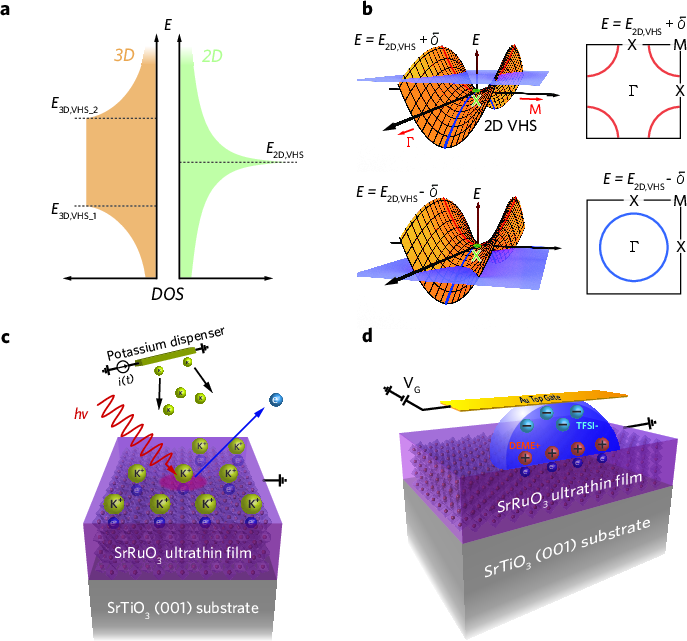
Figure 1: Tunable two-dimensional (2D) van Hove singularities (VHSs) with applied electric fields.
Methodology
The study employs angle-resolved photoemission spectroscopy (ARPES) to investigate the band structures of ultra-thin SRO films subjected to electric field modulation techniques. The electric field modulation is performed using two primary methods:
- Alkali Metal Deposition (AMD): Potassium is deposited on the SRO film surface to induce a significant change in electronic structure by applying an electric field, effectively doping the system with electrons.
- Ionic-Liquid Gating: This technique involves applying an external electric field using an ionic liquid to control the carrier density and transport properties of the film.
These methodologies enable precise control over the position of the VHS relative to the Fermi level, facilitating the study of its impact on electronic and transport properties.
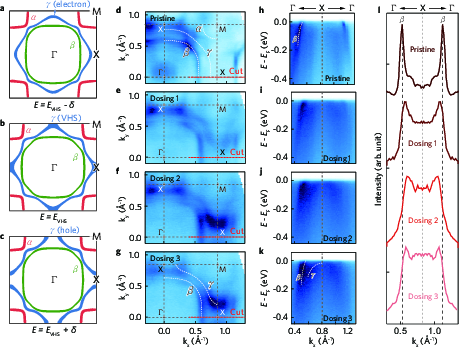
Figure 2: Electron band control of the 2D VHS with K deposition.
Results
Electronic Structure Control
The ARPES measurements revealed a Lifshitz transition in the γ band of the SRO film upon potassium dosing. Initially, the γ band is an electron-like band, but with increased doping, it evolves into a hole-like band as the VHS crosses the Fermi level. This transition is indicative of a significant alteration in the electronic structure, enabled by external electric field modulation.
Transport Characteristics
Transport measurements conducted using ionic-liquid gating showed a change in the majority charge carrier type as a function of gate voltage and temperature. The study observed a sign reversal in the ordinary Hall effect (OHE) resistivity, correlated with the VHS crossing the Fermi level. This demonstrates the VHS's role in modulating the transport properties of two-dimensional systems.
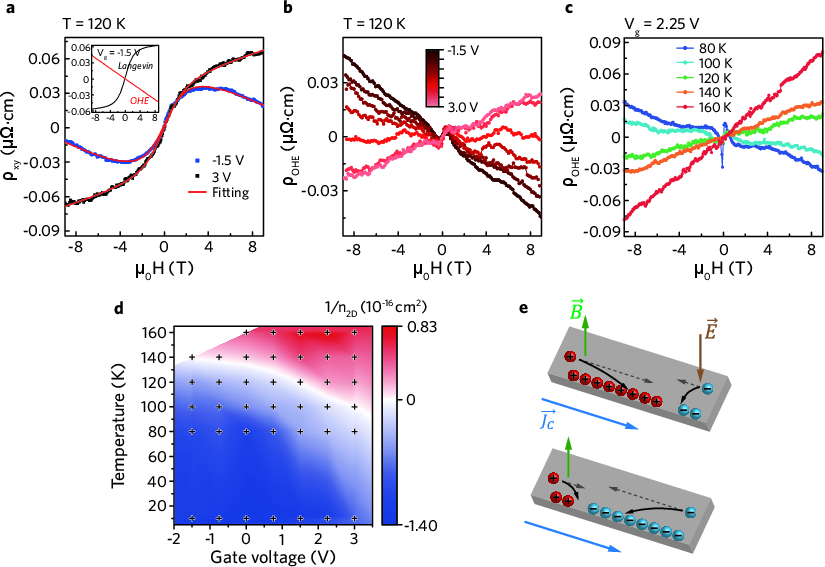
Figure 3: Transport control of the 2D VHS with ionic-liquid gating.
Theoretical Implications
The findings underscore the importance of VHSs in determining the electronic and transport properties of two-dimensional materials. The divergent DOS associated with VHSs can lead to dominant charge carriers in a multi-band system, significantly impacting the Hall coefficient. This suggests that VHSs can be strategically utilized to engineer material properties in thin films, offering potential applications in electronic and quantum devices.
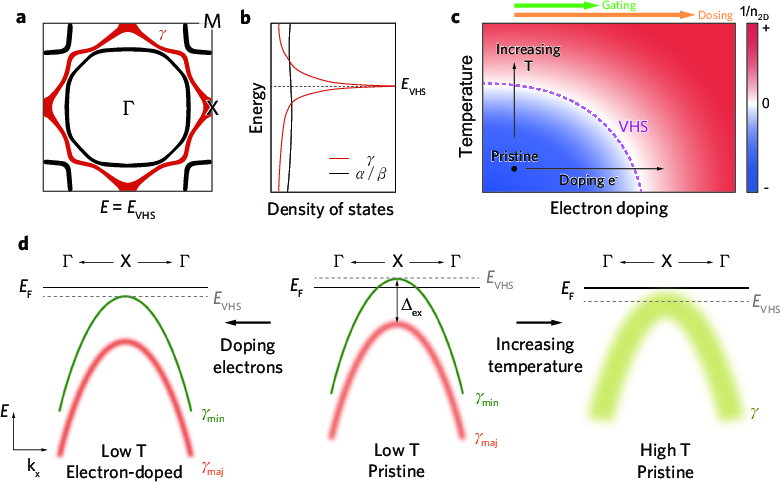
Figure 4: The 2D VHS in the effective one band model and ferromagnetism in SRO.
Conclusion
This study demonstrates the feasibility of controlling two-dimensional VHSs using external electric fields in oxide ultra-thin films, highlighting the tunability of the electronic properties through chemical potential modulation. The methods described provide a robust platform for exploring electronic correlations in materials by enabling precise control over band structures without altering the physical sample. These advancements could lead to new methods for engineering electronic states and tailoring material behaviors in nanostructured systems. As research continues, the implications for both theoretical understanding and practical applications in device engineering could be profound.
This paper, "Electric control of two-dimensional Van Hove singularity in oxide ultra-thin films," offers a comprehensive look at using external electric fields to control VHS and its consequences on high-dimensional physics, making significant contributions to the field of materials science and condensed matter physics (2302.06222).

