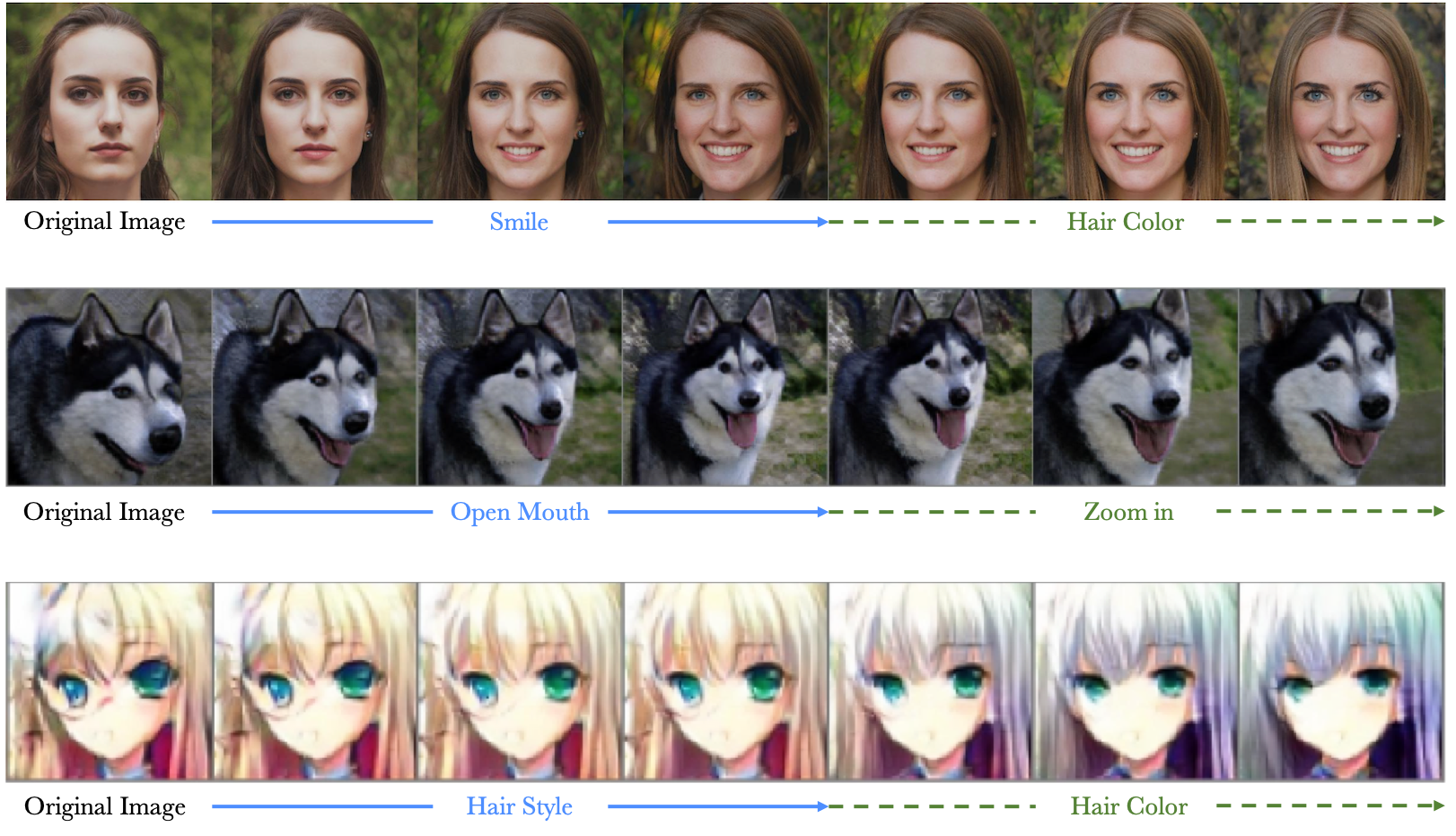
- The paper introduces an unsupervised framework to discover interpretable latent directions in GANs, enabling controlled image attribute manipulation.
- It leverages a deformator and a reconstructor with a novel centroid loss to ensure consistent and semantically meaningful transformations.
- The method demonstrates improved RCA and PPL metrics across datasets such as Anime Faces, ILSVRC, and FFHQ, enhancing latent space disentanglement.
Unsupervised Discovery of Disentangled Manifolds in GANs
Introduction
The paper "Unsupervised Discovery of Disentangled Manifolds in GANs" (2011.11842) addresses the challenge of interpretable manipulation in Generative Adversarial Networks (GANs). The interpretability of latent spaces in GANs is critical for various applications in image editing, where controlled manipulation of attributes is desired. Current GAN models often lack this interpretable structure, necessitating methods to disentangle and identify latent attributes without supervision.
Methodology
The authors propose a framework to discover interpretable directions in the latent space of GANs in an unsupervised manner. The core methodology includes a novel approach toward discovering these directions by leveraging a pre-trained generator alongside a deformator and a reconstructor network.
Experimentation
The paper validates the proposed framework across multiple datasets: Anime Faces, ILSVRC-ImageNet, and Flickr-Faces-HQ. The evaluation metrics include Reconstructor Classification Accuracy (RCA) and Perceptual Path Length (PPL), providing detailed insights into the model's performance.
- RCA and PPL Metrics: RCA measures the accuracy of direction prediction in image transformations, while PPL assesses the smoothness of transitions in generated images.
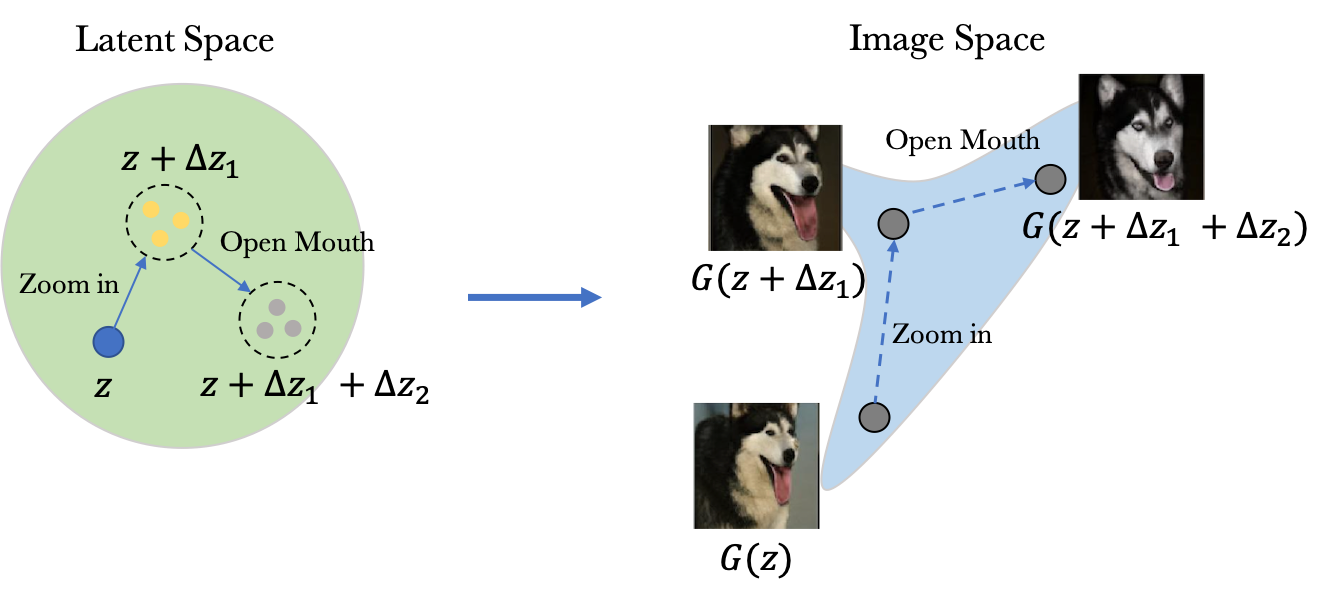
Figure 2: Concept Illustration. The method aims to discover interpretable directions in latent space in an unsupervised manner, transforming images along semantic attributes.
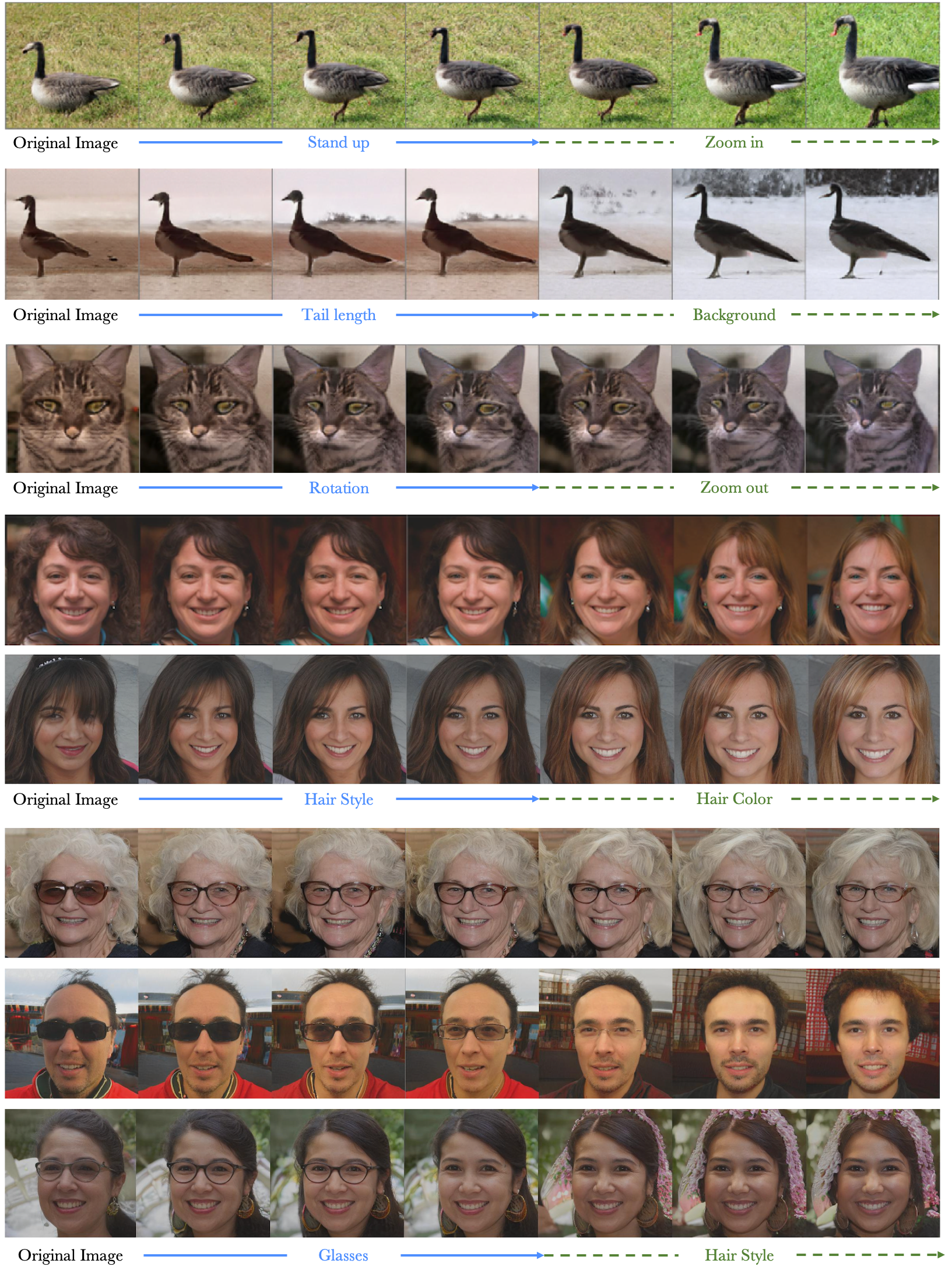
- Visual Results: The authors showcase transformations using Spectral Norm GAN, BigGAN, and StyleGAN2, revealing the system's capability to change attributes such as hair color, expression, and object motion.
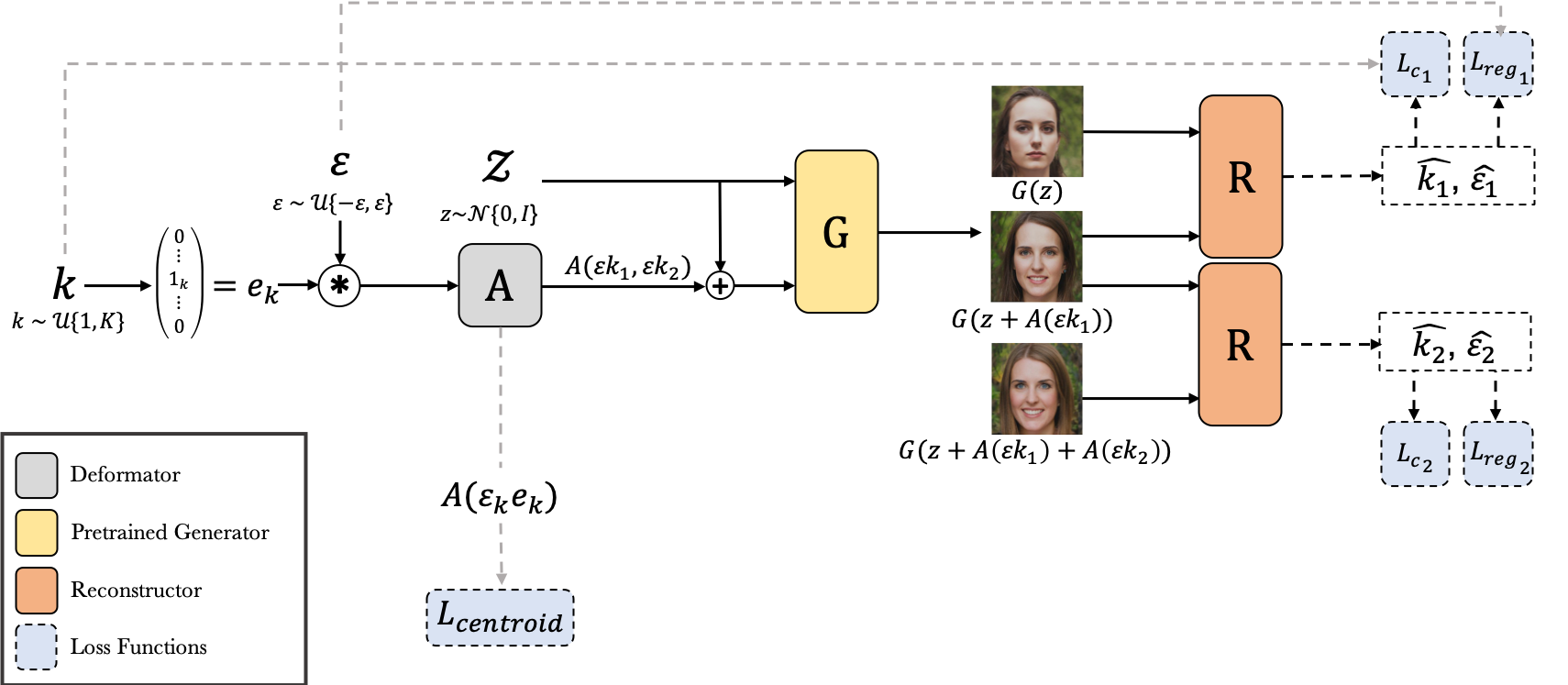
Figure 3: The proposed framework. The framework includes a pre-trained generator, deformator, and reconstructor. It illustrates the interactions among elements for discovering and applying latent space directions.
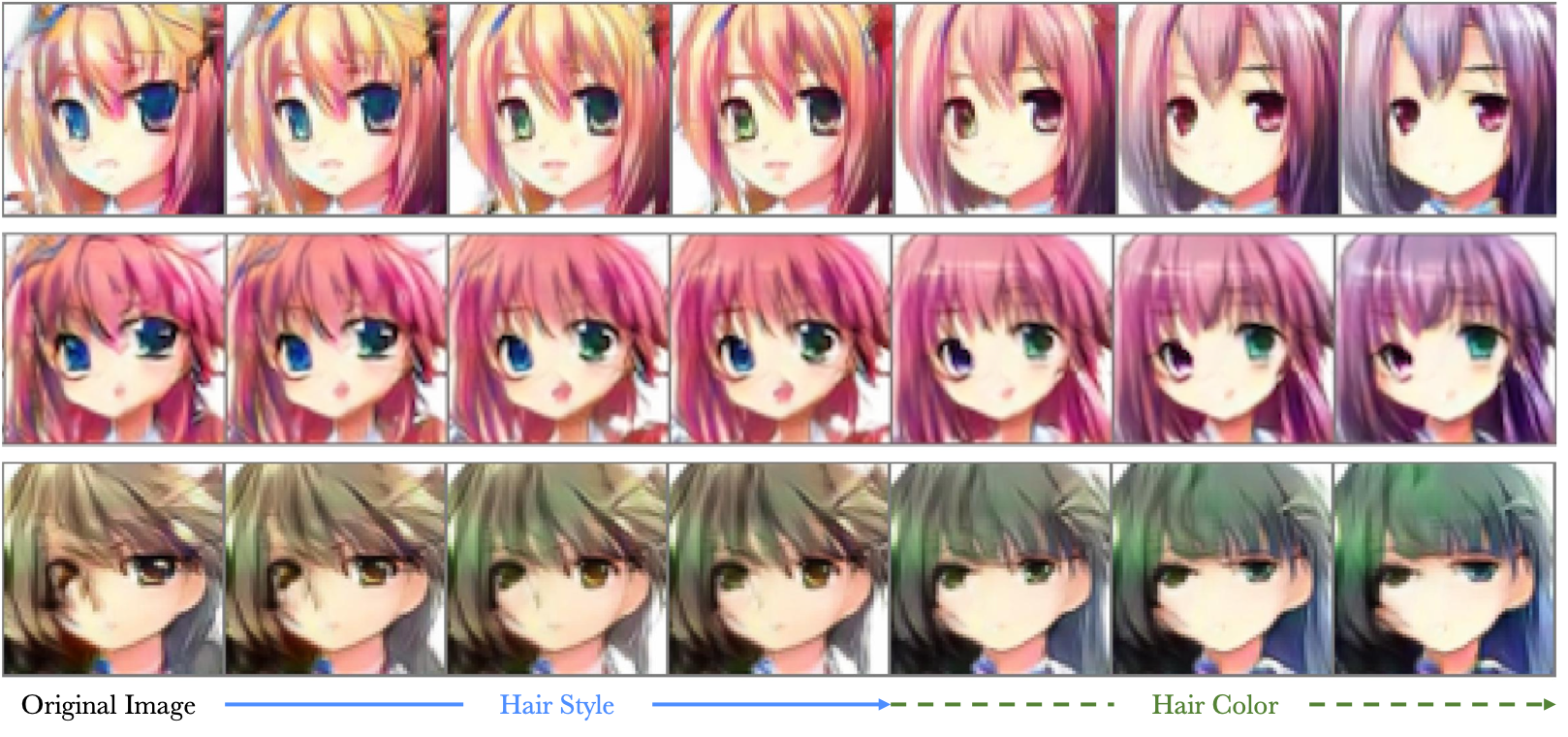
Figure 4: Sampled results. Examples of interpretable directions for Spectral Norm GAN on the Anime Faces dataset. Rows show the transformation of images along attribute directions.
Quantitative Analysis
The comparative experiments exhibit improvements over baseline methods, particularly in maintaining discriminability and smooth transitions. The innovative centroid loss significantly enhances the perceptual quality and diversity within generated image sequences.
Conclusion
The proposed framework presents a significant advancement in the discovery of interpretable latent directions in GANs. By introducing unsupervised disentanglement strategies and incorporating centroid loss, the paper offers a robust solution for generating images with diverse semantic attributes. Future work could expand on these findings by exploring further latent space strategies and integrating with other generative models to enhance versatility and interpretability in image synthesis applications.