Papers
Topics
Authors
Recent
2000 character limit reached

Invariant Risk Minimization (1907.02893v3)

Published 5 Jul 2019 in stat.ML, cs.AI, and cs.LG

Abstract: We introduce Invariant Risk Minimization (IRM), a learning paradigm to estimate invariant correlations across multiple training distributions. To achieve this goal, IRM learns a data representation such that the optimal classifier, on top of that data representation, matches for all training distributions. Through theory and experiments, we show how the invariances learned by IRM relate to the causal structures governing the data and enable out-of-distribution generalization.
Citations (1,999)

Summary

  • The paper introduces IRM as a principled approach for achieving robust out-of-distribution generalization by learning invariant predictors across multiple environments.
  • The authors formalize IRM via a constrained optimization framework, replacing hard constraints with a penalty-based method to balance predictive accuracy and invariance.
  • Empirical results, including Colored MNIST experiments, demonstrate that IRM outperforms standard ERM, highlighting its potential in causal inference and fair AI.

Invariant Risk Minimization: A Comprehensive Overview

The paper "Invariant Risk Minimization" (1907.02893) addresses the challenge of spurious correlations in machine learning models, which often hinder their ability to generalize effectively across different test environments. This paper introduces the concept of Invariant Risk Minimization (IRM) as a principled approach to reinforce models with the capacity for robust out-of-distribution (OOD) generalization.

Introduction to the Problem

Machine learning models frequently suffer from adopting spurious correlations due to inherent biases and confounding factors within the training data. Such biases lead to failures when models encounter novel testing conditions. A common illustrative example involves training a model to classify images of cows and camels, where cows predominantly appear in green pastures and camels in deserts. A model might exploit the landscape as a chief feature for classification, failing when faced with images outside this context, such as cows on sandy beaches.

The crux of IRM is developing models that discern stable correlations across diverse environments, which ideally correspond to causal relationships rather than coincidental statistical ones.

Contributions of Invariant Risk Minimization

The major contribution of this work is the formalization of IRM, a novel learning strategy aimed at OOD generalization by leveraging invariant predictors across multiple training environments. The central principle of IRM is:

To learn invariances across environments, find a data representation such that the optimal classifier on top of that representation matches for all environments.

This concept aligns seamlessly with causal inference, emphasizing the importance of invariance as a link to causation, facilitating generalization.

Methodology and Theoretical Underpinnings

The authors introduce IRM through a mathematical framework where datasets are collected under multiple environments, each representing potentially different conditions such as geographical location, time, etc. The learning objective entails minimizing the maximum risk across environments, aiming for a predictor Yf(X)Y \approx f(X) that performs consistently well across a broader set of unseen environments.

To concretely implement IRM, the paper derives a constrained optimization problem that balances predictive power across environments and invariance. The authors propose IRMv1, a practical instantiation of IRM, replacing hard constraints with a penalty-based approach, where the optimization involves a differentiable objective that encourages invariant behavior.

Simulation and Empirical Results

The empirical evaluations include a range of experiments designed to highlight the efficacy of IRM in discerning true causal structures over spurious correlations.

Synthetic Experiments

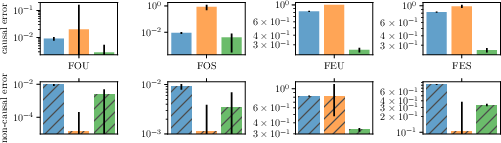
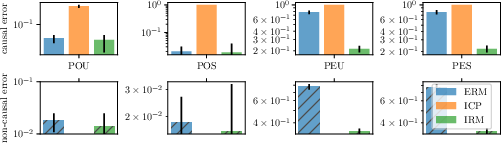
The synthetic experiments simulate scenarios where IRM outperforms standard Empirical Risk Minimization (ERM) by identifying and favoring stable causal predictors. The results demonstrate that IRM provides superior performance in recovering causal relationships compared to both ERM and previous invariant causal prediction methods. Figure 1

Figure 1

Figure 1: Average errors on causal (plain bars) and non-causal (striped bars) weights for our synthetic experiments. The y-axes are in log-scale. See main text for details.

Colored MNIST

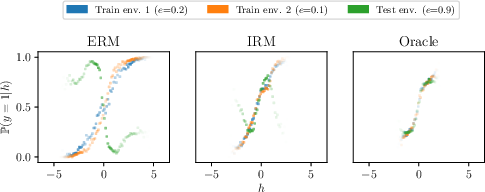
The Colored MNIST task presents a synthetic classification problem where the label is spuriously correlated with image color. IRM effectively discards the color bias, resulting in a model that better generalizes to a test environment where color correlations are inverted. This showcases IRM's potential in learning invariances that align with causally relevant features. Figure 2

Figure 2: P(y=1h)P(y=1|h) as a function of hh for different models trained on Colored MNIST. IRM learns approximate invariance from data alone and generalizes well to the test environment.

Implications and Future Directions

The application of IRM extends beyond supervised learning to implications in reinforcement learning, fairness, and causation as invariance. The proposed method aligns with broader views in causality research, where invariances suggest robust causal mechanisms, emboldening faithful prediction across varied environments. Further exploration is anticipated to improve IRM's flexibility in handling nonlinear invariances and to find minimal sufficient conditions for successful generalization from limited environments.

Conclusion

Invariant Risk Minimization marks significant progress towards a principled approach for achieving OOD generalization in machine learning models. By integrating causation through invariance, models fostered with IRM offer a promising avenue for future AI systems capable of performing consistently across diverse real-world scenarios.

Slide Deck Streamline Icon: https://streamlinehq.com

Whiteboard

Ai Generate Text Spark Streamline Icon: https://streamlinehq.com

Knowledge Gaps

Knowledge gaps, limitations, and open questions

The paper introduces Invariant Risk Minimization (IRM) and provides initial theory and simulations. The following gaps and open questions remain unresolved and point to concrete directions for future research:

  • How to construct or discover environments from raw datasets when explicit environment labels are unavailable, without inadvertently destroying the invariances of interest or introducing spurious correlations.
  • Practical criteria and procedures for ensuring “diversity” of environments; e.g., data-driven tests or diagnostics to assess whether training environments satisfy a usable analog of “linear general position” in finite samples.
  • Finite-sample generalization guarantees for IRM: sample complexity bounds, variance analyses, and concentration results for the empirical invariance penalty and risk terms.
  • Nonlinear generalization theory: a precise “nonlinear general position” assumption or alternative conditions under which IRM with nonlinear representations provably transfers invariance from training to unseen environments.
  • Formal characterization of when two (or few) environments suffice, beyond linear models—i.e., necessary and sufficient conditions relating environment diversity, hypothesis class, and the form of invariance.
  • Robustness to imperfect or approximate invariance: quantify how small violations of invariance affect out-of-distribution (OOD) error, and derive stability bounds for IRM under model misspecification.
  • Identification conditions for causal parents via IRM without a known causal graph, especially with high-dimensional perceptual inputs; clarify when IRM recovers causal predictors versus merely invariant but non-causal correlates.
  • Extension of the invariance penalty to nonlinear classifiers w (beyond linear last-layer), including design of differentiable penalties D(w, Φ, e) for richer hypothesis classes and analysis of their benefits and pitfalls.
  • Failure modes of IRMv1’s fixed scalar classifier w = 1.0: enumerate non-invariant predictors that can yield near-zero penalties (e.g., trivial or saturated representations) and devise mechanisms to detect and prevent them.
  • Optimization challenges: the IRM objective is nonconvex with multiple connected components; investigate initialization strategies, regularization schemes, and optimization algorithms with convergence guarantees.
  • Sensitivity to the trade-off hyperparameter λ: systematic methods to tune λ without access to target/OOD environments (e.g., proxy criteria, bilevel selection, or PAC-Bayes-inspired controls).
  • Handling multi-class and multivariate outputs more naturally than scaling by a scalar w = 1.0; design and analyze penalties tailored to softmax classifiers and structured outputs.
  • Requirements on support overlap: IRM’s invariance notion relies on equality of conditional expectations on the intersection of supports; develop techniques for partial or non-overlapping supports and quantify the impact on OOD generalization.
  • Interaction with noise heteroskedasticity and interventions on Y: broaden validity conditions beyond finite variance ranges and propose principled environment baselines r_e integrated with IRM (not only robust baselines).
  • Empirical scalability: large-scale, real-world evaluations beyond synthetic setups—benchmark breadth, ablations (e.g., number/diversity of environments, architecture, optimizer), and comparisons to strong modern OOD baselines.
  • Guidance for environment design in practice (e.g., feature-based splits, time/space contexts, controlled interventions) to reliably expose spurious vs. stable correlations for IRM to exploit.
  • Combining IRM with complementary strategies (e.g., causal data augmentation, counterfactual generation, domain adversarial methods) and understanding when such hybrids help or hurt invariance and OOD performance.
  • Verifiable conditions for the “scrambled setup” (latent Z mixed into observed X via S): specify identifiable classes of S (beyond partial invertibility on Z1) and derive algorithms that can learn such demixing robustly.
  • Extension of Proposition 1 (robust learning equivalence to weighted ERM) to non-differentiable losses or constrained models; clarify whether robust formulations outside KKT assumptions might capture invariance differently.
  • Diagnostics to detect when IRM is counterproductive (e.g., no true invariances exist or environments are ill-posed), and adaptive strategies to revert to ERM or alternate OOD methods accordingly.
Dice Question Streamline Icon: https://streamlinehq.com

Open Problems

We haven't generated a list of open problems mentioned in this paper yet.

List To Do Tasks Checklist Streamline Icon: https://streamlinehq.com

Collections

Sign up for free to add this paper to one or more collections.

X Twitter Logo Streamline Icon: https://streamlinehq.com

Tweets

Sign up for free to view the 1 tweet with 2 likes about this paper.

Youtube Logo Streamline Icon: https://streamlinehq.com