Harmonic Analysis on Directed Networks: A Biorthogonal Laplacian Framework for Non-Normal Graphs
Published 15 Dec 2025 in math.RA | (2512.13513v1)
Abstract: Classical spectral graph theory relies on the symmetry of the adjacency and Laplacian operators, which guarantees orthogonal eigenbases and energy-preserving Fourier transforms. However, real-world networks are intrinsically directed and asymmetric, resulting in non-normal operators where standard orthogonality assumptions fail. In this paper, we develop a rigorous harmonic analysis framework for directed graphs centered on the \emph{Combinatorial Directed Laplacian} ($L = D_{out} - A$). We construct a \emph{Biorthogonal Graph Fourier Transform} (BGFT) using dual left and right eigenbases, and introduce a directed variational semi-norm based on the operator norm $|Lx|_2$ rather than the quadratic form. We derive exact Parseval-type bounds that quantify the energy distortion induced by the non-normality of the graph, explicitly linking signal reconstruction stability to the condition number of the eigenvector matrix, $κ(V)$. Finally, we present experimental validation comparing normal directed cycles against non-normal perturbed topologies, demonstrating that while the BGFT provides exact reconstruction in ideal regimes, the geometric departure from normality acts as the fundamental limit on filter stability in directed networks.
The paper develops a novel biorthogonal Laplacian framework that defines a graph Fourier transform using left and right eigenvector pairs for directed networks.
It establishes two-sided Parseval-like bounds that order frequencies and relate signal smoothness to the eigenvector condition number.
The work extends sampling theory to bandlimited signals in non-normal graphs, revealing critical insights into filter stability and reconstruction under noise.
Harmonic Analysis on Directed Networks via a Biorthogonal Laplacian Framework
Introduction and Context
This paper develops a rigorous spectral framework for directed graphs, addressing the significant theoretical limitations of classical spectral graph theory when applied to asymmetric, non-normal operators. Rather than relying on the symmetry and normality that guarantee orthogonal eigendecomposition in undirected graphs, the proposed approach centers on the combinatorial directed Laplacian, L=Dout−A, and systematically constructs a Biorthogonal Graph Fourier Transform (BGFT). The analysis provides new foundations for graph signal processing (GSP) on directed networks, directly quantifying how geometric asymmetry and non-normality of the underlying topology induce instability and distort harmonic analysis.
Biorthogonal Spectral Framework for Directed Laplacians
Standard GSP techniques for undirected graphs depend on the Laplacian's self-adjointness, which ensures the existence of a real spectrum and orthogonal eigenbasis. For directed graphs, L is generically non-normal, so neither orthogonality nor real spectrum is guaranteed. The paper assumes L is diagonalizable (defective sets are of measure zero) and defines the BGFT via left and right eigenvector pairs. The BGFT is constructed as follows:
The transform projects the signal onto left eigenvectors, yielding biorthogonal spectral coefficients.
Synthesis reconstructs the signal by linearly combining right eigenvectors weighted by the transform coefficients.
The framework isolates the DC component (the constant signal) in the null space of L, ensuring that consensus and denoising applications have an exact notion of zero frequency, independent of degree regularity.
Directed Variation, Smoothness, and Frequency Interpretation
The paper explicitly distinguishes between asymmetry (complex spectrum) and non-normality (eigenvector non-orthogonality and ill-conditioning). Variation or smoothness is defined as the semi-norm ∥Lx∥2. The key theoretical development is the derivation of two-sided Parseval-like bounds:
where V is the matrix of right eigenvectors. This result provides a frequency ordering for the directed Laplacian by the modulus of λk. The bounds reveal that metric distortion is controlled by the condition number κ(V), with perfect identity only when L is normal.
Sampling, Bandlimiting, and Reconstruction Theory
The paper extends sampling theory to the biorthogonal setting, where the synthesis basis is generally non-orthogonal. Bandlimited signals are defined as lying in the span of right eigenvectors associated with the K lowest-frequency eigenvalues. Exact and stable recovery from vertex samples requires that the sampling matrix PMVΩ has full rank and is well-conditioned. The main recovery bound under noise is:
∥x−x∥2≤∥VΩ∥2γ(M,Ω)∥η∥2
where γ(M,Ω) is the minimum singular value of the sampling matrix and ∥VΩ∥2 encodes the eigenvector geometry. This analysis separates the influences of sampling set choice and the underlying non-normality.
Quantifying and Visualizing Non-Normality Effects
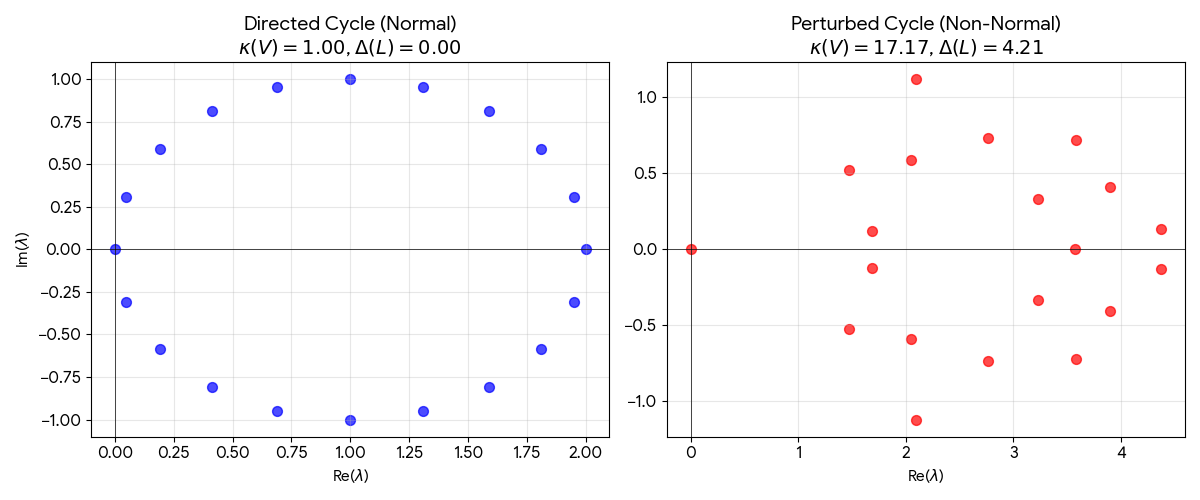
A core contribution is the analytic and empirical separation of asymmetry from non-normality. The Henrici departure-from-normality index, Δ(L), is used to measure the geometric deviation from normality. The condition number κ(V) quantifies the potential for noise amplification in spectral filtering and reconstruction.
The experimental results highlight the spectral and numerical consequences of non-normality. Figure 1 demonstrates the distinction between a normal directed cycle and a perturbed, non-normal cycle:
Figure 1: The spectrum of the normal directed cycle (left) is perfectly symmetric and exhibits zero departure from normality, while random perturbations induce spectral spread, a large condition number, and pronounced non-normal effects (right).
A sharp increase in κ(V) observable in the perturbed topology directly correlates with instability in spectral analysis.
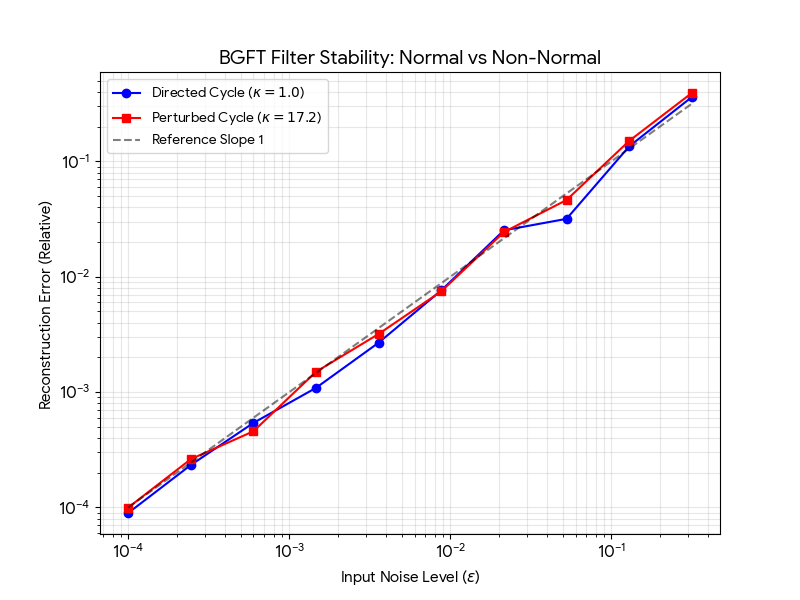
The filter stability experiment in Figure 2 shows how the reconstruction error, under additive noise, is tightly controlled by κ(V):
Figure 2: Reconstruction error for the Laplacian BGFT scales linearly with input noise for normal graphs, but is amplified according to κ(V) for non-normal graphs, confirming theoretical predictions for noise sensitivity.
This demonstrates that even mathematically exact transforms can be numerically unstable if structural non-normality is significant.
Theoretical and Practical Implications
The presented framework yields several important implications:
The BGFT achieves exact harmonic analysis for directed graphs, without requiring symmetrization or discarding directionality.
The derived variants of Parseval's identity and frequency ordering enable meaningful definitions of smoothness, energy, and filter design in the non-Hermitian setting.
Filter stability and denoising in highly non-normal graphs is fundamentally limited, with error amplification scaling with κ(V), sometimes exponentially.
Sampling theorems generalize classical results to the biorthogonal case, with stability depending on both the geometry of sampled nodes and eigenvector conditioning.
Non-normality, not mere asymmetry, is identified as the root cause of instability, rendering purely spectral approaches potentially ill-posed in many real directed networks.
Future Directions
The framework motivates several research directions:
Design of robust GSP algorithms: Filter and sampling method development must incorporate explicit conditioning regularization and sensitivity analysis for non-normal graphs.
Learning and network inference: Applications to graph-based machine learning or inference on asymmetric systems must confront non-normal-induced instabilities.
Random and real-world network analysis: Quantifying κ(V) and Δ(L) could guide the detectability, denoising, or pattern extraction in citation, transport, and neural networks.
Extension to non-diagonalizable cases: Treatment of defective graphs and generalization beyond the diagonalizable regime remains open.
Graph design for stability: Methods for graph augmentation or editing to restore normality or at least control κ(V) may prove crucial for practical signal processing networks.
Conclusion
By articulating a biorthogonal spectral analysis on the combinatorial directed Laplacian, this work systematically advances harmonic analysis and GSP for asymmetric and non-normal graphs. The analytical results and experiments precisely link geometric structure to spectral and numerical stability, equipping practitioners with the necessary tools to diagnose, predict, and control the effects of non-normality inherent in real directed networks.
“Emergent Mind helps me see which AI papers have caught fire online.”
Philip
Creator, AI Explained on YouTube
Sign up for free to explore the frontiers of research
Discover trending papers, chat with arXiv, and track the latest research shaping the future of science and technology.Discover trending papers, chat with arXiv, and more.