- The paper introduces a recursive autoencoding framework that progressively refines reconstructions to suppress anomalies.
- It integrates a Detail Preservation Network that restores high-frequency textures in normal regions to reduce false positives.
- Cross Recursion Detection leverages multi-step reconstruction dynamics to localize defects robustly, achieving state-of-the-art accuracy with low latency.
RcAE: Recursive Reconstruction Framework for Unsupervised Industrial Anomaly Detection
Introduction and Motivation
Unsupervised anomaly detection in industrial contexts is essential where defect data are scarce and diverse annotation is infeasible. Canonical autoencoder-based (AE) approaches, while intuitive, suffer from incomplete anomaly suppression, detail loss induced by single-pass decoding, overfitting to narrow normalcy manifolds, and suboptimal robustness with respect to anomaly scale and intensity. Recent augmentation-involved methods such as GANs, diffusion, and transformers improve expressiveness but impose substantial training and inference costs, contradicting industrial deployment constraints. The RcAE framework addresses these trade-offs, combining high detection fidelity with computational parsimony by recursively refining reconstructions and structurally analyzing reconstruction dynamics.
Recursive Convolutional Autoencoder (RcAE): Architecture and Advantages
The RcAE introduces a recursive mechanism whereby a shared-parameter autoencoder cyclically encodes and decodes the input, emulating deep hierarchical abstraction while keeping model size compact. Each recursion pass performs further anomaly suppression and enhances normalization, mitigating the expressiveness-induced tendency of classical AEs to inadvertently reconstruct anomalies. The recursion is operationalized by interleaving spatial downsampling/upsampling between passes, thus encoding multi-scale semantics while enabling progressive intensity and structural corrections.
The training process randomizes recursion depth per batch, increasing generalization across anomaly magnitude and mitigating shortcut learning. The loss combines pixelwise intensity and edge gradient supervision at each recursion terminal output.
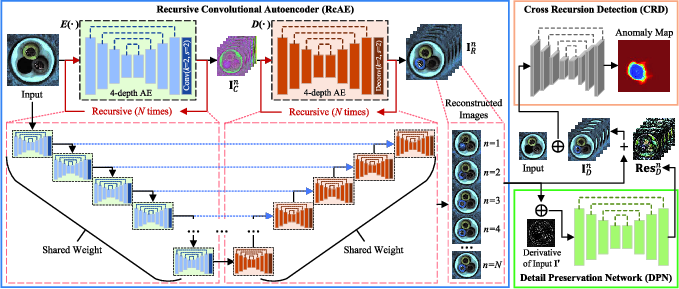
Figure 1: Overview of RcAE: iterative suppression and normalization in RcAE, selective texture recovery in DPN, and cross-step anomaly exposure via CRD.
Detail Preservation Network (DPN): Texture Restoration without Anomaly Regression
Recursive suppression inherently causes texture erosion in normal image regions, propagating false positives. The DPN, a lightweight autoencoder with selective skip connections, reintroduces high-frequency textures using concatenated recursive outputs and first-order image gradients. Critically, RcAE parameters are frozen during DPN training—ensuring the DPN learns only residual mappings related to recursive detail degradation on normal data. Anomalies elicit out-of-distribution residuals, which DPN fails to restore; thus, the original suppression remains, while normal region fidelity improves. Edge and intensity consilience is enforced via a dual-term ℓ1 reconstruction loss.
Cross Recursion Detection (CRD): Leveraging Recursion Dynamics for Robust Localization
The recursion process inherently generates spatial-temporal anomaly signatures: normal regions stabilize rapidly, while anomalies induce persistent, step-wise inconsistencies. CRD, a 3D ConvAE, discriminates these cross-step residual dynamics using sequence-wise input of detail-refined reconstructions and the original image. Training uses synthetic pseudo-anomaly masks generated via augmentations, optimizing for spatial and edge consistency. Unlike methods relying on a static residual map, CRD operationalizes anomaly localization as a temporal stability estimation problem, robust against artifact and noise confounds.
Numerical Validation
The RcAE pipeline achieves 98.9% I-AUROC and 98.7% P-AUROC on MVTec AD and 99.2%/98.6% on VisA, outperforming non-diffusion SOTA (e.g., RD4AD, DRAEM) and rivaling best published diffusion/diffusion+DINO approaches—while maintaining 10× fewer parameters and considerably superior inference latency.
Ablations reveal that:
- Recursive structure alone (RcAE w/o DPN or CRD) accounts for >10% accuracy gain over plain ConvAEs.
- Skip connections and weight sharing are essential; removing either induces catastrophic performance drops.
- DPN yields significant improvements in texture- and detail-dependent categories, as quantified by SSIM and PSNR.
- CRD benefits nontrivially from access to multiple recursion step outputs; performance saturates at N=5.
- With only 10% of the training data, RcAE surpasses full-data baselines—demonstrating data efficiency critical for real-world industrial scenarios.
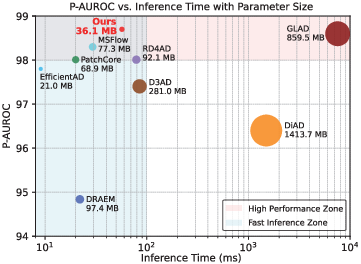
Figure 2: Computation-accuracy trade-off: RcAE achieves diffusion-level accuracy with markedly better speed and size characteristics.
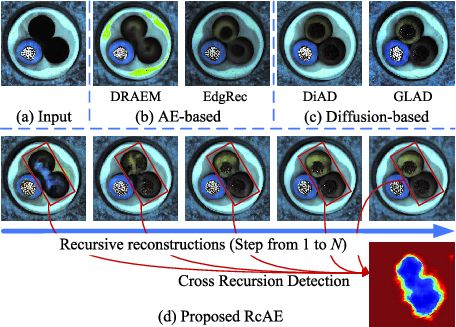
Figure 3: Multi-stage anomaly suppression and fidelity restoration: RcAE progressively normalizes, DPN resurrects texture, cross-recursion exposes persistent anomalies.
Theoretical and Practical Implications
The recursive paradigm disrupts the conventional size–fidelity trade-off by explicitly enforcing multi-scale, stepwise correction using parameter sharing and data-efficient self-supervision. Robustness to both subtle micro-defects and significant structural anomalies is achieved by harnessing dynamic instability as a localization signal rather than relying solely on static reconstruction error. The architecture is amenable to further enhancements, such as integrating lightweight semantic priors or attention modules for logical anomalies beyond appearance-based heterogeneity.
Practically, the model is deployable on resource-constrained hardware without requiring ImageNet-scale pretraining, and can be readily extended to video and multimodal industrial vision. The modular design facilitates adaptation to other unsupervised outlier detection tasks where high recall, low latency, and annotation efficiency are paramount.
Conclusion
RcAE demonstrates that parameter-efficient, recursive autoencoding frameworks with dynamics-aware detection modules can deliver SOTA performance in industrial anomaly detection scenarios, with key advantages in speed, model size, and robustness. Its design principles—recursive refinement, selective fidelity restoration, and temporal anomaly tracking—set the basis for deployment-ready, unsupervised defect detection pipelines. Future directions include integration of semantic anomaly reasoning and application to high-level, context-dependent anomaly domains.