- The paper introduces a context-sensitive AI-enhanced TOE model demonstrating significant positive effects on environmental (β = 0.487, p < 0.001) and manufacturing performance (β = 0.759, p < 0.001) among SMEs.
- Methodologically, the study employs PLS-SEM on data from 600 SMEs with rigorous construct validations (Cronbach's α > 0.7, AVE > 0.5) to ensure robust findings.
- It develops the ISEM-AIME phased framework with diagnostic tools (IDI, AEC, DYP) to balance industrial efficiency and environmental sustainability in fragile and transforming economies.
Introduction and Theoretical Foundations
The paper "AI-Enhanced TOE Framework for Sustainable Industrial Performance in Fragile and Transforming Economies: Evidence from Yemen and Saudi Arabia" (2512.10333) systematically extends the Technology-Organization-Environment (TOE) model by explicitly embedding AI as a transformative capability. The study critically investigates the differentiated roles of AI in shaping environmental and manufacturing performance among SMEs in Yemen (characterized by acute institutional fragility) and Saudi Arabia (undergoing rapid modernization via Vision 2030). It advances the theoretical foundation of AI adoption in developing economies by introducing the concept of "institutional leapfrogging" and by operationalizing diagnostic indicators for resilient digital transformation, thereby filling significant gaps in the digital transformation literature that previously centered on stable contexts.
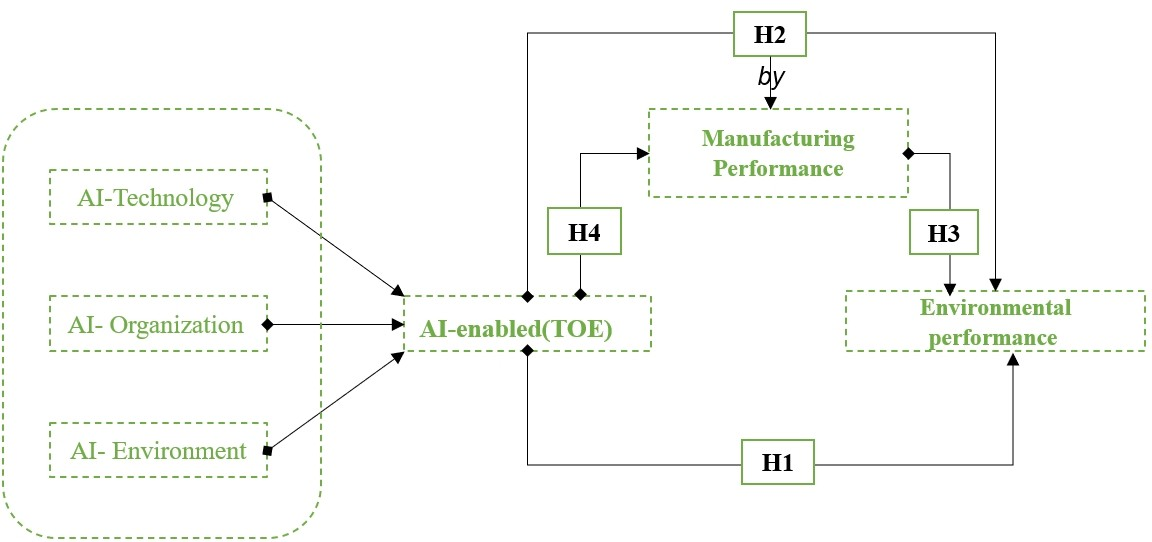
Figure 1: Research model representing the AI-TOE framework and hypothesized direct/indirect effects.
The authors reconceptualize the TOE model to accommodate the idiosyncratic dynamics of fragile economies. They frame AI both as a "survival-oriented" innovation (critical for institutional adaptation in Yemen) and as a driver for institutional agility and policy responsiveness (as observed in the Saudi case). This nuanced, context-sensitive approach not only highlights the contingency of AI-induced performance gains but also demonstrates that the strategic value of AI is strongly mediated by organizational and infrastructural readiness.
Methodological Rigor
The empirical analysis is grounded in field-based data collected from 600 SMEs (with 294 managers providing analyzable responses) in both Yemen and Saudi Arabia. The research design leverages partial least squares structural equation modeling (PLS-SEM) to rigorously test the path coefficients and structural relationships among TOE-AI dimensions, manufacturing efficiency, and environmental performance.
Respondents were sampled across urban and rural geographies, capturing cross-sectional differences in technological adoption and infrastructural maturity. The authors ensured robust construct validity through extensive literature-based scale adaptation, iterative expert review, and meticulous translation/back-translation procedures. The validity of the measurement and the discriminant reliability of the constructs were confirmed using established psychometric thresholds (e.g., Cronbach's α and AVE exceeding 0.7 and 0.5, respectively), and potential common method bias and multicollinearity were statistically excluded.
Key Findings and Numerical Outcomes
The findings provide statistically robust evidence supporting the centrality of AI in advancing both manufacturing and environmental outcomes. For the aggregated sample, the direct effect of AI-TOE on environmental performance was strong (β=0.487, p<0.001), as was the effect on manufacturing performance (β=0.759, p<0.001). Notably, the mediating role of manufacturing performance as a conduit between AI-TOE deployment and green outcomes was emphasized (indirect effect β=0.210, p<0.001). The differentiated context-specific results were particularly noteworthy:
- Yemen (fragile scenario): The AI-TOE effect on environmental performance (β=0.463) was substantially mediated by manufacturing improvements. Organizational flexibility and adoption of cost-effective AI solutions proved critical, suggesting that adaptive resilience is more valuable than pure technological sophistication.
- Saudi Arabia (transforming scenario): The direct AI-TOE impact on environmental outcomes was even stronger (β=0.780), but the manufacturing-to-environmental performance path was negative (β=−0.413). These results illustrate the Environmental Kuznets Curve pattern, where initial AI-driven industrial upgrades temporarily elevate environmental burdens, with longer-term green benefits materializing only after subsequent process optimization.
Statistically, the model explained a significant portion of variance in both outcomes: R2=54.4% (environmental) and R2=63.6% (manufacturing) for the full sample, with even greater explanatory power in Yemen for environmental outcomes (R2=64.9%).
In addition to its empirical contributions, the paper introduces the ISEM-AIME staged implementation framework for AI adoption:
- Phase 1 (ISEM – Controlled Inefficiency): Organizations operate at 70–80% efficiency to test and refine the system's institutional ductility, as measured by the Institutional Ductility Index (IDI). Threshold IDI ≥0.6 signals readiness for scale-up.
- Phase 2 (AIME – Calibrated Hardening): The adoption process transitions to efficiency optimization, where the AI Elasticity Coefficient (AEC ≥1.2) is used to ensure that manufacturing gains are not achieved at the expense of environmental sustainability.
Continuous monitoring via the Digital Yield Point (DYP) warning system ensures that any trade-off tipping toward environmental degradation is immediately addressed.
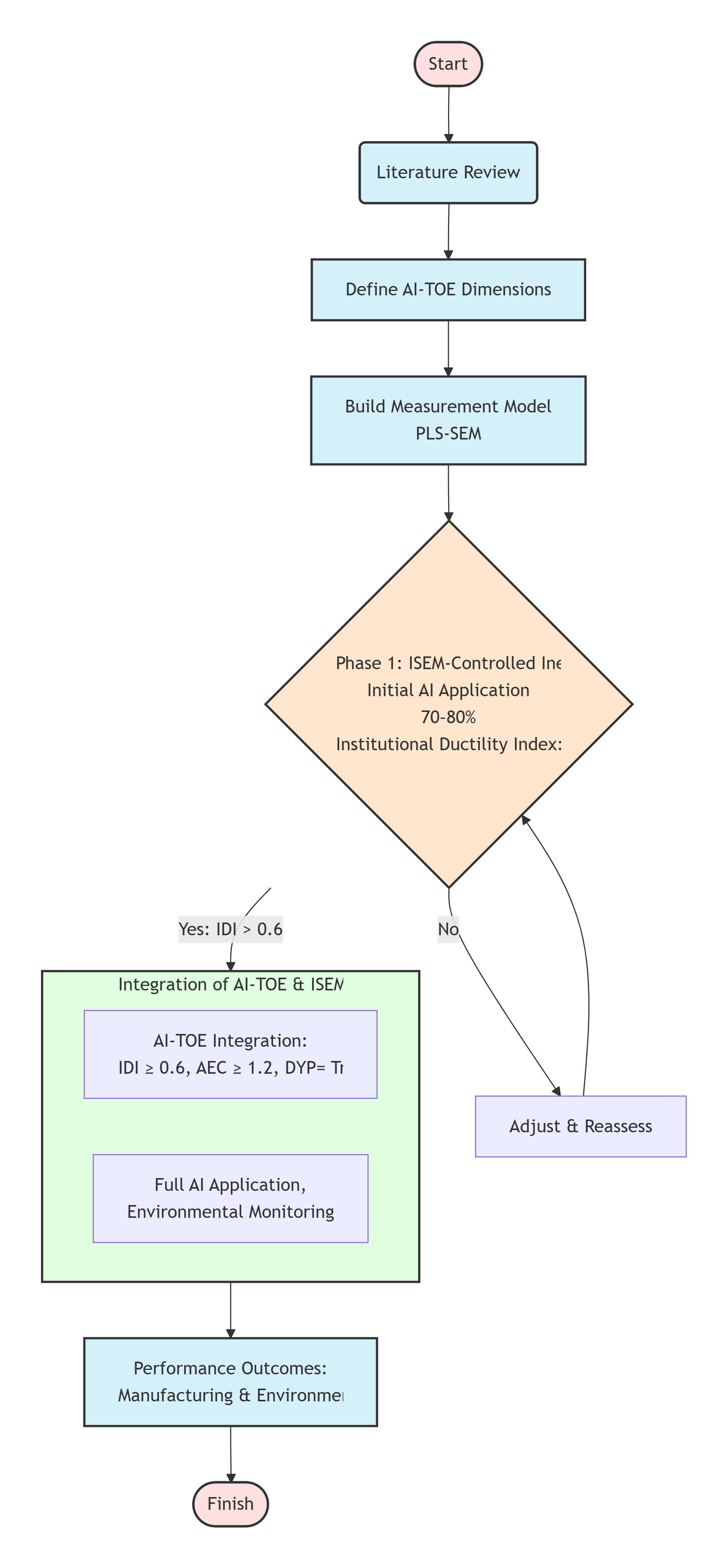
Figure 2: Generalized architecture for AI-TOE integration, including staged implementation and diagnostic feedback loops.
These quantitative diagnostics—IDI, AEC, and DYP—offer an operationalizable toolkit for dynamic equilibrium management between industrial efficiency and sustainable development in resource-constrained and unstable environments.
Practical and Theoretical Implications
The paper's framework has direct implications for engineering management and industrial policy. The staged model supports gradual, resilience-oriented AI adoption, customized for both low-infrastructure (fragile) and rapid-growth (transforming) environments. Policymakers and managers can leverage these indicators to prioritize interventions, calibrate AI investments, and ensure that environmental externalities are monitored and mitigated in real time. The multi-phase adoption design provides a blueprint for digital transformation strategies in post-conflict, climate-stressed, and institutionally volatile settings.
Theoretically, this research positions the AI-TOE as a generalizable platform for analyzing digital innovation trade-offs beyond the conventional stable-company paradigm and encourages further cross-contextual studies. The inclusion of the "leapfrogging" concept also reorients future methodology toward understanding how under-resourced contexts can bypass traditional industrial evolutionary paths through intelligent technology adoption.
Future Directions
The authors identify the need for longitudinal validation of the ISEM-AIME metrics across broader regional contexts, such as Sub-Saharan Africa and Southeast Asia, and call for further refinement of context-dependent diagnostic thresholds. They advocate for adaptive, scenario-specific policy frameworks to accompany technological interventions, explicitly recognizing the heterogeneity of digital maturation trajectories in the Global South.
Conclusion
This paper presents a rigorous, context-sensitive expansion of the TOE model, with AI as the fulcrum for sustainable performance in fragile and emerging economies. It delivers actionable constructs (IDI, AEC, DYP), clear quantitative evidence, and a phased implementation methodology that is adaptable to varying levels of institutional readiness. The insights establish a foundation for both immediate practical application by industrial managers and further theoretical development in sustainable digital transformation research.

