- The paper proposes a variational QISAC protocol that merges superdense coding with quantum metrology and neural post-processing for concurrent communication and sensing.
- It employs a hybrid optimization strategy alternating between tuning quantum circuit parameters and training classical neural decoders to optimize the sensing-communication trade-off.
- Numerical results demonstrate a flexible Pareto frontier where reducing communication rate improves sensing accuracy, highlighting practical resource allocation in quantum networks.
Variational Protocols for Quantum Integrated Sensing and Communication
Introduction and Motivation
The integration of sensing and communication (ISAC) is a critical direction for next-generation wireless networks, offering shared spectrum and resource efficiency. Extending ISAC to quantum systems, commonly referred to as quantum integrated sensing and communication (QISAC), promises significant improvements in both reliable information transmission and parameter estimation by leveraging quantum entanglement. This paper, "Variational Quantum Integrated Sensing and Communication" (2511.16597), proposes a novel protocol in which superdense coding and quantum metrology are merged, utilizing variational quantum circuits augmented by classical deep learning post-processing. The approach is specifically tailored to the capabilities of near-term quantum devices and explores the fundamental sensing-communication trade-off through adaptive, end-to-end optimization.
QISAC Protocol and System Model
The protocol employs a tripartite scenario: Charlie prepares a maximally entangled state of two d-dimensional qudits, distributing one to Alice (transmitter) and the other to Bob (receiver). Alice applies a unitary encoding of B bits using generalized Pauli operators as in superdense coding, and her qudit is sent through a channel parameterized by an unknown discrete variable x. Bob receives both qudits and applies a two-stage measurement process: a fixed sequence of gates for decoding, followed by a variational quantum circuit parameterized by μ. Upon measurement, classical outcomes are processed by neural network decoders to reconstruct both the transmitted message and an estimate of the parameter x.
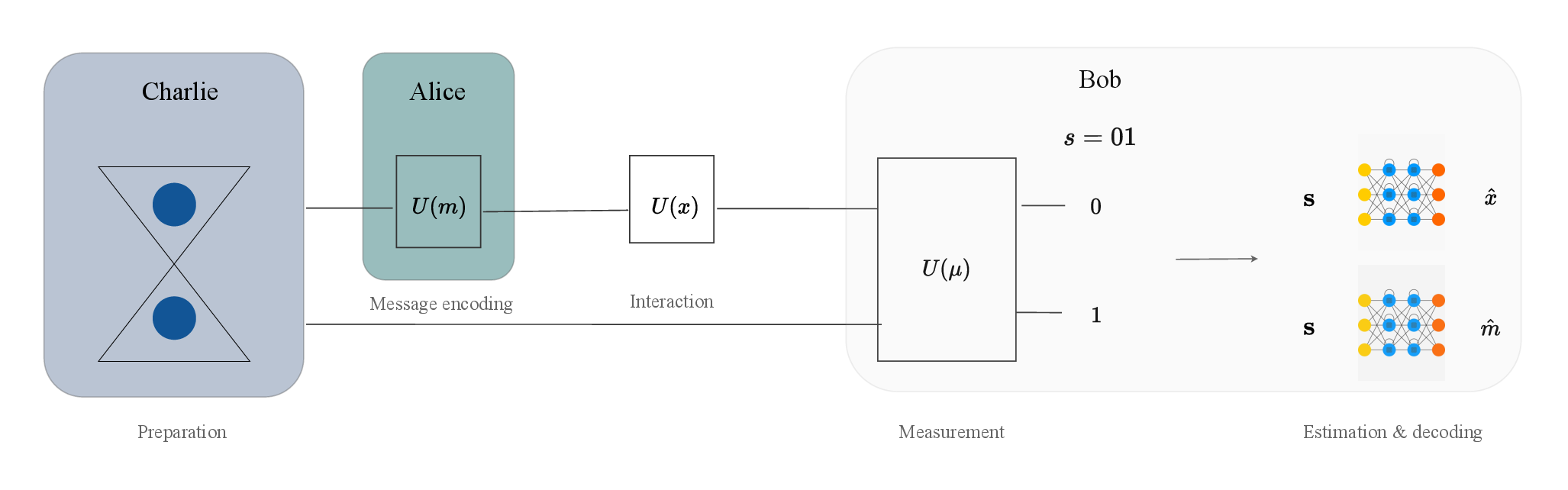
Figure 1: Diagram of the QISAC protocol showing entangled probe preparation, message encoding, parameter-dependent channel action, variational decoding, and classical post-processing for simultaneous communication and sensing.
Distinctly, Alice can back off the communication rate by reducing the encoding subspace (d′<d), trading off bits for improved sensing capability. Bob’s variational circuit flexibly adapts the measurement basis to best support joint decoding and parameter estimation for the current regime.
Hybrid Variational Optimization and Neural Post-Processing
This protocol’s hybrid optimization strategy alternates between:
- Classical Decoder/Estimator Training: Neural networks are trained to maximize the likelihood of accurate message and parameter recovery from quantum measurement outcomes. Cross-entropy loss is used for both tasks, with outputs representing probability distributions over respective hypotheses.
- Quantum Circuit Tuning: The variational circuit parameters μ are updated using gradient ascent (parameter-shift rule), optimizing a weighted sum of communication reliability and sensing accuracy.
The training loop iterates between updating classical neural network weights and quantum circuit parameters, yielding an end-to-end learned receiver tailored to the statistical environment and task requirements.
Numerical Results: Sensing-Communication Trade-Off
The core numerical experiment evaluates the throughput-accuracy Pareto frontier for d=8 and d=10, quantifying how increasing the communication rate back-off ΔB (reducing transmitted bits per use) progressively enhances parameter estimation accuracy at the expense of throughput. The system is tested with a simple, yet representative, parameter-dependent quantum channel (phase rotation), for discrete K=4 parameter values.
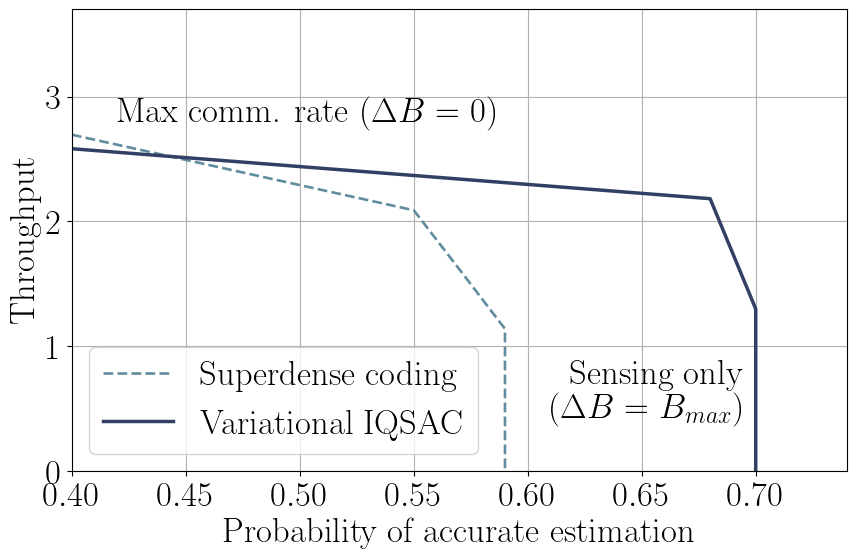
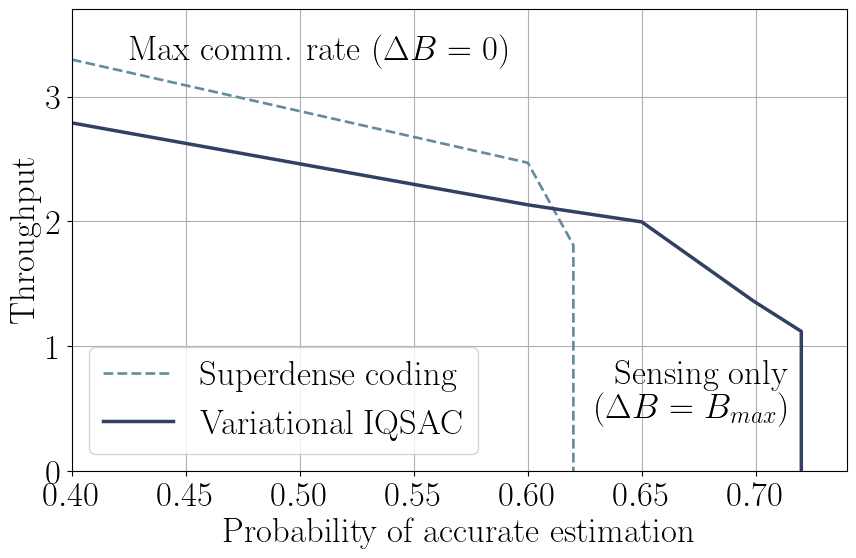
Figure 2: Trade-off curves of communication throughput (bits per channel use) versus sensing estimation accuracy for d=8 and d=10; throughput decreases and accuracy increases as communication rate back-off parameter ΔB increases.
Key findings:
- Joint Operation: Simultaneous non-zero communication rate and high sensing accuracy is achievable, demonstrating the practical feasibility of integrated operation on limited-dimensional qudit systems.
- Superiority of Variational Measurement: Variationally optimized measurements yield significantly higher sensing accuracy Pacc compared to static, non-optimized (superdense-coding) measurements, especially at intermediate back-off rates.
- Flexible Trade-Off: The protocol supports tunable weights wsucc,wacc in the objective, enabling operation anywhere along the sensing-communication Pareto boundary.
Theoretical and Practical Implications
The proposed framework advances QISAC on two fronts:
- Practical Quantum Machine Learning for QISAC: By employing feed-forward neural decoders and end-to-end variational optimization, the protocol effectively adapts to realistic, noisy hardware and multi-task learning, avoiding reliance on idealized analytic measurement designs.
- Fundamental Resource Trade-Off: The analysis and empirical results clarify how entanglement and encoding dimensionality can be flexibly allocated—through ΔB—to balance disparate objectives, suggesting a resource allocation paradigm for integrated quantum networks.
The methods are extensible: richer parameterized circuits, continuous or multiparameter estimation, and noise-robustification (e.g., via conformal inference [NikoloskaConformal2025]) are immediate next directions.
Conclusion
This work formulates and demonstrates a variational QISAC protocol that leverages entangled probe states, hybrid variational optimization, and classical neural decoding for simultaneous quantum communication and sensing. The numerical results establish flexible control over the rate-accuracy trade-off and show distinct advantages from optimizing the measurement process variationally rather than relying on classical superdense coding configurations. The findings motivate further research in quantum machine learning-based QISAC systems, including extensions to more general settings and robustness-enhanced learning strategies.