Abstract: In quantum information geometry, the curvature of von-Neumann entropy and relative entropy induce a natural metric on the space of mixed quantum states. Here we use this information metric to construct a random matrix ensemble for states and investigate its key statistical properties such the eigenvalue density and probability distribution of entropy. We present an algorithm for generating these entropy-based random density matrices by sampling a class of bipartite pure states, thus providing a new recipe for random state generation that differs from the well established Hilbert-Schmidt and Bures-Hall ensemble approaches. We find that a distinguishing feature of the ensemble is its larger purity and increased volume towards the boundary of full-rank states. The entropy-based ensemble can thus be used as a uninformative prior for Bayesian quantum state tomography in high purity regimes, and as a tool for quantifying typical entanglement in finite depth quantum circuits.
The paper presents a new BKM-based method for generating random quantum states with lower average von Neumann entropy than traditional ensembles.
It derives the asymptotic eigenvalue distribution and demonstrates the exponential decay of the minimum eigenvalue, leading to enhanced state purity.
The provided algorithm and analysis offer practical insights for Bayesian quantum state tomography and entanglement quantification in quantum circuits.
Entropy-based Random Quantum States: Construction, Properties, and Implications
Introduction
This paper introduces a novel ensemble of random quantum states constructed via the information geometry induced by the curvature of the von Neumann entropy, specifically the Bogoliubov-Kubo-Mori (BKM) metric. The work situates itself within the context of random matrix theory and quantum information, providing a new method for generating random density matrices that diverges from the established Hilbert-Schmidt (HS) and Bures-Hall (BH) approaches. The BKM ensemble is shown to possess distinctive statistical properties, including higher purity and increased measure near the boundary of full-rank states, with direct implications for Bayesian quantum state tomography and entanglement quantification in quantum circuits.
Metric-Induced Ensembles and the BKM Construction
Traditional random quantum state ensembles, such as HS and BH, are generated by partial tracing Haar-random pure states or by specific superpositions involving Haar unitaries. These ensembles are deeply tied to the geometry of quantum state space, with the HS and BH measures corresponding to particular metrics. The BKM metric, derived from the negative Hessian of the von Neumann entropy, provides an alternative geometric structure:
ds2=−d2S(ρ)=ν,μ∑[rν−rμlnrν−lnrμ]∣dρνμ∣2
This metric induces a Riemannian volume form over the space of density matrices, leading to a probability measure:
where r are the eigenvalues of ρ and CN is a normalization constant.
Asymptotic Properties and Random Matrix Theory Connections
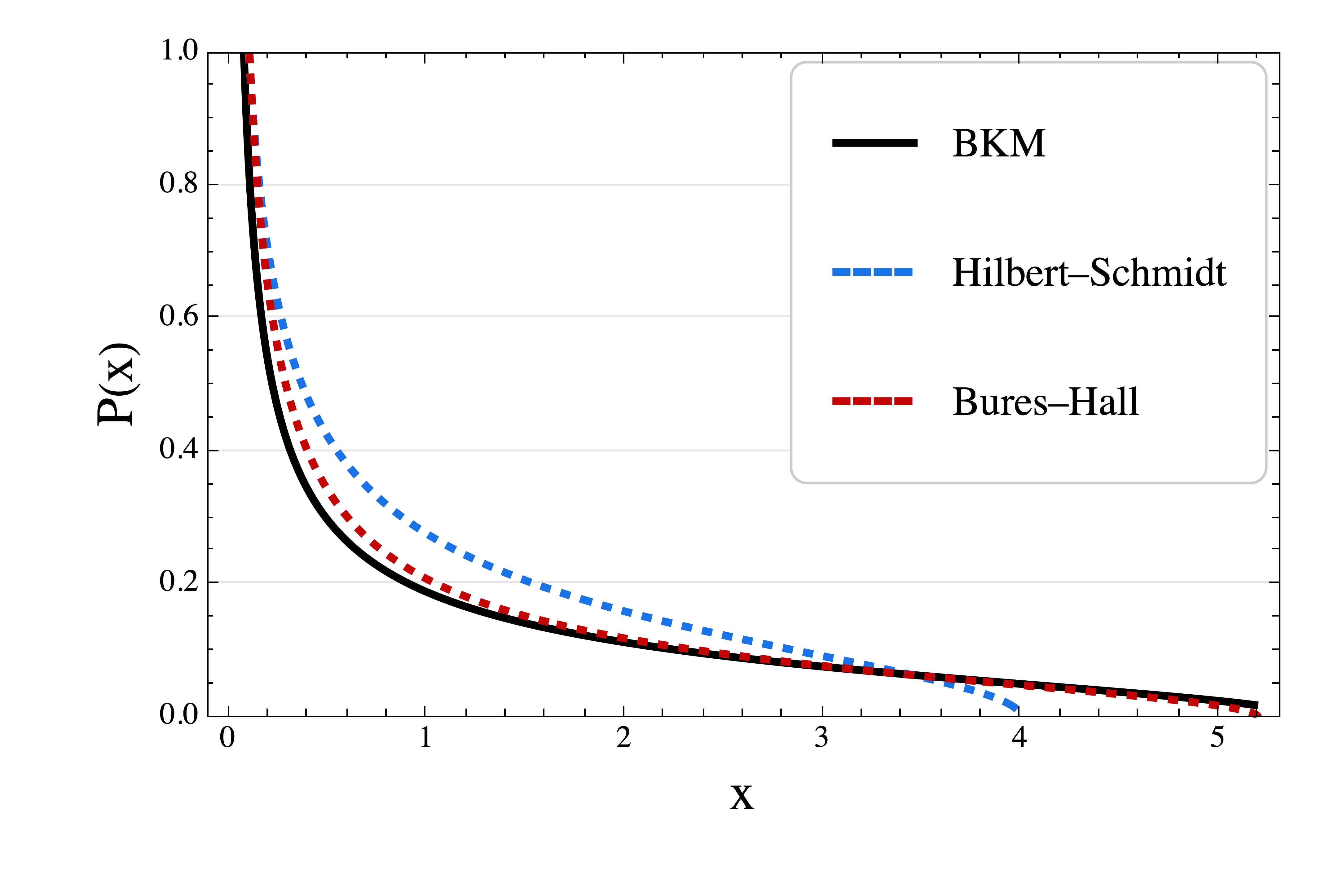
The BKM ensemble is closely related to the Muttalib-Borodin class of random matrix ensembles, particularly in the limit θ→0 and α=−1/2. This connection enables the derivation of asymptotic eigenvalue distributions and entropy statistics. The marginal eigenvalue density for large N is given by:
P(x)N→∞=−ℑ[πxW(−2x−1)1],x∈[0,2e]
where W(x) is the Lambert W-function.
Figure 1: Asymptotic marginal eigenvalue density for the BKM ensemble, compared to HS and BH ensembles.
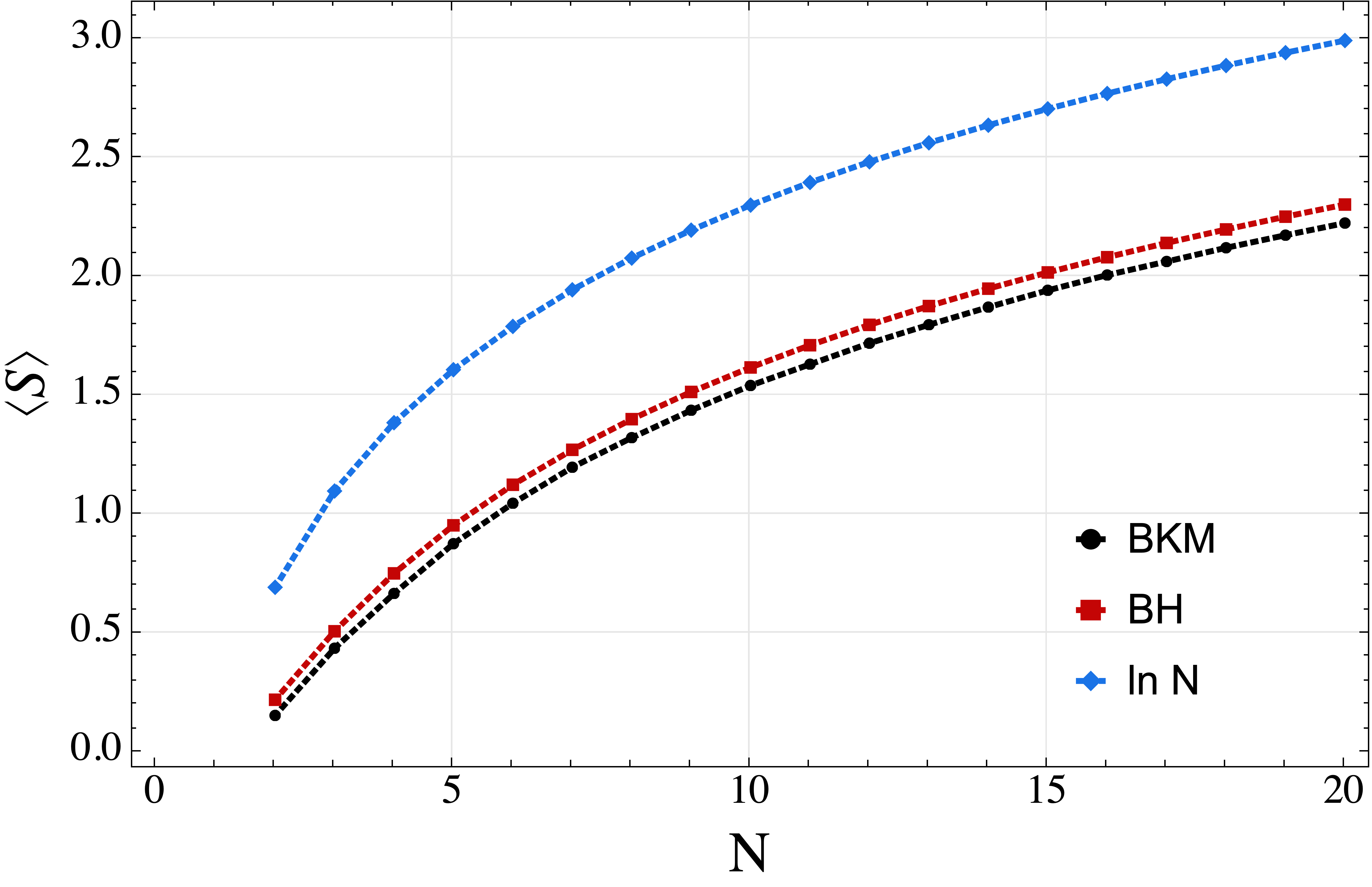
The average von Neumann entropy for the BKM ensemble in the large N limit is:
⟨S(ρ)⟩BKM≃lnN−γ−ln2+21+O(NlnN)
where γ is the Euler-Mascheroni constant. This is strictly less than the average entropy for BH and HS ensembles, indicating that BKM states are less mixed:
⟨S(ρ)⟩BKM<⟨S(ρ)⟩BH<⟨S(ρ)⟩HS
Additionally, the minimum eigenvalue in the BKM ensemble decays exponentially with system size, ⟨rmin⟩∼2e−N/N, in contrast to the polynomial decay in HS and BH ensembles.
Algorithm for Generating BKM Random States
The paper provides a concrete algorithm for sampling BKM random density matrices:
Sample a lower-triangular complex matrix X with off-diagonal elements as standard complex Gaussians and diagonal elements as χ1-distributed magnitudes with random phases.
Sample a Haar random unitary U∈U(N).
Construct the density matrix:
ρ=Tr(XX†)UXX†U†
This procedure is proven to yield density matrices distributed according to the BKM measure.
Numerical Results and Entropy Concentration
Numerical sampling confirms the theoretical predictions for average entropy and its concentration. The entropy distribution for large N is approximately Gaussian, with variance decreasing monotonically as N increases, indicating strong concentration of measure.
(Figure 2)
Figure 2: Probability density function of standardized von Neumann entropy for N=70 and 105 samples; inset shows entropy standard deviation versus N.
The BKM ensemble thus inherits the concentration properties of HS and BH ensembles but at lower mixedness.
Implications for Quantum Information and Tomography
The BKM ensemble's higher purity and effective rank deficiency make it a suitable uninformative prior for Bayesian quantum state tomography, especially in high-purity regimes. This addresses limitations of HS and BH priors in experiments involving low-rank states, such as entanglement distillation. The ensemble also provides a tool for quantifying typical entanglement in finite-depth quantum circuits, as the reduced density matrices from the BKM construction exhibit less entanglement than those from Haar-random pure states.
Future Directions
Several avenues for further research are identified:
Resource analysis for generating BKM states in quantum circuits, compared to existing random state generation methods.
Exploration of connections between the BKM ensemble and concepts in statistical mechanics, many-body chaos, and thermalization.
Extension to infinite-dimensional systems, such as Gaussian states, leveraging the information-geometric foundation of the BKM metric.
Conclusion
The entropy-based BKM ensemble constitutes a new class of random quantum states with distinct statistical and geometric properties. Its construction via the curvature of von Neumann entropy and connection to Muttalib-Borodin ensembles enriches the landscape of random matrix theory in quantum information. The practical utility of the BKM ensemble as an uninformative prior in Bayesian inference and its implications for entanglement quantification highlight its relevance for both theoretical and experimental quantum information science.