- The paper demonstrates a software-orchestrated system that automates quantum entanglement distribution across a campus-scale testbed.
- It employs a three-plane SDN-inspired architecture that synchronizes, calibrates, and compensates quantum devices to maintain high interference visibility.
- Experimental results show stable entanglement over 12 hours with robust performance metrics, including >90% interference visibility and high concurrence.
Experimental Demonstration of Software-Orchestrated Quantum Network Applications Over a Campus-Scale Testbed
The paper presents the design, implementation, and evaluation of an orchestrated control plane for a campus-scale quantum network, specifically the Argonne Quantum Network (ArQNet). This work emphasizes the integration of software-defined networking (SDN) principles to automate and optimize the operation of quantum communication experiments.
Introduction and Motivation
Quantum networks are pivotal for enabling ultra-secure communication, distributed quantum computation, and quantum-enhanced metrology. However, the transition from isolated quantum testbeds to scalable quantum networks necessitates an orchestration framework capable of managing the complex coordination among various quantum devices such as entangled-photon sources (EPS), polarization analyzers (PA), and Bell state analyzers (BSA). Unlike classical systems, maintaining coherence in quantum states and precise timing in the presence of thermal noise and other environmental factors is challenging. This paper addresses these issues by developing an orchestration system for a quantum network that automates entanglement distribution across a campus-scale network with service-level abstraction.
System Architecture
The ArQNet's architecture employs a three-plane model analogous to classical SDN designs:
- Infrastructure Plane: It includes all physical components such as quantum devices, optical fibers, and synchronization systems. This layer provides interfaces for device management and connectivity establishment.
- Control Plane: Hosts network functions managing synchronization, calibration, and scheduling through a centralized orchestrator. It effectively coordinates entanglement processes over the network.
- Service Plane: Composes end-user services such as continuous entanglement distribution between network nodes.
The ArQNet orchestrator facilitates high-level abstractions and automates operations, leveraging the separation of control and data paths for effective management.
Implementation
Experimental Testbed
The infrastructure comprises a centralized EPS at Site 1 that distributes entangled photons to remote nodes (Sites 2 and 3) over dark fiber links (Figure 1).
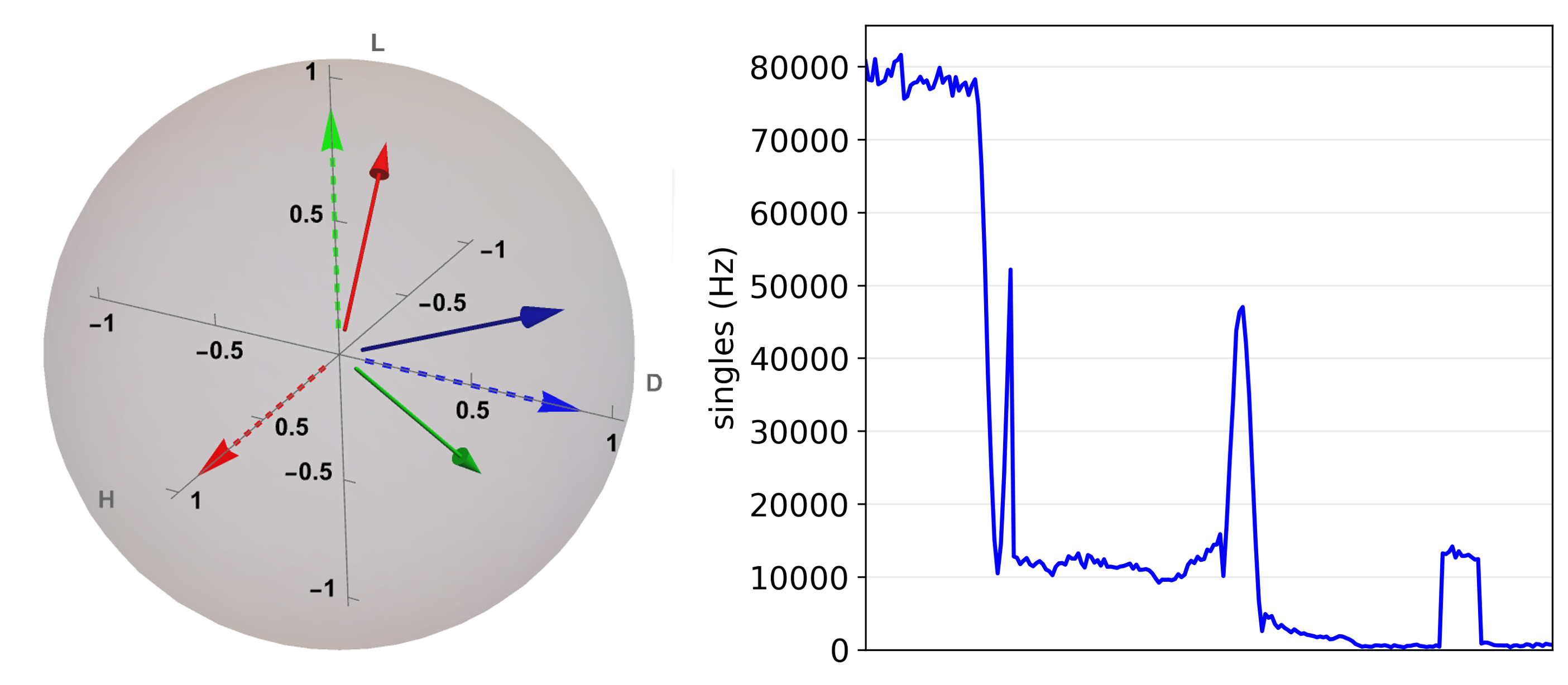
Figure 1: Left: Poincare Sphere representation of the misaligned measurement bases at the end of the fiber link (solid) and the ideal measurement bases (dashed) defined by the source's polarizing beam splitter. Right: Singles counts measured by the time tagger during the alignment procedure. A minimum is found near the dark count level of the detectors.
Control Plane Functions
- Synchronization: Achieved with radio-over-fiber distribution, maintaining sub-nanosecond jitter, facilitating phase-aligned time stamping critical for photon detection.
- EPS Calibration: Determines optimum pump attenuation to enhance the coincidence-to-accidental ratio, providing robust operation points.
- Polarization Drift Compensation: Automated waveplate adjustments minimize polarization drift, crucial for maintaining high interference visibility and entanglement fidelity.
Service Implementation
A prototype service for continuous entanglement distribution was demonstrated running over 12 hours with automated alignment corrections, maintaining interference visibility at network endpoints above a specified threshold. Results showed stable entanglement propagation, supporting the orchestrator's ability to autonomously manage quantum tasks.
Results and Discussion
Quantum state tomography (QST) results confirm high fidelity of distributed entangled states, with remote network nodes displaying concurrence levels indicative of robust entanglement. The symmetrically distributed EPS setup exhibited interference visibilities exceeding 90% in various configurations (Figure 2).
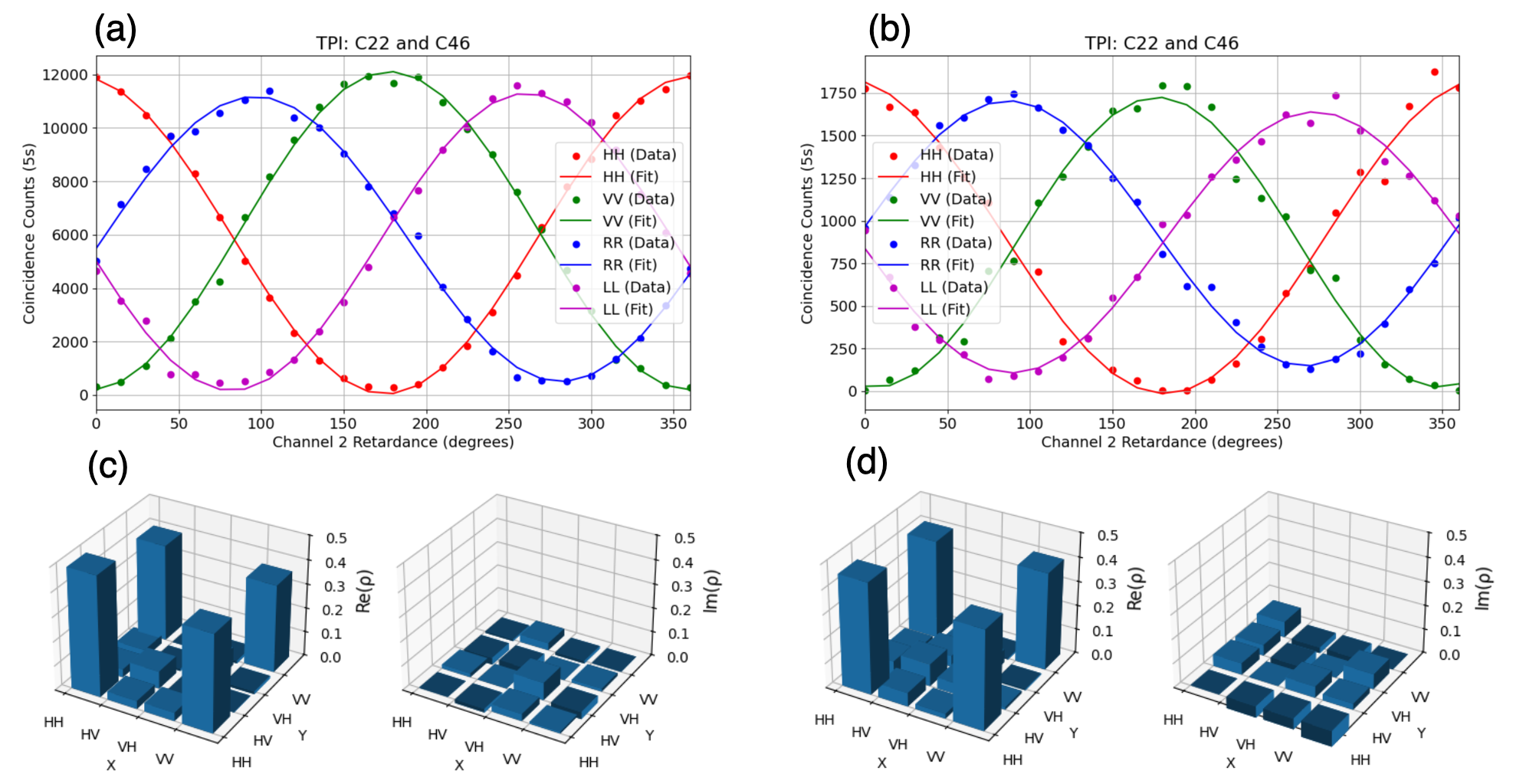
Figure 2: Two-photon interference and quantum state tomography under different network configurations, confirming robust entanglement distribution.
Conclusion
This research successfully demonstrates software-defined orchestration of quantum networks, transitioning from experimental quantum optics setups towards operational quantum networks capable of delivering networking services autonomously. The ArQNet orchestrator proves applicable for scalable, programmable quantum networks, paving the way for advancements in distributed quantum computing and quantum communication protocols. Future work focuses on expanding network capabilities and integrating more heterogeneous devices toward the vision of a quantum internet.

