- The paper introduces the Manager Agent paradigm, demonstrating its role in decomposing complex tasks and orchestrating dynamic human-AI collaborations.
- It applies a POSG framework to model workflow management, highlighting hierarchical task decomposition and multi-objective optimization in dynamic teams.
- Experimental evaluations via the Manager Agent Gym benchmark diverse workflows, illustrating improved coordination and compliance in human-AI team settings.
Orchestrating Human-AI Teams: The Manager Agent as a Unifying Research Challenge
Introduction
The paper "Orchestrating Human-AI Teams: The Manager Agent as a Unifying Research Challenge" (2510.02557) addresses the complexities of managing dynamic human-AI collaborations. As AI systems excel at discrete tasks, orchestrating more intricate workflows involving multiple agents remains challenging. The authors propose the concept of an Autonomous Manager Agent (MA) tasked with orchestrating the collaboration of human and AI workers, managing task decomposition, dynamic allocation, and monitoring progress within complex workflows.
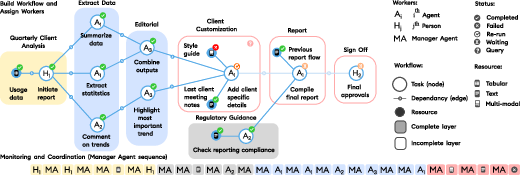
Figure 1: The Manager Agent (MA) as an orchestrator. Goal: ``Write an updated quarterly report for the client''. Based on this prompt, the MA is responsible for creating, modifying, and executing actions on a task graph, G, with a heterogeneous team of workers, W.
Conceptual Framework: The Manager Agent
The Manager Agent is designed as a central coordinating entity analogous to a human project manager, optimizing large-scale workflows. The environment consists of dynamic task graphs, where nodes are tasks and edges represent dependencies, managed by a team of heterogeneous workers. This paradigm emphasizes "human-on-the-loop" control, enhancing human productivity by leveraging AI for complex coordination tasks. The Manager Agent must possess capabilities akin to a human counterpart, including structuring workflows, assigning tasks, monitoring progress, adaptive planning, and stakeholder communication.
The workflow management problem is modeled as a Partially Observable Stochastic Game (POSG), capturing the interactions among agents with individual action sets, observations, and preferences. The POSG framework includes:
- Set of Agents (I): Consisting of the Manager Agent (M) and human or AI worker agents (W).
- State Space (S): Represents the complete snapshot of workflow, tasks, workers, communications, artifacts, and stakeholder preferences.
- Action Spaces (Ai): Each agent has distinct actions, where the Manager Agent's actions include increasing observability, modifying graph structures, and managing delegation and communication.
- Transition and Observation Dynamics (P): Defines state transitions based on joint actions or stochastic by worker performance.
- Reward Functions (Ri): Reflect individual agent preferences, including team-wide constraints and penalties for violating conditions.
Foundational Research Challenges
The pursuit of an autonomous Manager Agent involves addressing several core challenges across AI domains:
Hierarchical Task Decomposition
Efficiently mapping high-level goals into a structured task graph remains crucial. This involves enhancing structured latent planning with neuro-symbolic approaches and employing meta-adaptive techniques for decomposition.
Multi-Objective Optimization with Non-Stationary Preferences
A Manager Agent must balance competing objectives amid shifting stakeholder preferences. Contemporary methods like Multi-Objective Reinforcement Learning (MORL) and RLHF provide partial solutions, yet demand substantial extensions to handle dynamic environments and preferences.
Coordination in Ad Hoc Teams
Assembling and managing heterogeneous, dynamic teams of new and evolving agents poses significant coordination challenges. This requires rapid inference of teammate capabilities and proactive negotiation protocols for real-time collaboration.
Governance and Compliance by Design
Ensuring adherence to governance and evolving regulations is vital. This involves developing systems to interpret natural language constraints into actionable policies, enabling real-time governance without compromising productivity or compliance.
Manager Agent Gym: A Simulator for Human-AI Workflow Orchestration
The Manager Agent Gym provides a testbed for evaluating algorithms across hierarchical control, preference adaptation, ad-hoc teamwork, and governance compliance. It includes 20 diverse workflows to benchmark various performance metrics using LLM-based Manager Agents like GPT-5.
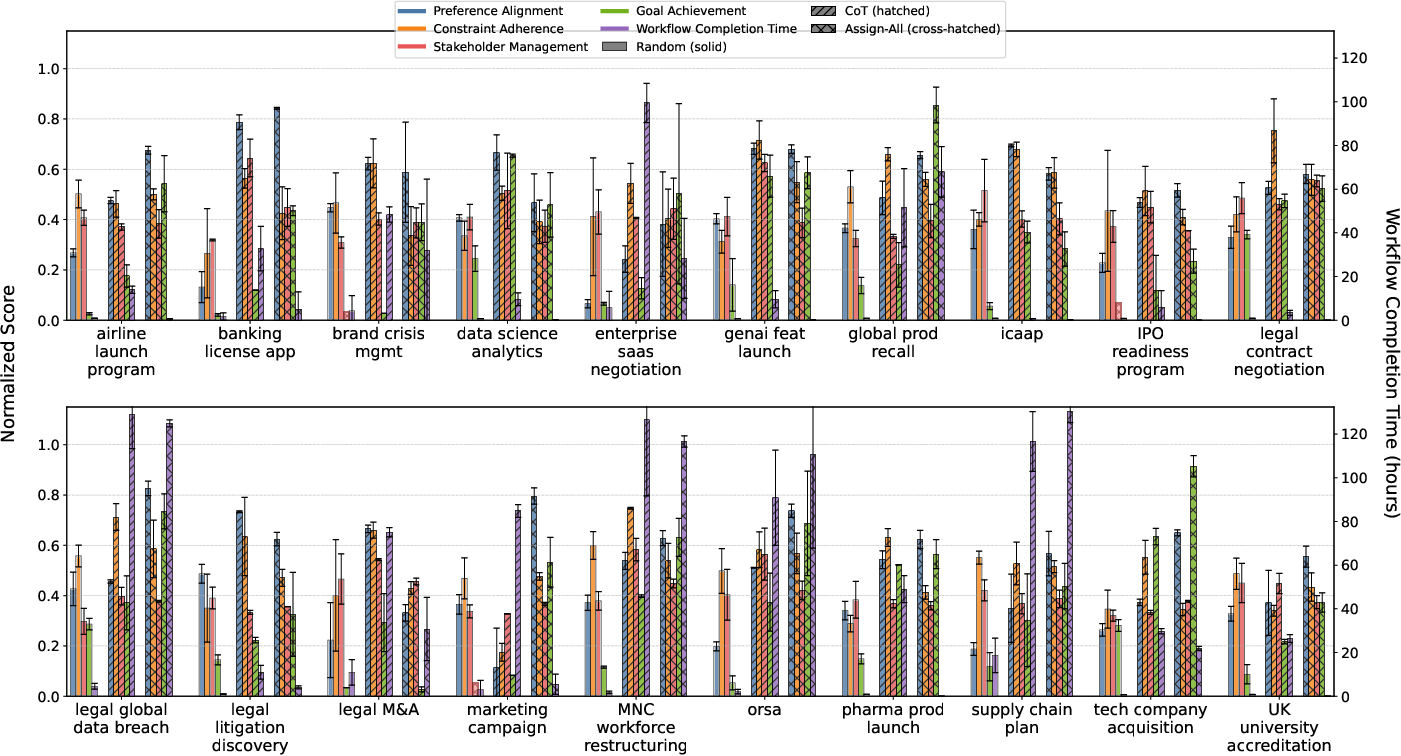
Figure 2: Random, Chain-of-Thought (CoT), and Assign-All policy performances plotted across 20 workflows.
Organizational and Ethical Considerations
Deploying Manager Agents in organizational contexts presents ethical and governance challenges, including fair resource allocation and privacy concerns. The Manager Agent should ensure accountability transparency and mitigate biases in automated task assignments by incorporating fairness criteria directly into its optimization processes.
Conclusion
The concept of a Manager Agent posits a unique research challenge, with implications for enhancing human-AI collaboration through sophisticated autonomous coordination mechanisms. Future efforts aim to expand the range of workflow scenarios and further refine algorithms to address open challenges in task orchestration.
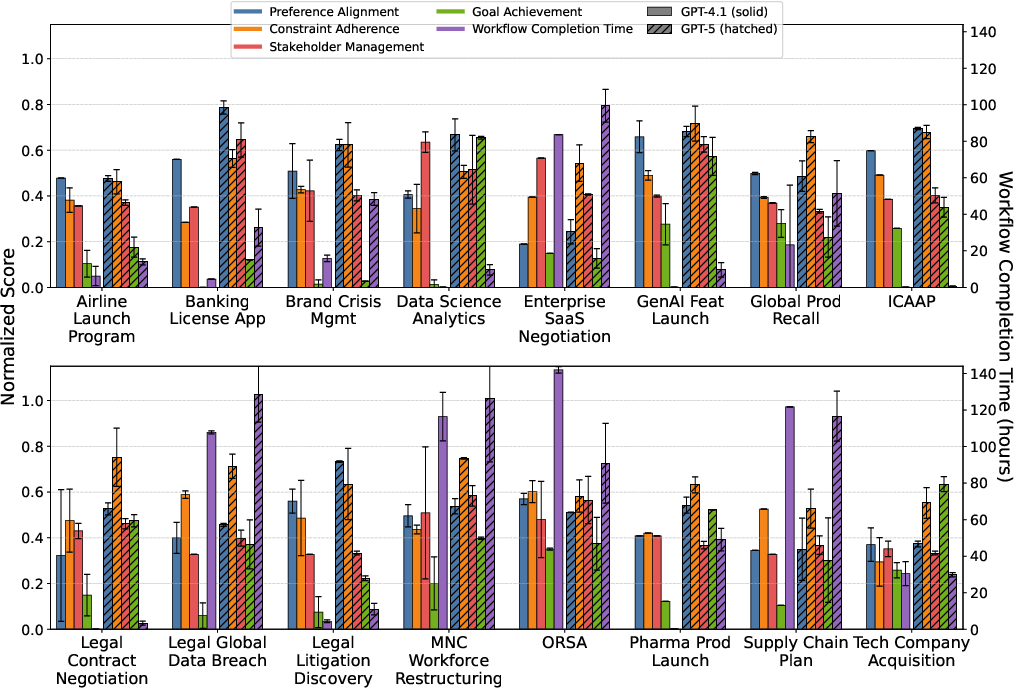
Figure 3: GPT-4.1 vs.\ GPT-5 on Manager Agent performance. GPT-5 achieves consistently higher goal achievement through improved reasoning, but absolute levels remain modest.