- The paper demonstrates that adding an inverse-square potential leads to high topological entropy via symbolic dynamics.
- It applies Maupertuis' functional minimization to construct non-collisional chaotic trajectories under positive-energy conditions.
- Key findings challenge traditional ergodicity by revealing quasi-ergodic behavior and subtle conserved quantities in perturbed systems.
Boltzmann's Billiard Systems and Chaotic Dynamics
Boltzmann's billiard systems provide a mathematical framework to study a particle subjected to a central potential with gravitational and inverse-square components. This paper investigates the dynamics when positive-energy conditions are met, particularly those leading to chaotic behavior, and addresses foundational aspects of the ergodic hypothesis, pivotal to understanding statistical mechanics.
Billiard Dynamics and Potential Structure
Boltzmann introduced a billiard model within R2, defined by a potential V(z)=−α/∣z∣−β/∣z∣2 and reflections against a straight wall. The Keplerian component α/r contributes gravitational influence, while β/r2, an inverse-square correction, modifies the dynamics significantly, particularly at high energies h>0. Central to these investigations is the notion that elastic reflections disrupt angular momentum conservation—originally proposed by Boltzmann—and enable the particle to uniformly explore all accessible phase space regions.
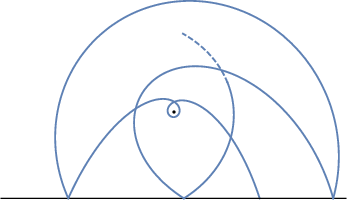
Figure 1: Boltzmann billiard with L=1, α=1, and β=0.3.
Chaotic Trajectories Via Symbolic Dynamics
The paper examines chaotic behavior by employing symbolic dynamics, encoding particle motion around the center via sequences of integers. This discrete framework models chaos in continuous systems effectively. For small β>0, the paper establishes high topological entropy due to symbolic dynamics in conjunction with variational methods to construct chaotic trajectories.
The innovative approach uses Maupertuis' functional minimization, critical in finding non-collisional trajectories satisfying fixed-end conditions. The principle asserts that trajectories correspond to critical points of this functional, highlighting areas where variational methods yield insights into chaotic systems.
Theoretical Implications in Dynamics
Felder and others have explored integrable structures at β=0, revealing regular periodic orbits interacting under perturbative conditions akin to KAM theory. However, this study shows that such results do not straightforwardly apply in non-Keplerian cases when β>0. Indeed, while integrability persists at zero energy corrections (in simple Keplerian systems), the introduction of β=0 introduces chaotic dynamics not mitigated by smallness of $\beta due to inherent system sensitivity to perturbations near the origin.
Addressing Ergodicity
Traditional ergodicity definitions, relying on invariance across full phase space, face challenges under these dynamics. The paper revises Boltzmann's assertions per Ehrenfest, suggesting instead trajectories near chaotic attractors may exhibit quasi-ergodic behaviors—encompassing traversals arbitrarily close to all phase space points.
This offers compelling evidence contradicting Boltzmann's original hypothesis, reaffirming integrability indirectly under specific cases, as Gallavotti and Jauslin noted via additional conserved quantities that emerge subtly in Keplerian scenarios.
Conclusion
Overall, the paper embarks on a rigorous exploration of chaos within Boltzmann billiard systems, linking theoretical constructs to dynamic demonstrations of chaos through symbolic dynamics and trajectory variances. The work sets foundations for further exploration into celestial mechanics, suggesting perturbations in inverse-square corrections inspire novel chaotic regimes integral to understanding real-world dynamical systems beyond simple periodic paradigms.