- The paper introduces a framework for quantifying energy transmission in open holographic systems using double-trace deformations and transparent boundary conditions.
- It establishes a novel strong/weak coupling duality by mapping standard and alternate quantization regimes.
- The analysis reveals that dissipative quasi-normal modes emerge even at zero temperature, providing insights into black hole evaporation and non-equilibrium dynamics.
Dissipation and Duality in Open Holography
Introduction
This work investigates the dissipative dynamics of open holographic systems realized by coupling a conformal field theory (CFT) to an external bath via a double-trace deformation, with the gravitational dual described by transparent boundary conditions between two AdS spacetimes. The analysis focuses on three central aspects: the energy transmission coefficient across the boundary, a strong/weak coupling duality, and the emergence of dissipation quantified by the quasi-normal modes (QNMs) of the coupled system. The results provide a quantitative framework for understanding open-system effects in holography, with implications for black hole evaporation, mixed-state phases, and the general study of non-equilibrium quantum dynamics.
Double-Trace Coupling and Transparent Boundary Conditions
The system consists of two CFTs, each with a gravity dual in AdSd+1, coupled via a marginal double-trace deformation h∫OLOR. Marginality requires ΔL+ΔR=d, enforcing that the bulk scalar fields have identical mass and that one side is in standard quantization (Δ>d/2) while the other is in alternate quantization (Δ<d/2). The transparent boundary conditions at the AdS boundary are:
αL=h(2ΔR−d)βR,αR=h(2ΔL−d)βL
where α and β are the coefficients in the near-boundary expansion of the bulk scalar field. These conditions allow energy and information to flow between the two AdS regions, in contrast to the usual reflecting boundary conditions that enforce isolation.
Energy Transmission Coefficient
The transmission coefficient quantifies the fraction of energy transmitted across the boundary due to the double-trace coupling. The analysis proceeds by solving the bulk wave equation for the scalar field and computing the energy flux using the improved stress tensor, ensuring finiteness for both standard and alternate quantizations. The transmission and reflection amplitudes are found to be independent of the details of the incoming excitation (e.g., frequency or momentum), depending only on the boundary conditions and the conformal dimension:
∣t∣2=h2(1+(d−2ΔL)2h2)24(d−2ΔL)2sin2(π(2d−ΔL))
∣r∣2=cos2(π(2d−ΔL))−(1+(d−2ΔL)2h2)2(−1+(d−2ΔL)2h2)2sin2(π(2d−ΔL))
The sum ∣r∣2+∣t∣2=1 is preserved, confirming energy conservation. For the conformally coupled scalar, the transmission matches that of a free scalar in flat space, providing a nontrivial consistency check.
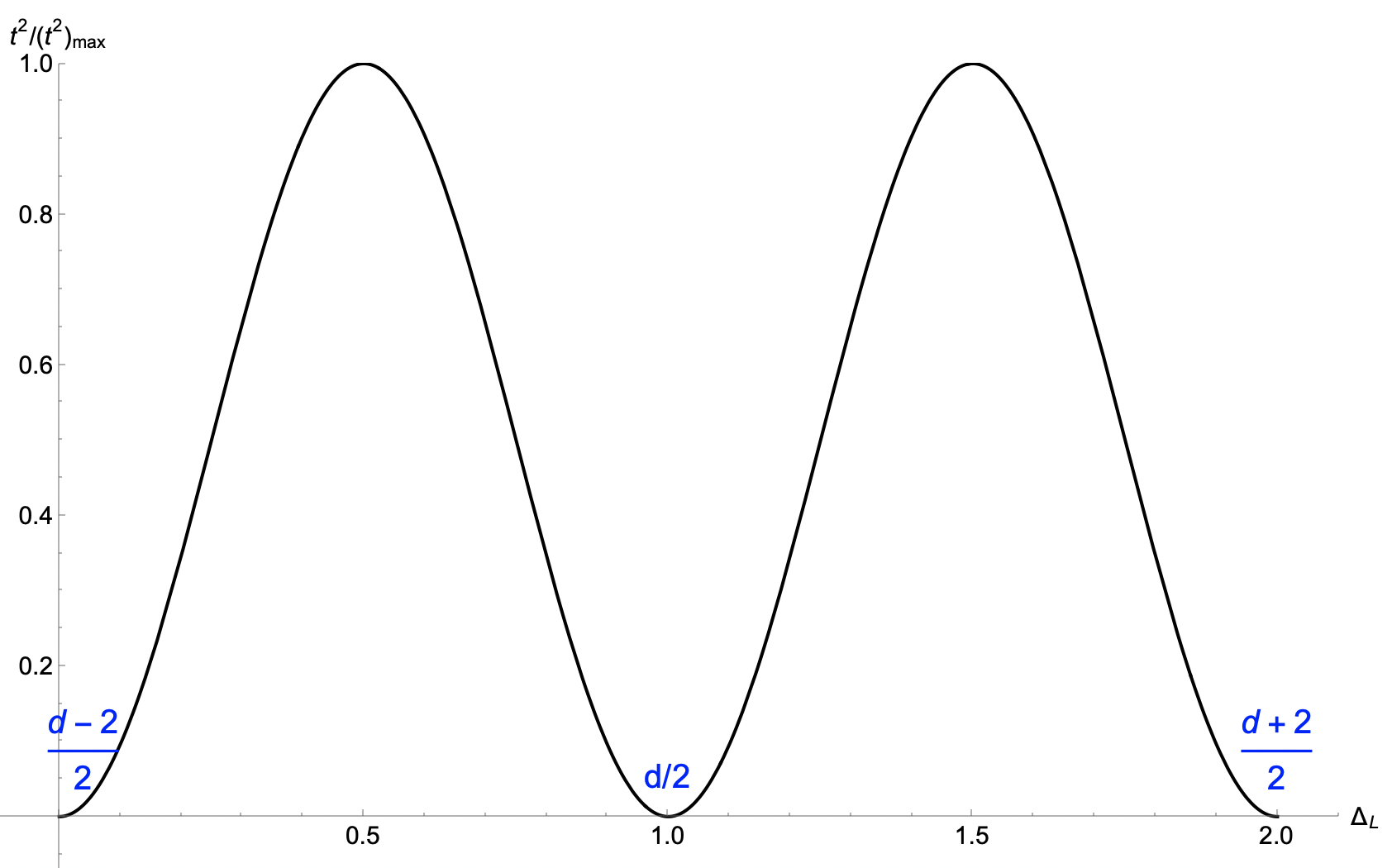
Figure 1: Transmission coefficient across the transparent boundary conditions as a function of conformal dimension and coupling.
Strong/Weak Coupling Duality
A novel duality is established: the partition function of the system at coupling h and conformal dimension Δ is equivalent to that at coupling 1/h(2Δ−d)2 and dimension d−Δ, with the roles of standard and alternate quantization reversed. Explicitly,
Z[Δ,d−Δ,h]=Z[d−Δ,Δ,h(2Δ−d)21]
This duality is manifest in the structure of the boundary conditions and is confirmed numerically by tracking the QNMs as the coupling is varied. As h increases, the system interpolates between the two quantization schemes, with the QNMs looping in the complex frequency plane and exchanging their localization between the two AdS regions.
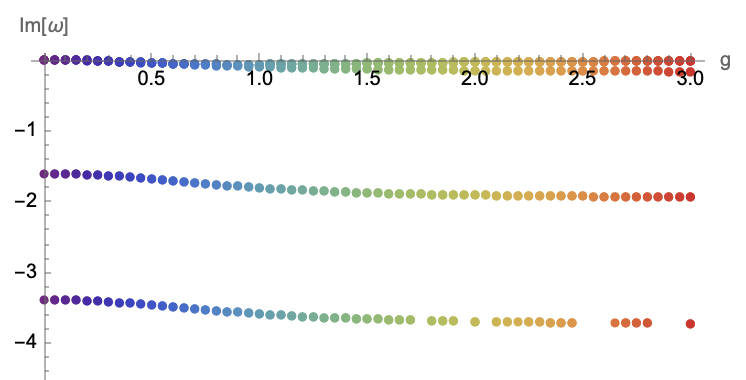
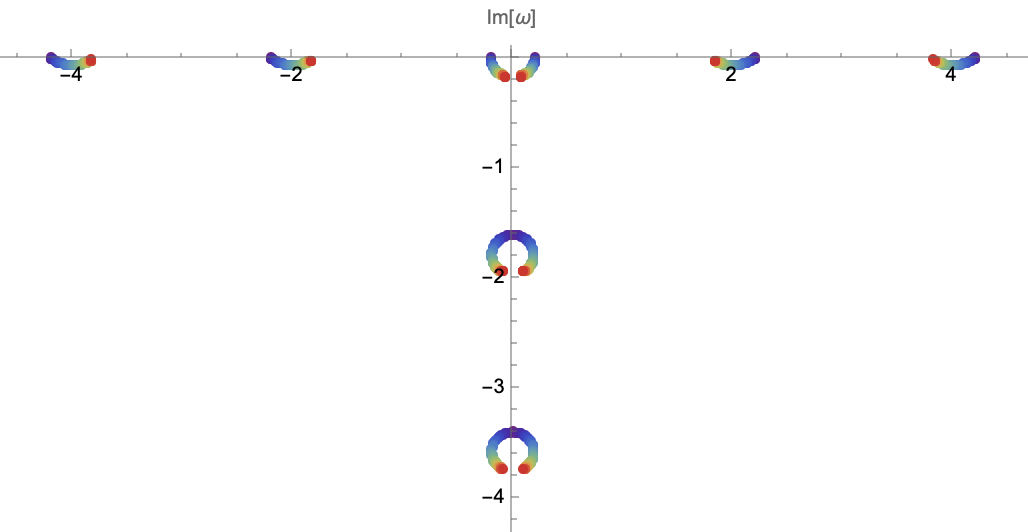
Figure 2: Manifestation of the duality between g and $1/g$ in the QNM spectrum as the coupling is varied.
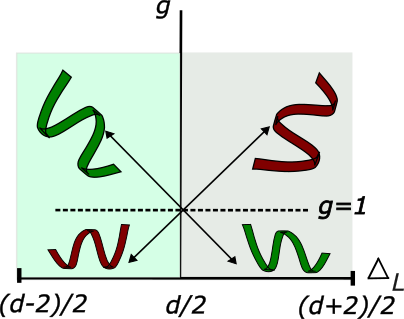
Figure 3: Phase diagram illustrating the strong/weak duality in the space of conformal dimensions and couplings.
Quasi-Normal Modes and Dissipation
The QNMs of the coupled system are computed both analytically (for equal temperatures) and numerically (for unequal temperatures or black hole masses). In the absence of coupling, a zero-temperature CFT exhibits real normal modes, while a finite-temperature black hole has QNMs with negative imaginary parts, indicating decay. Upon coupling, the normal modes of the zero-temperature system acquire imaginary components, signaling the onset of dissipation even at zero temperature. The imaginary part of the QNM frequency quantifies the dissipative timescale.
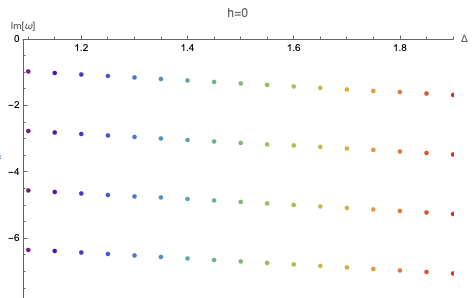
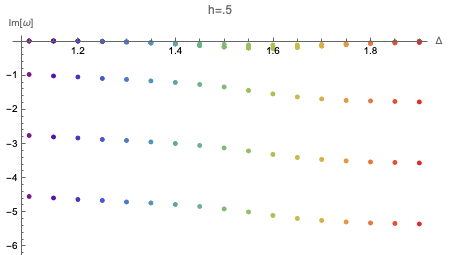
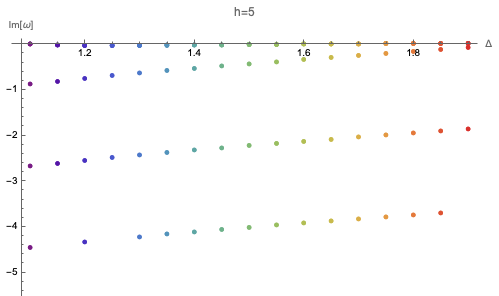
Figure 4: Imaginary part of QNM frequencies versus conformal dimension for various coupling strengths, showing the emergence of dissipation.
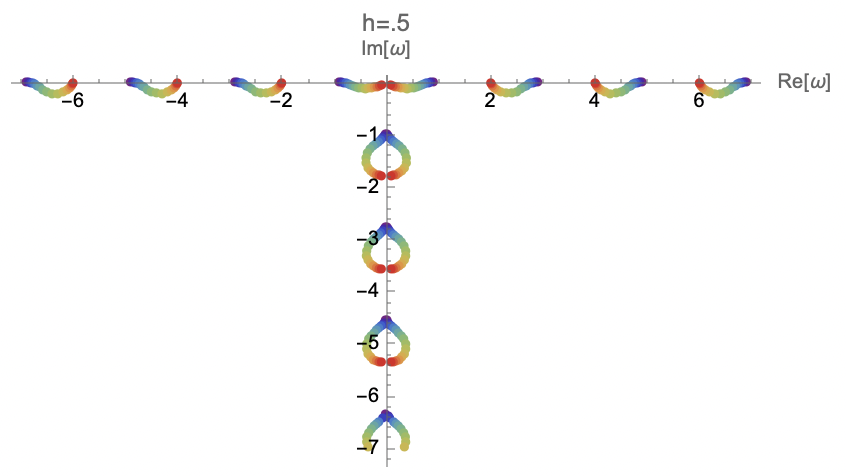
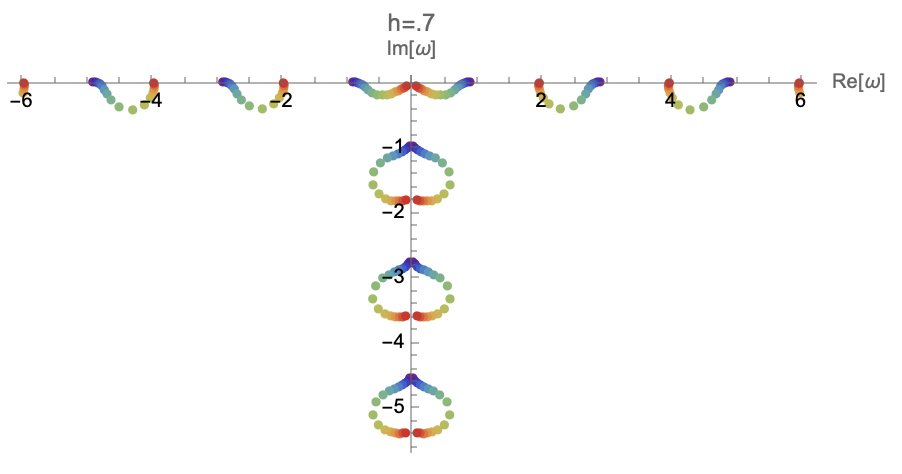
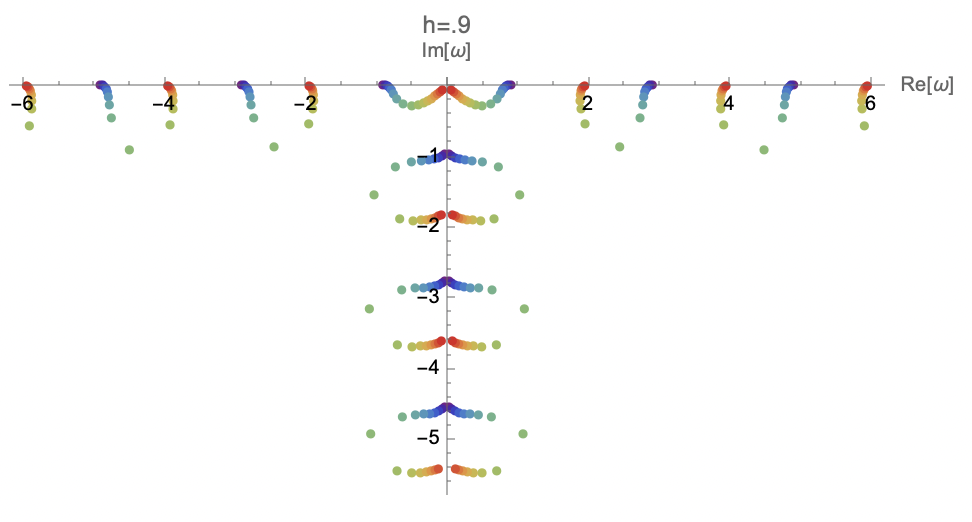
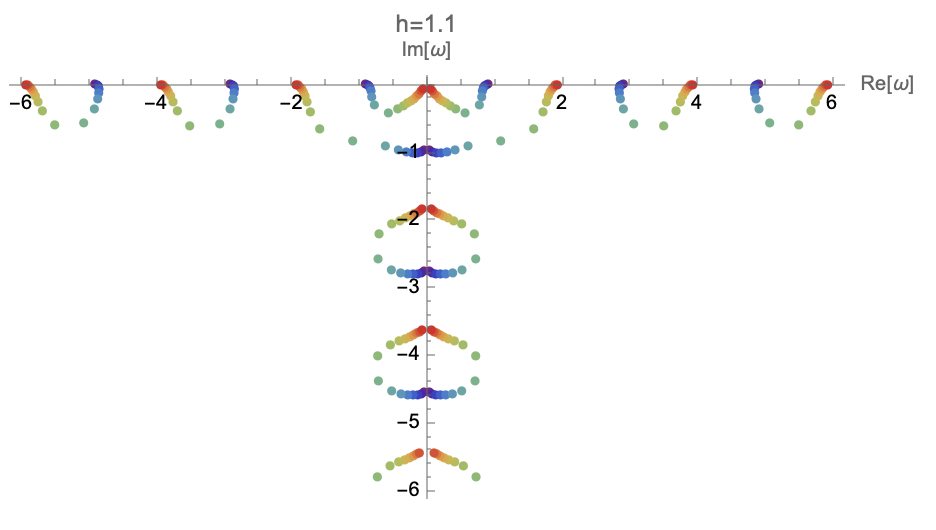
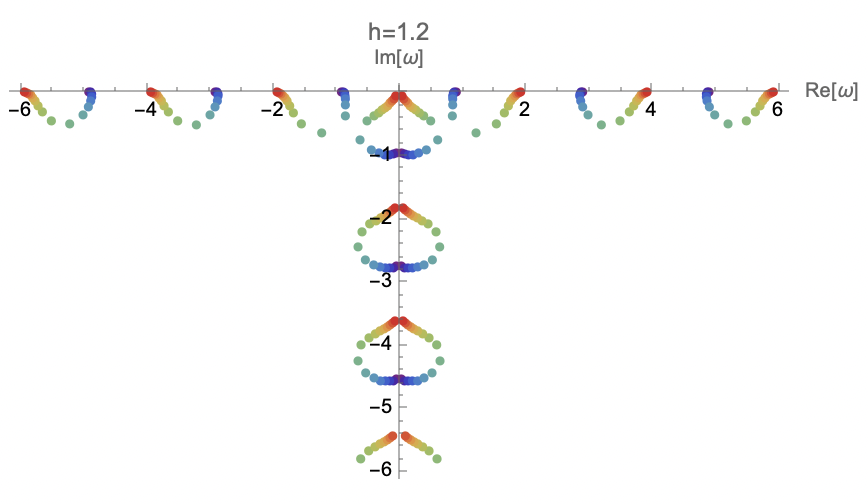
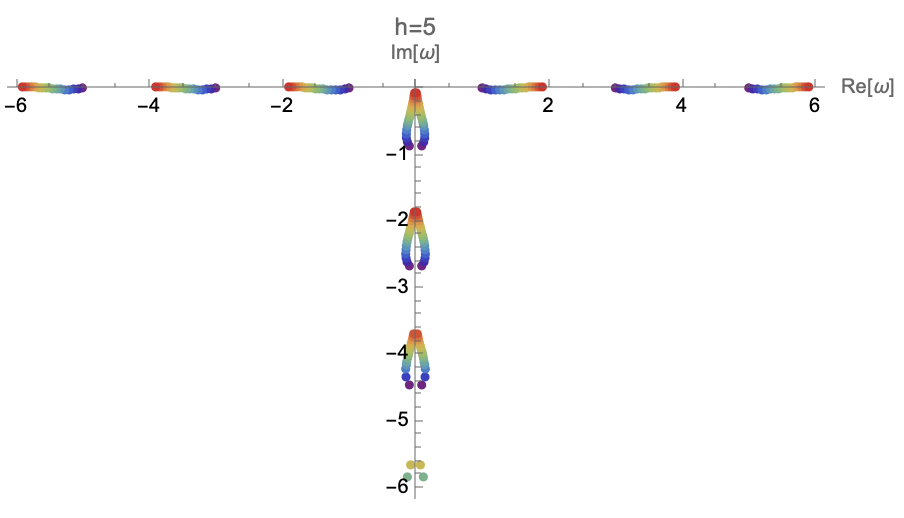
Figure 5: QNM spectrum for varying Δ and fixed h, illustrating the transition from non-dissipative to dissipative behavior.
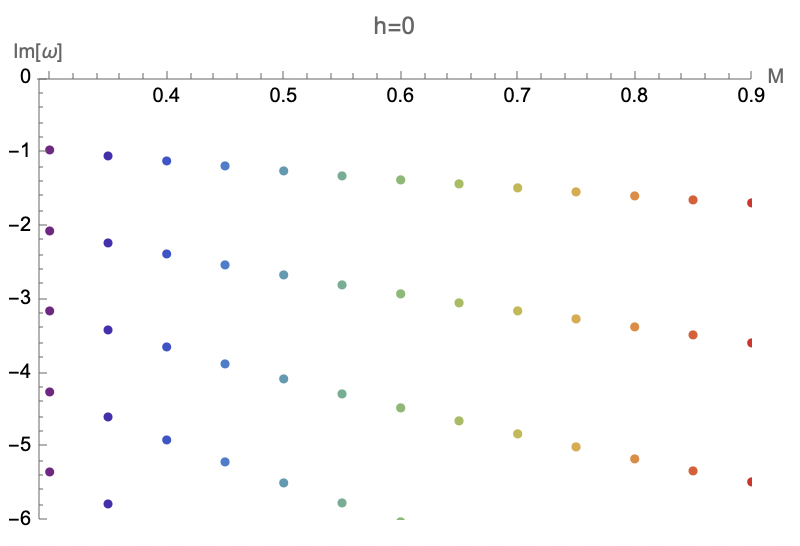
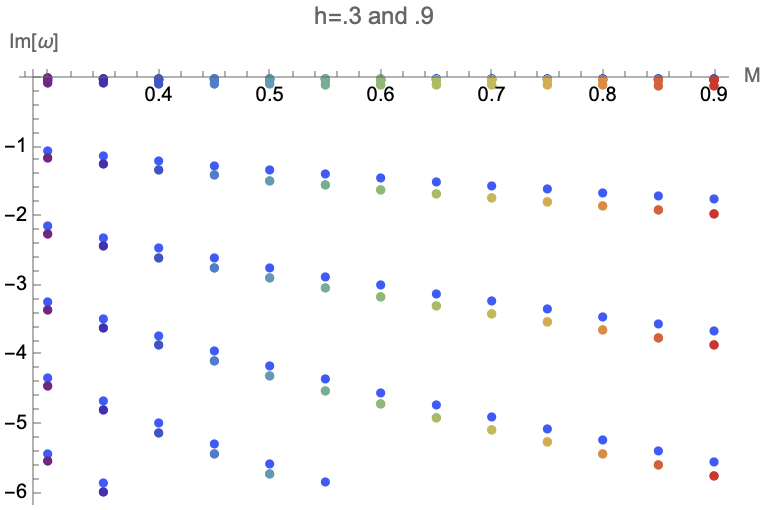
Figure 6: Imaginary part of QNM frequencies versus black hole mass for different couplings, demonstrating increased dissipation with mass and coupling.
The numerical results reveal several key features:
- For small h, the QNMs are localized on one side, with minimal leakage.
- As h increases, the modes interpolate between the two quantizations, consistent with the duality.
- The onset of dissipation is controlled by both the coupling and the conformal dimension.
- For two black holes of different sizes, the QNM spectrum exhibits more complex behavior, but dissipation remains evident.
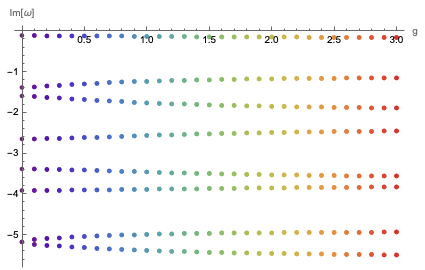

Figure 7: QNM spectrum for two black holes of different sizes and varying coupling, showing the duality and mode localization.
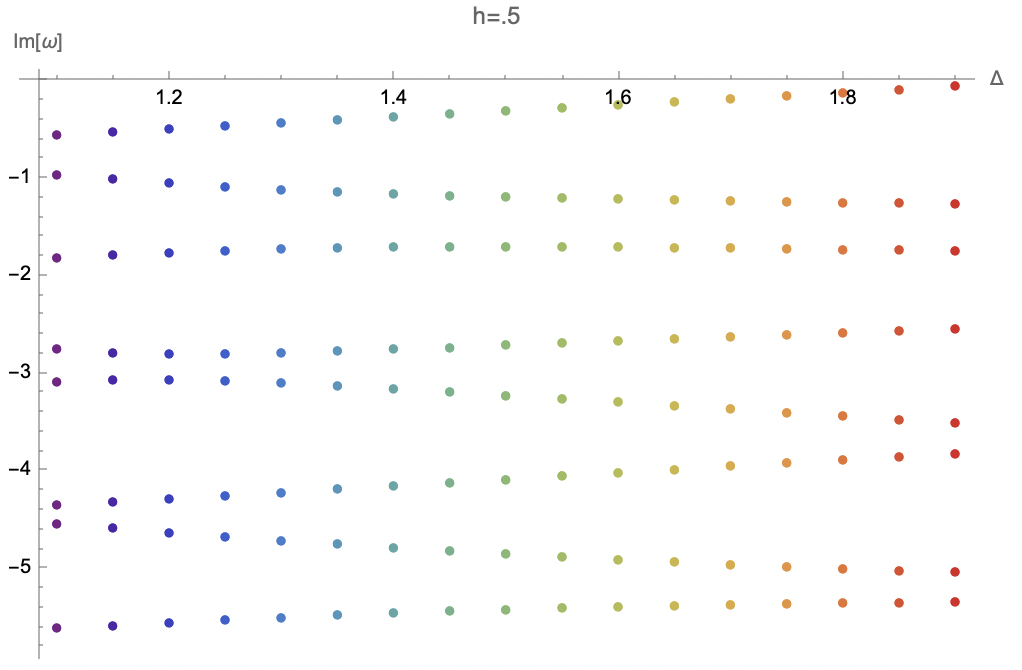
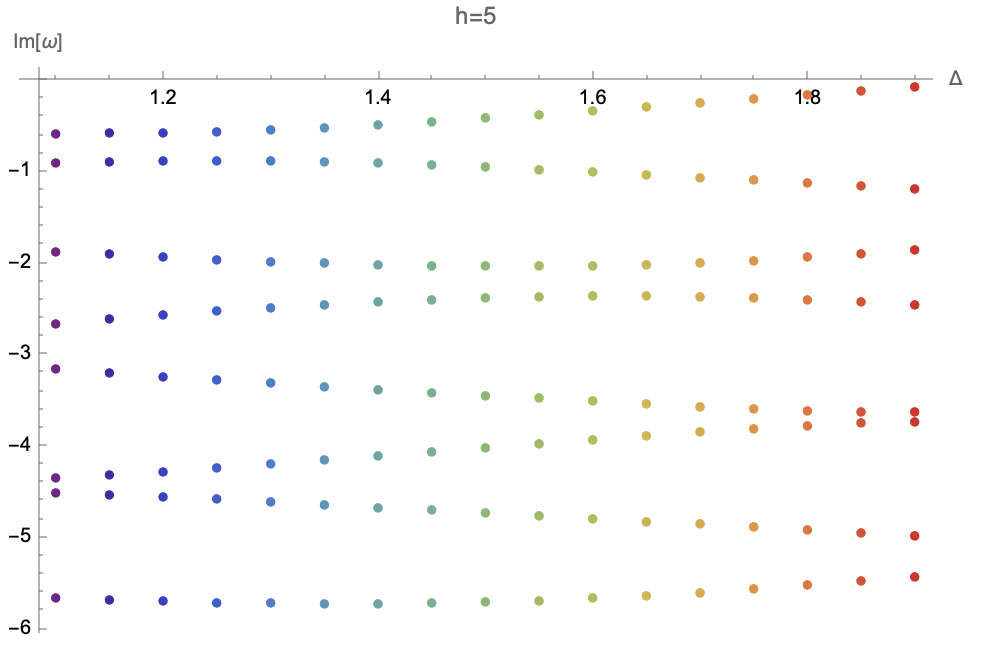
Figure 8: Imaginary part of QNM frequencies versus conformal dimension for two black holes and different couplings.






Figure 9: QNM spectrum for varying Δ and h in the two-black-hole case.
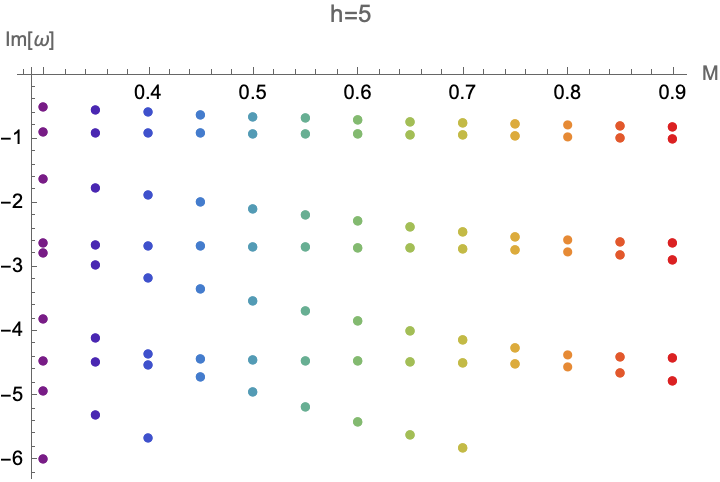
Figure 10: Imaginary part of QNM frequencies versus black hole mass for different couplings and conformal dimensions.
Implications and Future Directions
The results demonstrate that coupling a CFT to a bath via double-trace deformation induces dissipation, even at zero temperature, and that the transmission properties are universal, depending only on boundary data. The strong/weak duality provides a powerful tool for mapping between regimes and understanding the interpolation between quantization schemes.
Practically, these findings have direct relevance for the study of black hole evaporation in AdS, the emergence of mixed-state phases, and the modeling of open quantum systems in holography. The explicit retention of bath degrees of freedom enables the study of unitary evolution of the combined system, but tracing over the bath would yield effective Lindblad dynamics and non-Hermitian extensions, with potential applications to entanglement entropy, Page curves, and quantum information transfer.
Theoretically, the universality of the transmission coefficient and the duality suggest deep connections between boundary conditions, operator dimensions, and open-system dynamics. The framework is amenable to generalization, including higher-spin fields, more complex baths, and time-dependent couplings.
Conclusion
This work provides a quantitative and conceptual foundation for the study of dissipation and duality in open holographic systems. By coupling two CFTs via double-trace deformation and analyzing the resulting transmission, duality, and QNM spectra, the paper elucidates the mechanisms by which open-system effects arise in holography. The results have broad implications for black hole physics, quantum information, and the theory of open quantum systems, and open several avenues for future research, including the emergence of Lindbladian dynamics and the study of entanglement in mixed states.

