- The paper demonstrates a precision confirmation of Hawking's area law by comparing pre-merger and ringdown horizon areas using GW250114 data.
- It employs multi-model Bayesian inference and time-domain truncations to extract quasinormal modes, verifying the Kerr spectrum and no-hair theorem.
- The study constrains alternative gravity theories by rigorously showing no evidence of area decrease or significant deviations from general relativity.
Tests of Black Hole Dynamics with GW250114: Area Law and the Kerr Hypothesis
Introduction
The LIGO-Virgo-KAGRA collaboration reports the detection of GW250114, the highest signal-to-noise ratio (SNR) binary black hole (BBH) gravitational wave event to date. This event enables precision tests of classical general relativity (GR) in the dynamical, strong-field regime, leveraging state-of-the-art inference on both the remnant's quasinormal mode spectrum and horizon area evolution. The analyses are structured to be theory-agnostic regarding the non-linear merger epoch, focusing on minimally modeled time-domain truncations that isolate inspiral and ringdown regimes.
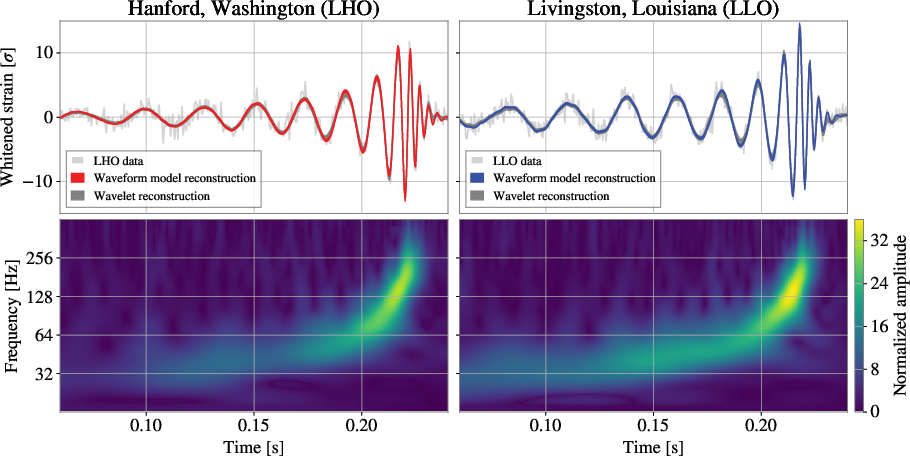
Figure 1: LIGO Hanford (left) and Livingston (right) data for GW250114 including signal reconstructions and spectrograms indicating the >10σ detection significance.
Source Characterization
Parameter inference utilizes multi-model Bayesian approaches, incorporating modern waveform approximants (including surrogate models trained on NR, aligned-spin models with higher harmonics, and models allowing for residual eccentricity), drawing from pre-merger and post-merger data for independent mass/spin estimates. GW250114 is inferred to arise from a near-equal-mass, low-spin BBH system:
- Primary mass: m1∼36 M⊙ (credible intervals are quoted at 90% throughout)
- Secondary mass: m2∼34 M⊙
- Dimensionless spins: χ1,χ2∼0
- Total redshifted mass: (1+z)M∼72 M⊙
- Remnant mass/spin: Mf∼67 M⊙, χf∼0.69
Results are consistent with GW150914, but with significantly tighter constraints (an order-of-magnitude improvement in component masses), primarily due to the event's SNR and sky localization in two almost equally sensitive detectors.
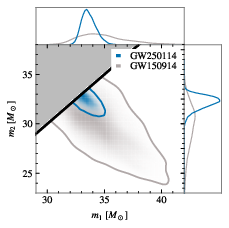
Figure 2: Posterior distributions for the source-frame masses of GW250114 and GW150914.
Black Hole Ringdown and the Kerr Spectrum
The post-merger signal is analyzed with time-domain truncated models, starting at varying times after the peak strain, to probe the expected quasinormal mode (QNM) content. The data robustly support (at 4.1σ) the presence of two dominant QNMs, identified as the (ℓ,∣m∣)=(2,2),n=0 fundamental mode and its first overtone (n=1), with measured frequencies and damping rates consistent with the spectrum predicted by the Kerr solution, for parameters independently inferred from the inspiral.
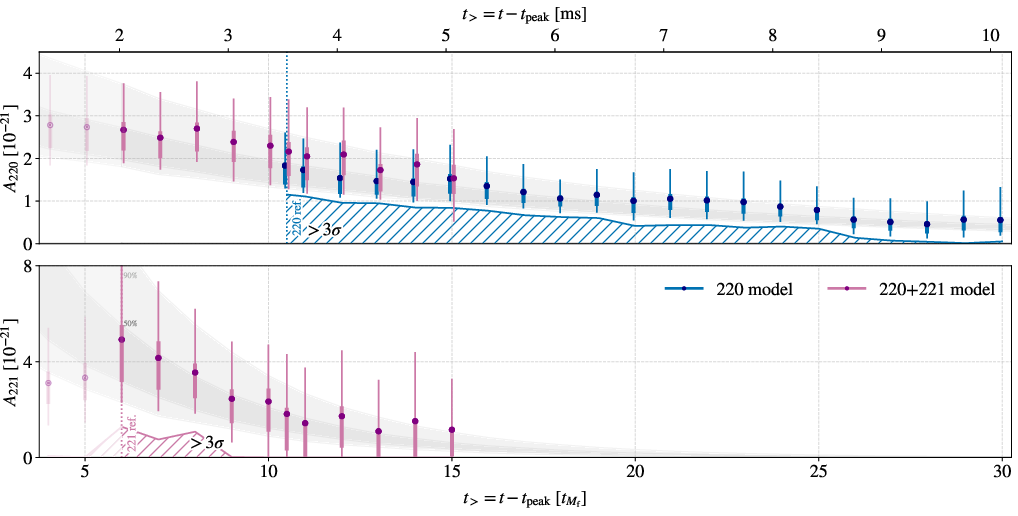
Figure 3: Measured strain amplitudes for the fundamental and first overtone A220 and A221 as a function of analysis start time; colored bars denote SNR-weighted credible intervals.
Spectroscopic tests parametrizing frequency and damping deviations from the Kerr metric are performed (following variation-parameterized QNM templates). Results show that the data are consistent with the GR-predicted values to within statistical uncertainties, with no significant evidence for non-Kerr deviations:
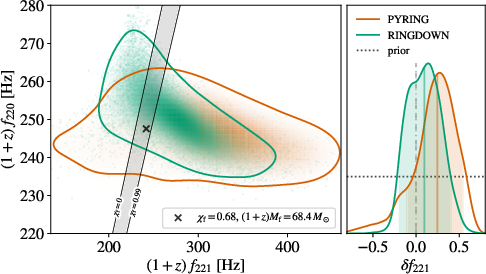
Figure 4: Posterior on measured QNM frequencies vs. the Kerr spectrum (left), and direct constraints on spectral deviations δf221 (right).
Significance of additional (especially n=1 overtone) mode detection diminishes as the ringdown analysis start time is shifted later, quantitatively confirming theoretical predictions for relative mode amplitudes and decay.
Test of the Hawking Area Law
A central result is the quantification of the irreducible area evolution of the system, testing Hawking's area law (i.e., the classical second law of black hole mechanics) in a regime that is as agnostic as possible about near-merger physics. The total initial area Ai (sum over individual holes at wide separation) is inferred from pre-merger data, and the final area Af from the ringdown QNM fits. Crucially, data during the non-linear merger epoch are excised.
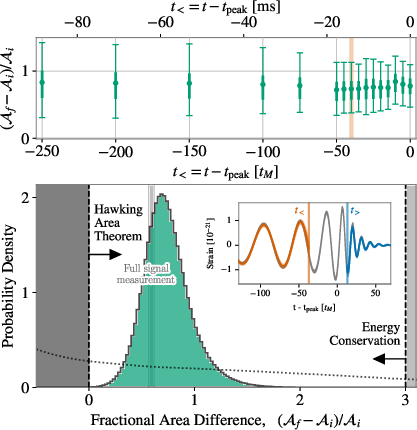
Figure 5: Posterior distribution for (Af−Ai)/Ai as a function of pre-merger truncation time; bottom: histogram shows area difference posterior and inferred constraints. Results at key truncation times highlighted.
At all analysis points, Af>Ai at >4σ significance, including analyses that discard up to five strong pre-merger cycles and that apply the ringdown model as soon as consistent with single-mode dominance. Results are strictly theory-agnostic for the excised merger phase. The ability to recover the classical area increase at this significance, even after removal of the peak merger SNR, is unprecedented.
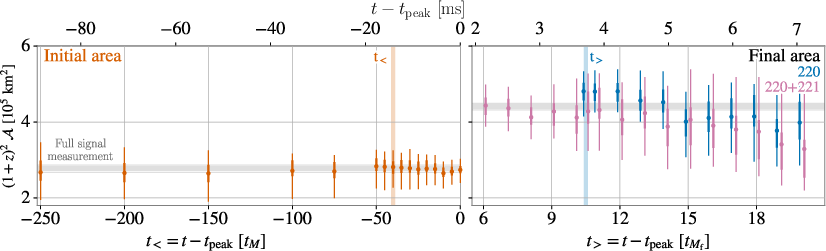
Figure 6: Top: evolution of initial (pre-merger) and final (post-merger) area measurements vs truncation time; vertical bands highlight preferred reference values. Bottom: 90% credible intervals from the full-signal IMR analysis (grey bands) for comparison.
Implications and Theoretical Outlook
The absence of area law violation (to this precision) places strong constraints on possible violations of: (i) the null energy condition, (ii) cosmic censorship, (iii) validity of the Kerr solution, and (iv) standard quantum/semiclassical corrections with classically significant impact. In particular, models of non-Kerr exotic compact objects, or those predicting 'bounces' or significant dissipative non-GR merger stages at classical scales, are strongly disfavored.
The QNM-based ringdown spectroscopy, with overtone identification, supports the no-hair theorem and metric uniqueness at the level of measurable spectrum deformations. This framework enables consistent, model-independent tests of GR and horizon thermodynamics in the high-curvature regime, independent of merger modeling systematics.
Future improvements will leverage additional multiple-mode detections at similar or higher SNR, facilitating more complete spectral inverse problems (probing multipolar structure, higher overtones, and potential isospectrality violation). These will enable precision black hole spectroscopy and tests of quantum-gravitational corrections to black hole mechanics.
Conclusion
GW250114 represents a new benchmark for high-precision, agnostic testing of gravitational dynamics in black hole mergers. The independent confirmation of the Hawking area law, the clean Kerr QNM spectrum, and exclusion of area decrease or Kerr spectral deviation at previously unreachable significances, all demonstrate the utility of combining time-frequency truncation, data-driven agnosticism near the merger, and modern Bayesian multi-model inference. Astrophysical black holes continue to exhibit the simplicity and universality predicted by classical general relativity, and these results provide new constraints on departures permitted by quantum extensions and alternative gravity theories.
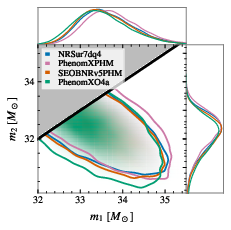
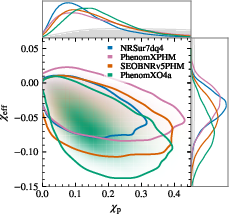
Figure 7: Mass/spin posterior with multiple waveform models, effective spin measures; all models favor low-spin, nearly equal-mass merger.
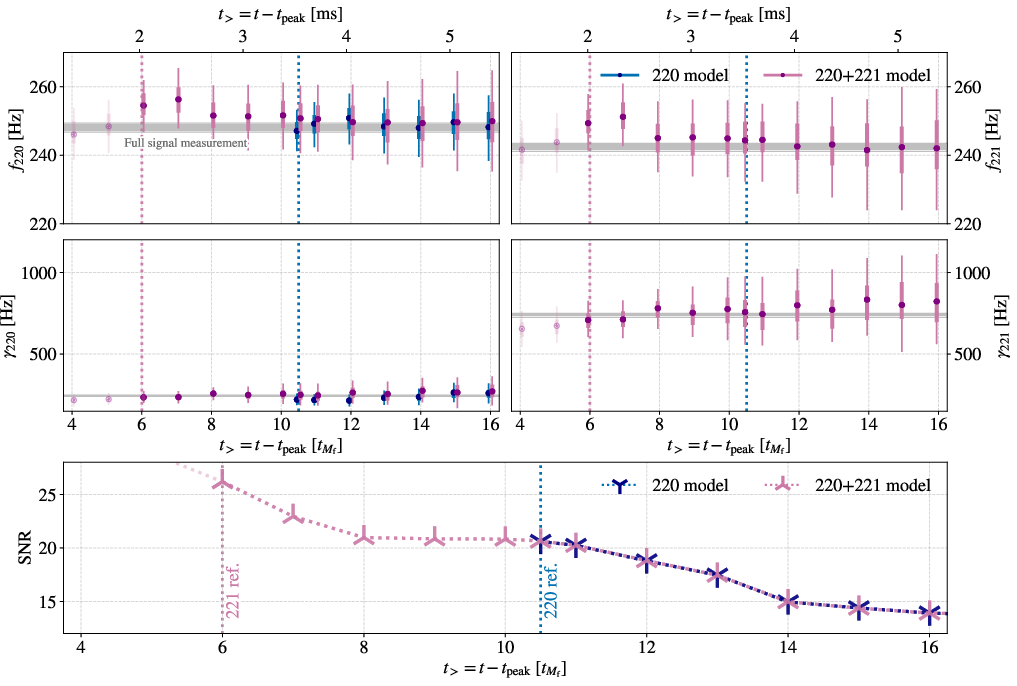
Figure 8: (Not shown: see technical appendix for additional fits and robustness checks.)
References
For numerical and computational details, parameter estimation software, and waveform model references, see source code and supplements. Data and scripts to reproduce analysis are available through the Gravitational Wave Open Science Center and associated Zenodo release as referenced in the original article.