- The paper reveals that malicious actors can exploit RAG data loaders via document poisoning, achieving a 74.4% attack success rate.
- The paper introduces nine types of knowledge-based attacks including content obfuscation and injection, specifically targeting DOCX, HTML, and PDF formats.
- The paper’s experimental evaluation on six RAG systems underscores the urgent need for enhanced validation mechanisms and standardized security protocols.
The Hidden Threat in Plain Text: Attacking RAG Data Loaders
Introduction
The paper "The Hidden Threat in Plain Text: Attacking RAG Data Loaders" (2507.05093) explores vulnerabilities in the data loading stage of Retrieval-Augmented Generation (RAG) systems. With the increasing reliance on LLMs integrated with RAG frameworks to enhance outputs by external document ingestion, the security of these systems is paramount. This paper uncovers a critical vulnerability where malicious actors can exploit document ingestion to poison RAG pipelines, leading to compromised output integrity.
Vulnerability Analysis
RAG systems are designed to augment LLMs by retrieving relevant documents and incorporating external information into generated responses. However, this reliance introduces several vulnerabilities at the document ingestion phase. The paper identifies nine types of knowledge-based poisoning attacks, focusing specifically on two novel vectors: content obfuscation and content injection. These attacks target common formats such as DOCX, HTML, and PDF. The authors demonstrate the efficacy of 19 stealthy injection techniques using an automated toolkit, revealing a 74.4% attack success rate across various scenarios.
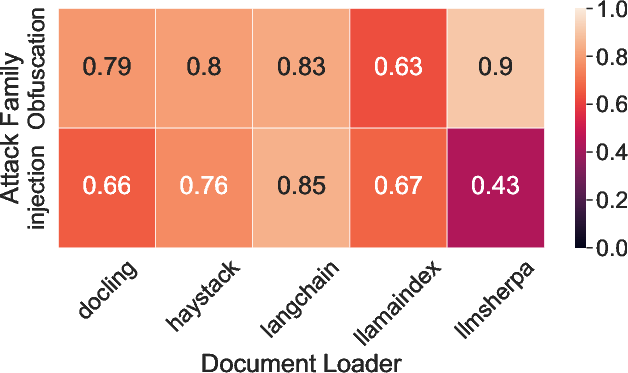
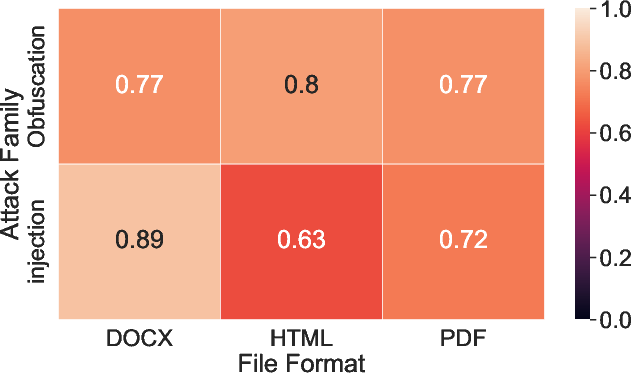
Figure 1: Document Loaders
Experimental Evaluation
The paper's experiments reveal significant vulnerabilities in popular data loaders used in RAG systems. The attack success rates are alarmingly high in both content obfuscation and injection scenarios, indicating that RAG pipelines are susceptible to covert manipulations. Furthermore, end-to-end evaluations on six RAG systems highlight the effectiveness of these attacks in bypassing filters, silently altering the generation process.
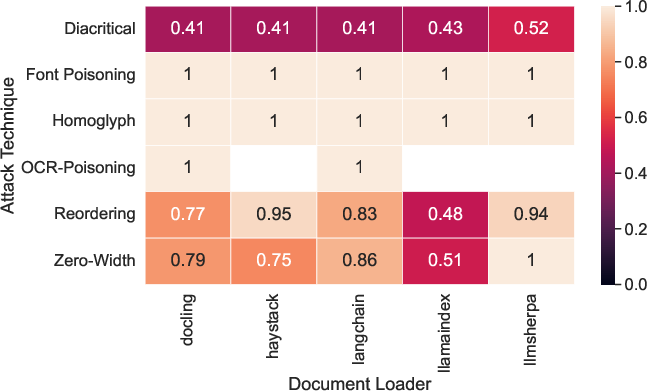
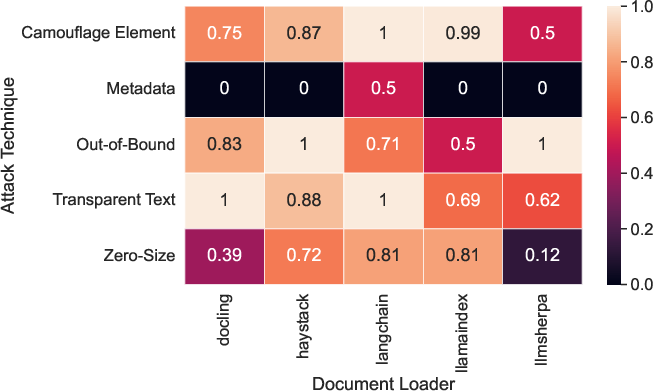
Figure 2: Content Obfuscation
One critical observation is the heterogeneous response among different RAG implementations to these attacks. Document formats such as DOCX exhibit higher vulnerability compared to others, and specific techniques, like font poisoning and homoglyph substitution, consistently achieve high success rates. These findings underscore the need for robust security measures tailored to diverse document formats and data loader configurations.
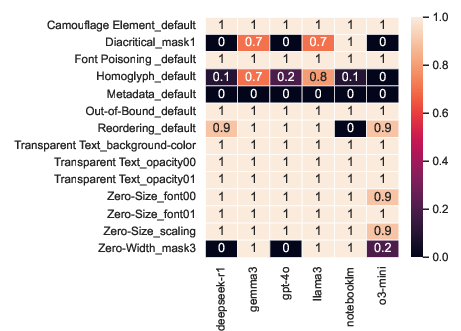
Figure 3: Experiment 2 -- End-to-End RAG Manipulation.
Implications and Future Directions
The implications of these findings are significant from both practical and theoretical perspectives. On a practical level, the paper stresses the urgent need for enhanced security in document ingestion processes within RAG systems. Theoretical implications extend to understanding the vulnerabilities in model adaptation and retrieval mechanisms within AI systems. The paper suggests deploying stronger data validation mechanisms and exploring advanced document format standardizations to mitigate these risks.
As RAG systems become increasingly mainstream, future research should focus on developing comprehensive frameworks to protect against document poisoning and advocating for standardized security protocols in AI systems. The evolution of large-scale malicious document injectors underscores the necessity of adopting proactive security measures, ensuring that RAG pipelines remain resilient against sophisticated adversarial attacks.
Conclusion
The paper "The Hidden Threat in Plain Text: Attacking RAG Data Loaders" (2507.05093) provides critical insights into the vulnerabilities inherent in the data loading stages of RAG systems and emphasizes the need for robust defenses. As the integration of external document ingestion in enhancing LLM outputs continues to grow, the adoption of secure practices and the development of protection measures against document poisoning become pivotal to safeguarding the integrity and reliability of AI-driven systems.