- The paper establishes that loop current order emerges as the dominant ground state on the kagome lattice using FRG calculations.
- It demonstrates that sublattice interference, driven by second nearest-neighbor repulsion, suppresses competing orders like CDW.
- The study highlights experimental implications for kagome metals, linking loop current order with quantum anomalous Hall effects.
Loop Current Order on the Kagome Lattice
Introduction
Recent advances in kagome materials have revealed these systems as fertile grounds for the emergence of exotic quantum states, such as charge density waves (CDW) and superconductivity, particularly in the presence of time-reversal symmetry (TRS) breaking. The paper "Loop Current Order on the Kagome Lattice" explores the establishment of Loop Current Order (LCO) on the spinless kagome lattice, focusing on a microscopic model realized via functional renormalization group (FRG) calculations. This study attempts to provide insight into the mechanisms by which LCO can emerge as a stable many-body ground state in such systems and its implications for quantum anomalous Hall states.
Kagome Lattice and Resonance Group Flow
The kagome lattice, characterized by its distinctive geometric frustration due to corner-sharing triangles, is known for hosting flat bands and Dirac cones, in addition to tunable van Hove singularities (vHs). These characteristics make it a promising candidate for studying unconventional electronic phenomena. In this work, the authors have leveraged this unique lattice structure to theoretically establish LCO using FRG—a methodological approach that treats intertwined electronic fluctuations across different scattering channels.
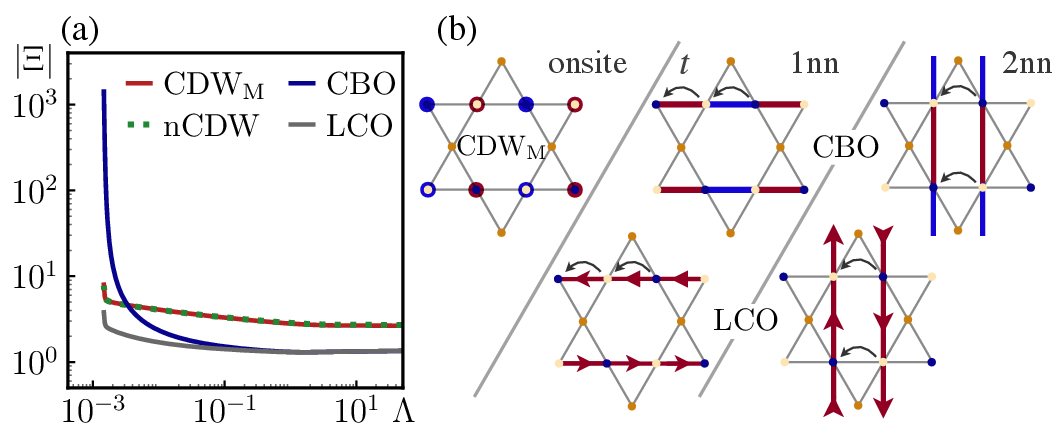
Figure 1: Representative RG flow with 1nn repulsion and real-space CDW patterns. (a) RG flow of the expectation values of CBO, LCO, nCDW, and CDWM and for V1=t and V2=0.
The focus is directed towards the system's propensity for various symmetry-broken phases, including bond charge orders (CBO) and LCO, which emerge under a regime of strong second nearest-neighbor (2nn) repulsion.
Phase Diagram and Order Instabilities
The calculated phase diagram indicates that LCO prevails over substantial parameter space. The FRG approach highlights sublattice interference effects, which suppress onsite CDW order, thereby favoring LCO, CBO, and nematic CDW states as the primary ordering instabilities.
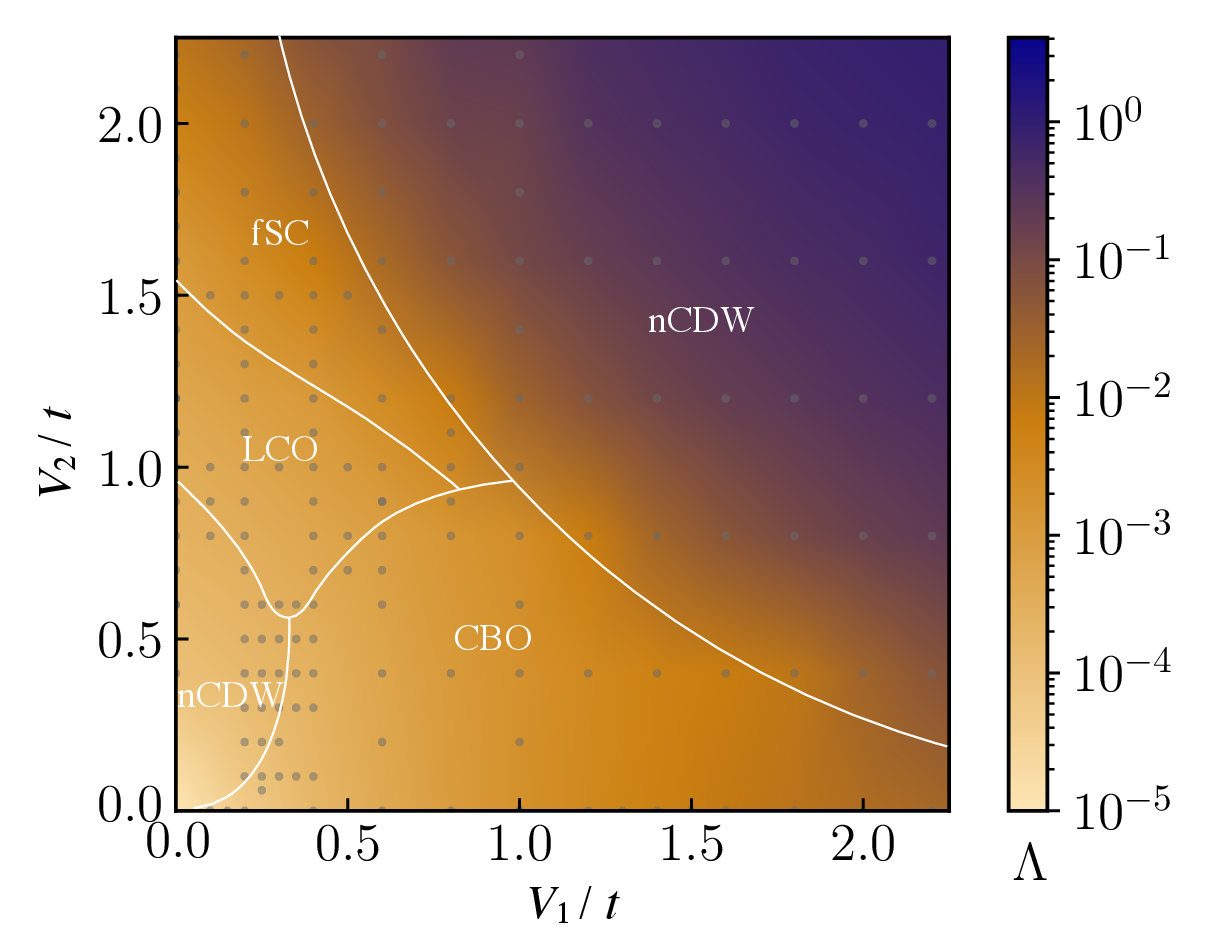
Figure 2: Phase diagram of the spinless kagome Hubbard model at the upper van Hove filling. The critical scales Λc proportional to the expected transition temperature Tc are indicated by color.
In the regime with notable second nearest-neighbor repulsion, interactions promote fluctuations that favor an imaginary bond charge order. LCO emerges as the dominant ground state, aligning with models like the Haldane model, known for realizing topologically nontrivial band structures.
Functional Renormalization Group Analysis
FRG calculations reveal that an essential driver of LCO is sublattice interference, facilitated by the kagome lattice's geometrical properties. The study explores how the interplay of second nearest-neighbor interactions leads to the stabilization of LCO over competing phases such as nCDW, which become pronounced under certain parameter regimes. The RG flow analysis illustrates the transition between these phases.
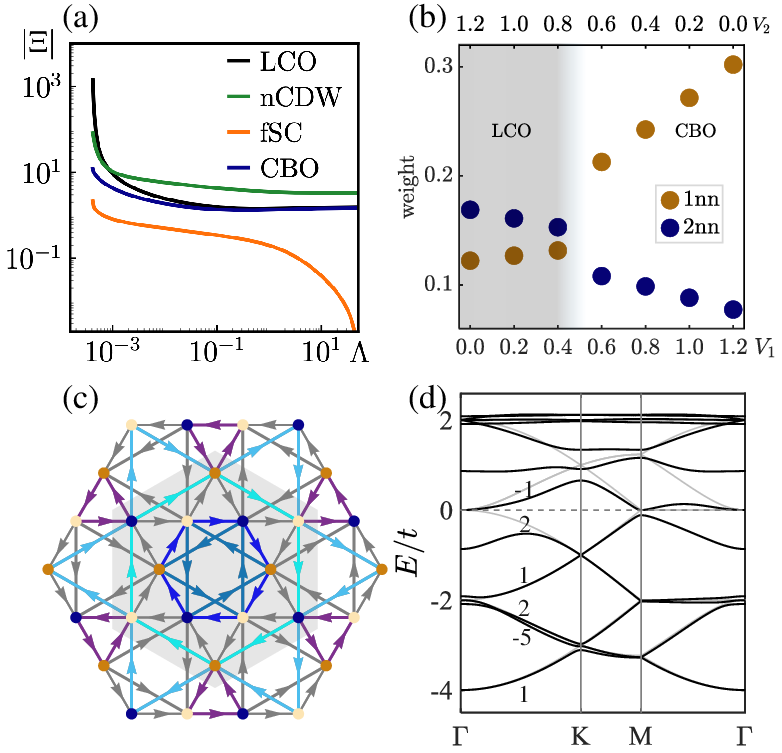
Figure 3: RG flows, real-space pattern and electronic structure of the Loop current order. (a) Representative RG flow of the expectation values of nCDW, 2nn CBO, 2nn LCO and fSC for V1=0 and V2=1.10t.
Implications for Materials and Models
The LCO realized here holds experimental implications for kagome metals, where a similar scale of first and second nearest-neighbor repulsions have been proposed. As TRS breaking is critical in systems such as AV3Sb5 and FeGe, which possess notable vHs near the Fermi level, these materials are potential platforms for observing LCO experimentally. By manipulating the kagome lattice's electronic environment, observable effects like orbital magnetic moments and quantum anomalous Hall states may arise.
Future Prospects
The realization of LCO in the kagome lattice through unbiased many-body simulations marks a pathway for future explorations of similar exotic states in correlated systems. Future studies might focus on the interactions of LCO with superconductivity, potentially leading to the discovery of novel quantum phases and dynamics in both single-orbital and multi-orbital models.
Conclusion
This paper establishes a theoretical foundation for LCO on the kagome lattice, transforming it from a hypothetical construct to a microscopically validated phenomenon. Such insights are crucial in guiding experimental investigations into the kagome metals' rich quantum landscape, highlighting the importance of geometric and electronic factors in determining stable quantum states.