- The paper surveys recent innovations in event cameras, emphasizing asynchronous sensing, low latency, and efficient data management.
- It reviews key methodologies and milestones from neuromorphic sensors to gesture recognition and visual odometry improvements.
- The study underscores practical applications in autonomous vehicles and robotics, showcasing significant performance gains over traditional cameras.
Recent Event Camera Innovations: A Survey
Introduction to Event-based Vision
Event-based vision presents a paradigm shift in visual sensing inspired by the human visual system, capable of detecting scene changes asynchronously. Unlike traditional frame cameras, event cameras produce data streams by recording changes in light intensity at each pixel. This enables high temporal resolution, low latency, high dynamic range, reduced power consumption, and efficient data management.
Event cameras are particularly adept at capturing fast-moving objects and dynamic scenes without motion blur, as illustrated in Figure 1. They focus on changes instead of absolute light levels, leading to less redundancy and lower bandwidth requirements. These features make event cameras suitable for applications necessitating real-time decision-making, such as autonomous vehicles and robotics.
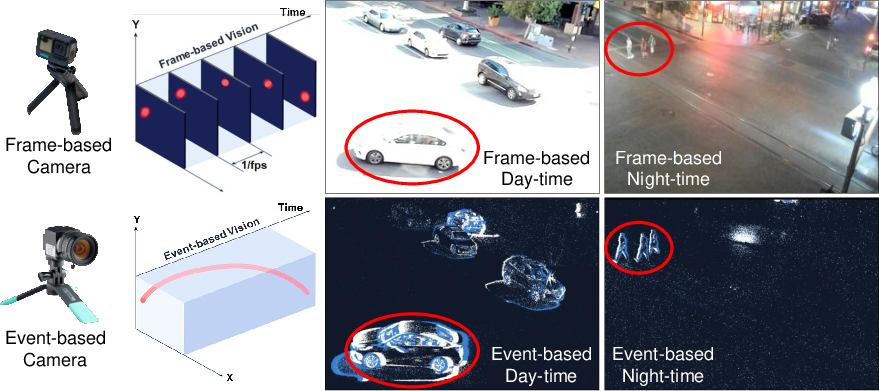
Figure 1: Comparison of Frame vs. Event Cameras: The top row shows common issues like motion blur and visibility in frame-based images, while the bottom row shows event-based images with reduced motion blur and better visibility in challenging lighting conditions.
Publication Trends and Milestones in Event-based Vision
In recent years, event-based vision research has expanded significantly, as evidenced by publication trends (Figure 2). The rise began in the early 2000s with advancements in neuromorphic sensors and continued with the introduction of event cameras and simulators.
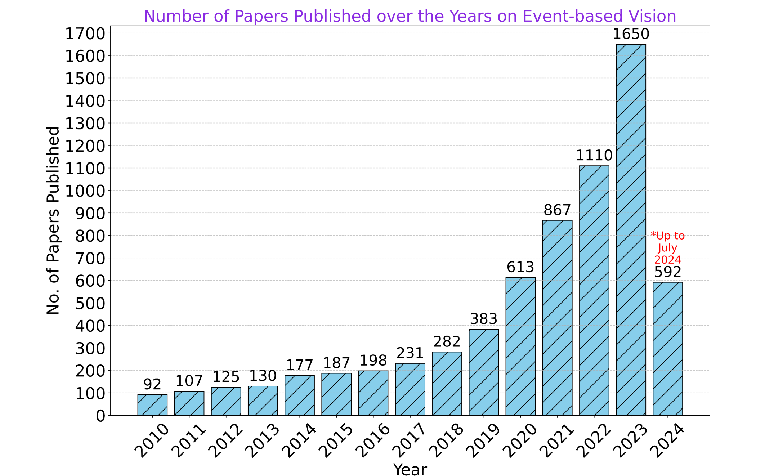
Figure 2: Publication Trends in Event-based Vision Research.
Key milestones from 2017 to 2024 include the development of gesture recognition systems [amir2017low], high-speed vision applications [mueggler2017event], data sets for motion deblurring and video reconstruction [pan2019bringing], stereo vision techniques [zhou2021event], neural networks for classification [schaefer2022aegnn], and visual odometry improvements with new datasets [gehrig2021dsec].
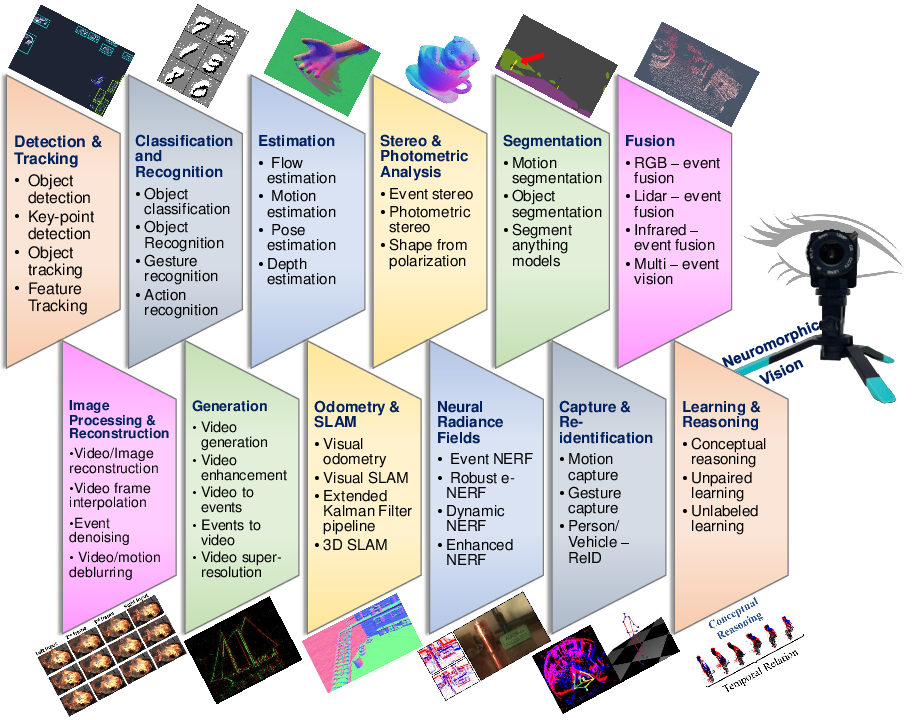
Figure 3: Key Milestone Papers and Works in Event-based Vision.
Event Camera Technologies and Models
Numerous manufacturers like iniVation and Prophesee have contributed significantly to event camera technology with models such as the DAVIS346, DVXplorer, and Prophesee EVK4-HD, offering varied features for different applications. These models provide high dynamic range, low latency, and high throughput, supporting diverse event-based applications.
Diverse Applications and Impacts
Event cameras have a broad range of applications including detection, classification, estimation, and motion analysis (Figure 4). They enhance object detection, tracking, and feature extraction with high temporal resolution. Classification tasks, such as gesture recognition, benefit from detailed temporal information provided by event cameras. Estimation tasks utilize event cameras for optical flow, motion, pose, and depth estimation due to their high-speed capabilities. Innovation in stereo vision, semantic segmentation, and fusion with other modalities is also significant.
(Figure 4)
Figure 4: Showcasing Broad Applications and Notable Works in Event-based Vision Research.
Event-based Datasets and Simulators
Both real-world and synthetic datasets are crucial for advancing event camera research, providing diverse scenarios for training and testing algorithms. Datasets like EventVOT and DSEC encompass high-resolution visual tracking and stereo data under varying conditions. Simulators such as ESIM and DAVIS Simulator facilitate controlled experimentation and validation of event-based algorithms in virtual environments.
Conclusion
Event cameras represent a significant development in sensing technology, offering transformative features such as low latency, high dynamic range, and efficient data handling. The increasing adoption of event cameras across various applications underscores their potential. Continued innovation, supported by real-world datasets and advanced simulators, will drive further advancements in event-based vision. A GitHub resource page will provide ongoing updates and consolidation of research materials to support the community in solving complex challenges with event-based technology.

