- The paper introduces the X-MOS framework that integrates deep learning to map CMIP outputs to real-world measurements for more accurate extreme event prediction.
- It employs quantile regression and attention mechanisms to enhance accuracy metrics like MAE and average precision in forecasting extreme weather conditions.
- The approach improves climate risk assessments and offers a practical enhancement for existing CMIP models, aiding policy decision-making.
Improving Climate Models with Extreme Model Output Statistics
Introduction
The study titled "CMIP X-MOS: Improving Climate Models with Extreme Model Output Statistics" introduces the Extreme Model Output Statistics (X-MOS) framework aimed at enhancing the accuracy of climate models, particularly in predicting extreme weather events. Climate models from the Coupled Model Intercomparison Project (CMIP) are crucial for understanding climate dynamics, yet often fall short when addressing the tails of climate parameter distributions, which are essential for risk assessment related to extreme weather phenomena.
Methodology
The X-MOS approach integrates deep learning techniques to map CMIP model outputs directly to real-world measurements from weather stations. This mapping focuses on improving the prediction of extreme weather events by emphasizing the tails of these distributions through deep regression techniques.
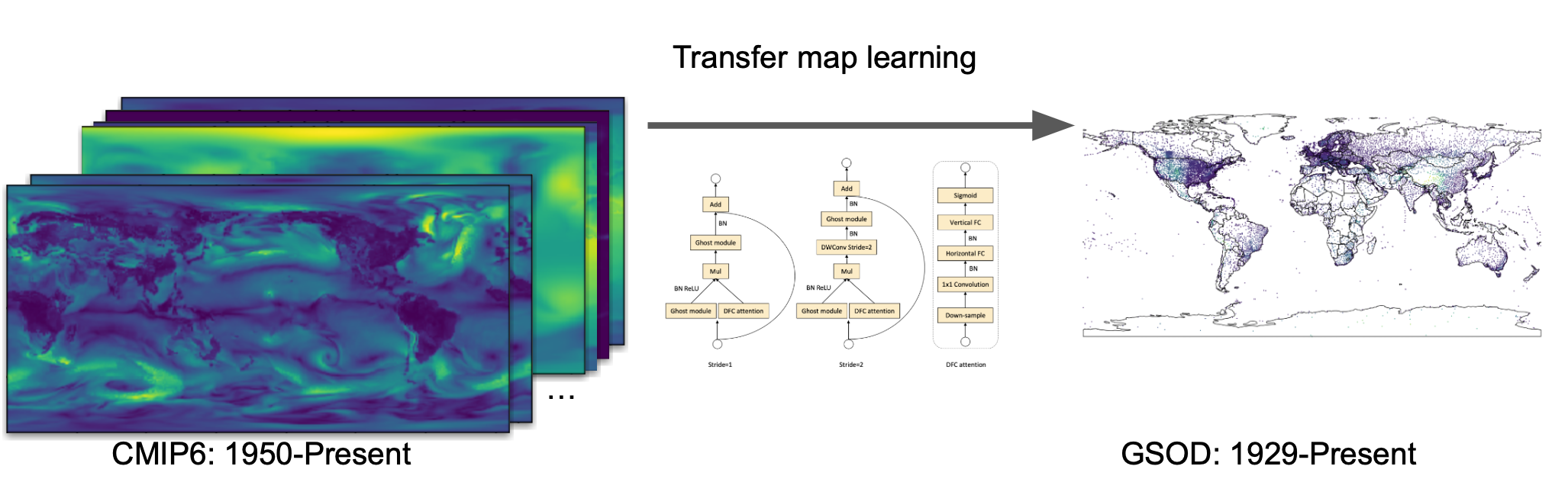
Figure 1: The X-MOS approach: GhostNetV2 is used as MOS base utility illustrated in [tang2022ghostnetv2].
Key facets of the methodology include:
- Training with Quantiles: The model regresses various quantiles, including extreme values, helping to better focus on statistical postprocessing outcomes.
- Attention Models: The integration of attention mechanisms enhances the spatial-channel feature extraction, allowing for more nuanced modeling of climate data.
- Utilization of Comprehensive Datasets: The paper employs datasets such as CMIP6 outputs, E-OBS v27 observations, and GSOD data, all contributing to the robustness of the framework.
Experimental Setup
The paper details an extensive experimental setup contrasting the X-MOS model with baseline methods like direct CMIP data outputs and traditional Linear Regression approaches. The dataset spans various periods up to 2100, with explicit attention to the accuracy of extreme weather prediction.
Metrics and Hardware
Metrics used for evaluation include Mean Absolute Error (MAE) for different quantile estimations, and Average Precision for identifying extreme weather conditions based on temperature and wind thresholds. The computational experiments are conducted on high-performance hardware such as the A100 GPU, facilitating efficient training of models.
Results
The results unequivocally underscore the advances made by the X-MOS approach in accurately modeling extreme weather events globally. In comparison with baseline approaches, the X-MOS model demonstrates superior performance across both temperature and wind predictions.
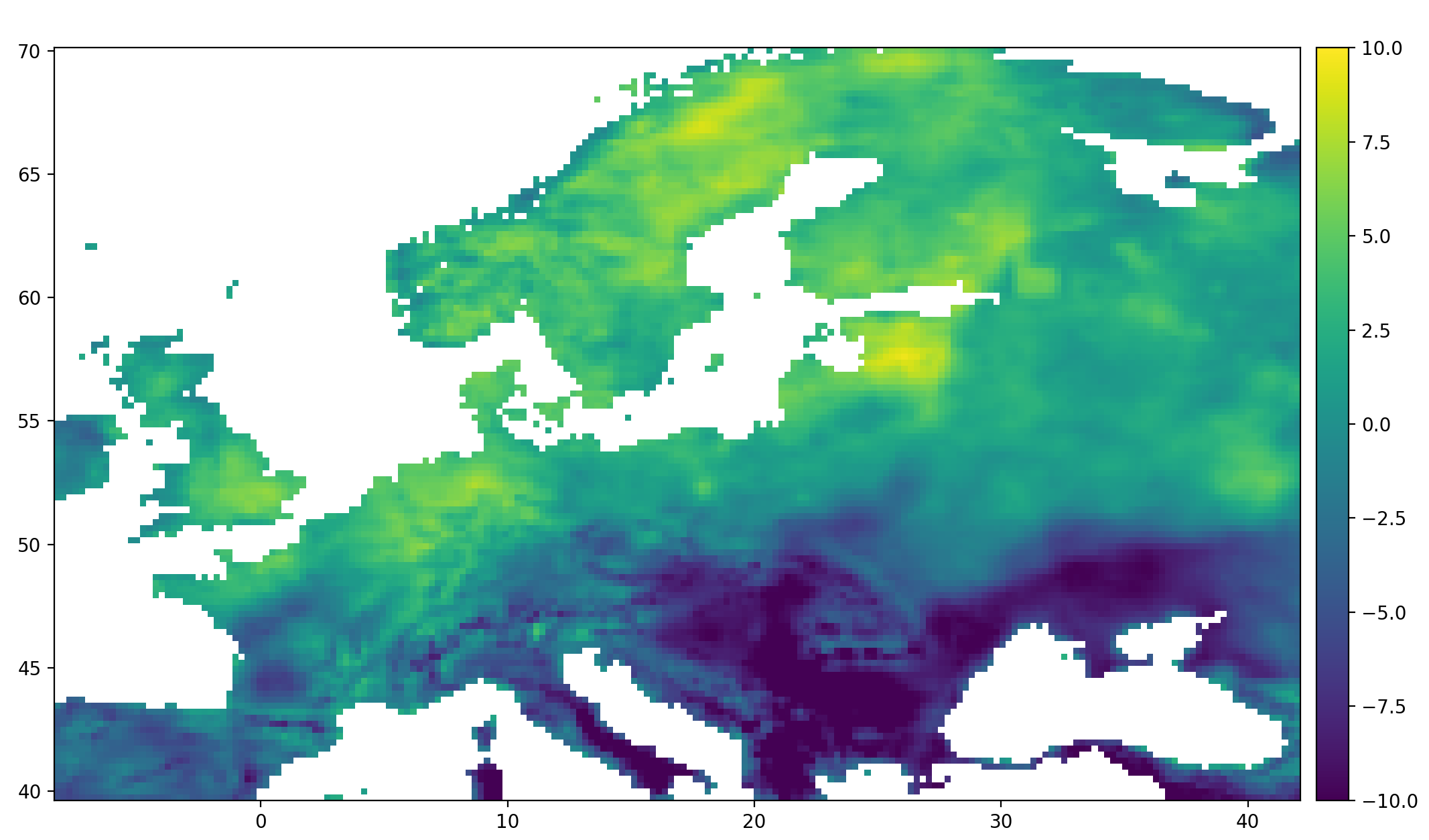
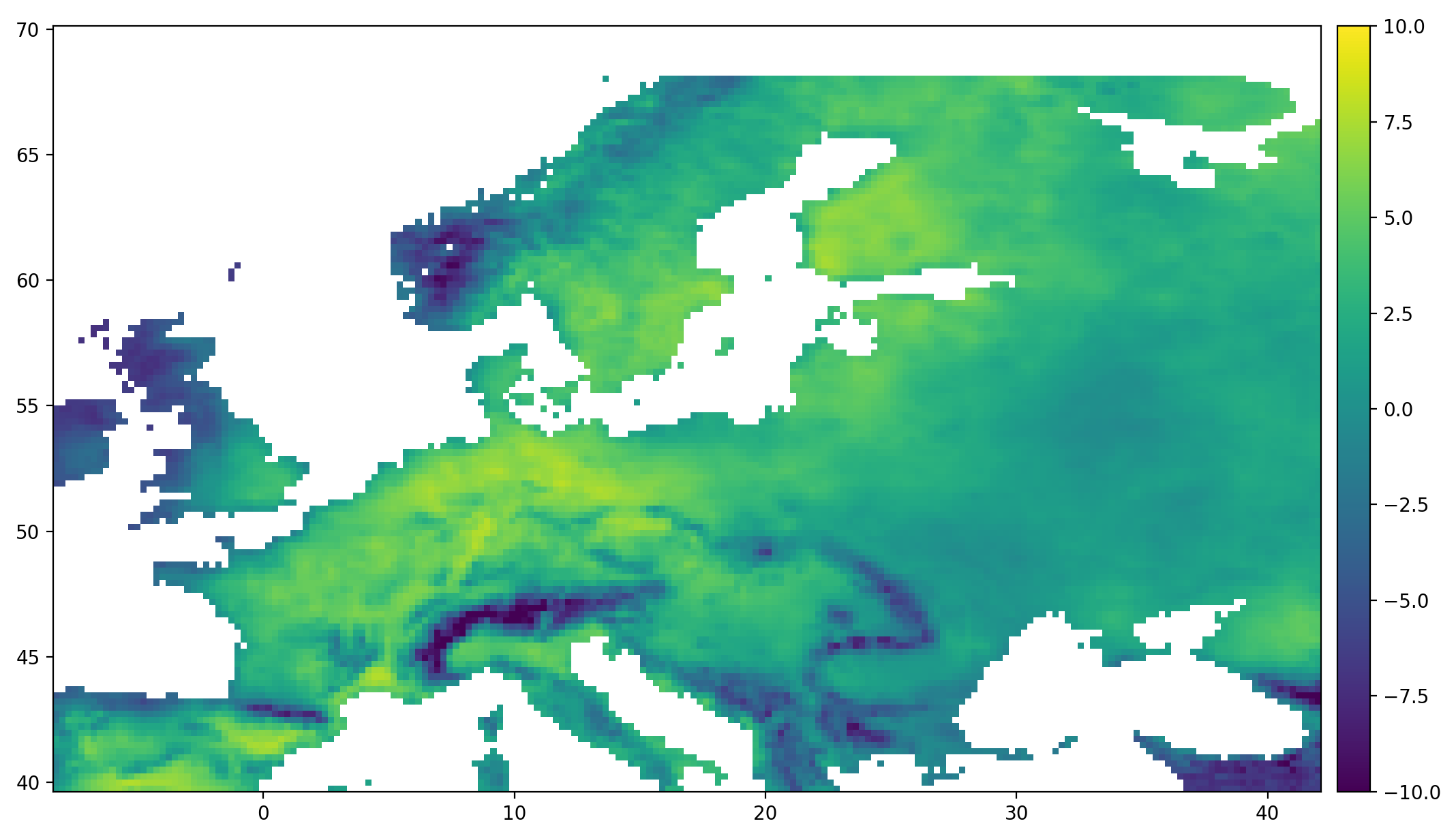
Figure 2: (Left) The difference between $0.95$ quantile tx variable of E-OBS v27 and interpolated $0.95$ quantile of CMIP6 tasmax, 2018.08.03±14 days. (Right) The difference between $0.95$ quantile tx variable of E-OBS v27 and interpolated $0.95$ quantile of X-MOS 2018.08.03±14 days.
Discussion
The improvements achieved by the X-MOS framework suggest significant practical implications in climate risk assessment and mitigation. The enhanced accuracy in predicting extreme events supports policymakers and decision-makers in developing informed strategies to manage climate-related risks. Additionally, the methodological innovations proposed in this paper could be integrated into existing CMIP-type models, broadening their applicability and enhancing their utility in future climate research.
Conclusion
The introduction of the X-MOS framework represents a noteworthy enhancement in the field of climate modeling, particularly in its application to extreme weather prediction accuracy. By leveraging advanced model output statistics, this approach offers a promising direction for future research and implementation in climate science. Further exploration into comparative analysis with emerging advanced models could offer additional insights to refine this approach further.

