- The paper introduces a multi-valued extension, mATL*, that enriches traditional ATL for strategic reasoning under uncertainty.
- It leverages distributive lattice structures and join-irreducible elements to translate multi-valued logic issues into classical model checking tasks.
- Experimental evaluations with autonomous drones validate superior performance and practical feasibility in uncertain, dynamic environments.
Multi-Valued Verification of Strategic Ability
This essay discusses a comprehensive study on extending alternating-time temporal logic (ATL) with a multi-valued logic framework. The paper "Multi-Valued Verification of Strategic Ability" explores the implications of this extension for strategic reasoning in multi-agent systems, presenting both theoretical insights and practical applications.
Motivation and Background
The motivation for introducing multi-valued logic into strategic reasoning is rooted in scenarios where truth values aren't binary. Traditional ATL provides tools for reasoning about what agents can enforce with certainty in a system. However, there are numerous situations where this binary logic falls short. Systems with uncertainty, conflicting information, or incomplete data require a richer set of truth values to adequately represent states and properties.
The paper leverages the concept of multi-valued logics to extend ATL into what they term mATL∗. This extended logic allows for more nuanced interpretations of strategic abilities in multi-agent contexts, offering a continuum of truth values beyond the simple true/false dichotomy.
Technical Contribution: Multi-Valued ATL
Syntax and Semantics
The authors define a new multi-valued variant of ATL, mATL∗, characterized by:
- Syntax: The inclusion of lattice-valued propositions which allow for complex truth values. The operators in mATL∗ mimic those of traditional ATL but are evaluated over a lattice structure rather than boolean algebra.
- Semantics: The multi-valued semantics extend traditional ATL by interpreting formulas over distributive lattices, allowing for varying degrees of truth. This generalization reveals how agents’ strategic capabilities can be interpreted across various scenarios, capturing both certainty and uncertainty in outcomes.
Key Results
The study presented various results, notably:
- Conservative Extension: The paper shows that mATL∗ is a conservative extension of ATL, meaning it retains the properties and interpretations of classical ATL when restricted to a two-valued domain.
- Model Checking Complexity: The model checking problem for mATL∗ scales linearly with the number of truth values, making the approach computationally feasible.
Figures:
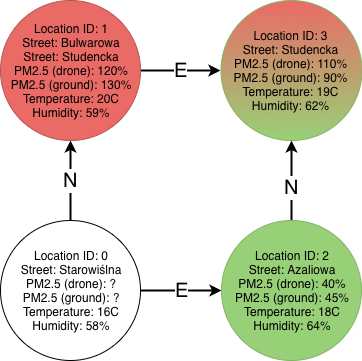
Figure 1: Map: drone navigation and measurements in an area of Cracow. Location colors indicate whether the PM2.5 readings are within or beyond the norm.
Methodology: Translation to Classical Model Checking
A cornerstone of the study is a translation methodology from multi-valued models to classical two-valued model checking. This methodology exploits the structure of distributive lattices:
- The use of join-irreducible elements allows decomposition of multi-valued reasoning into a series of classical two-valued checks.
- This reduction approach guarantees theoretical soundness by preserving the logical properties of mATL∗ in its classical analog.
The recursive and non-recursive algorithmic approaches developed leverage this reduction, thus enabling the practical application of traditional model checkers to multi-valued problems.
Applications and Experimental Evaluation
Application Scenario: A case study involving autonomous drones tasked with monitoring pollution was used to demonstrate the experimental feasibility of the approach. Each drone operates under uncertainty with regard to positioning and sensor accuracy, making it an ideal candidate for multi-valued reasoning.
Experimental Results: The multi-valued approach was quantifiably evaluated against this scenario, with the results indicating:
- Superior performance in environments with varying degrees of truth.
- Enhanced capability to deal with systems characterized by incomplete or uncertain information.
Figures:
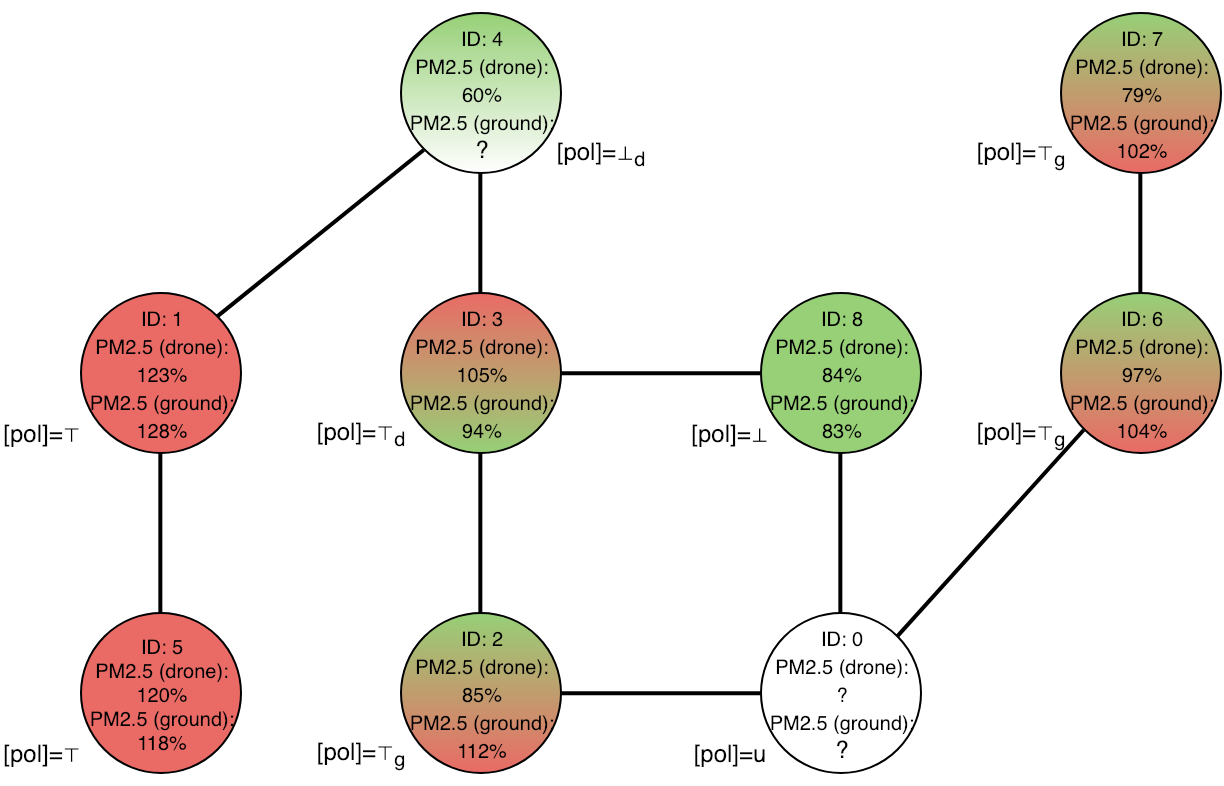
Figure 2: The map used in the experiments
Implications and Future Work
The implications of adopting mATL∗ in strategic reasoning for multi-agent systems are multifaceted:
- Practical Complexity Reduction: By translating complex multi-valued reasoning into classical logic problems, the authors open up new avenues for efficient verification of complex systems under uncertainty.
- Theoretical Insights: The study adds to the foundational understanding of how strategic abilities are affected by multi-valued interpretations, pushing the boundaries of classical ATL.
Future work involves further refining these methods to handle more sophisticated types of uncertainty and exploring their application in broader domains beyond strategic reasoning.
Conclusion
This research marks a significant step towards integrating multi-valued logic into the verification of strategic abilities in multi-agent systems. By extending ATL into mATL∗, the authors provide a powerful tool for capturing and reasoning about uncertainty and complex strategic interactions, essential for modern distributed systems.