- The paper introduces two coarse-graining approaches (I-GLE and P-GLE) to analyze non-equilibrium dynamics by deriving explicit memory kernels and noise correlations.
- It shows that model responses in harmonic and sawtooth potentials reveal deviations from equilibrium predictions and effective temperature variations.
- Active microrheology experiments validate the I-GLE model by linking microscopic friction forces to transport phenomena in non-equilibrium conditions.
Mobility, Response, and Transport in Non-Equilibrium Coarse-Grained Models
This paper explores the behavior and properties of coarse-grained models in non-equilibrium systems, focusing on mobility, response, and transport phenomena. Two different coarse-grained approaches are analyzed: one derived analytically by integrating out oscillators and another using projection operator techniques. The study compares these approaches to better understand their implications for dynamic coarse-graining beyond linear systems, with detailed examinations of equilibrium and non-equilibrium conditions.
Microscopic Model and Dynamic Coarse-Graining
The microscopic system under investigation is a tagged particle interacting with several solvent particles. Three distinct variations—EQ, FEED, and OU—are studied, each presenting unique microscopic dynamics and interactions. The study's coarse-grained models are derived using the Generalized Langevin Equation (GLE) through two methods:
- Integration Method (I-GLE): Here, solvent particles are analytically integrated out, providing explicit memory kernels and noise autocorrelation functions.
- Projection Method (P-GLE): The Mori-Zwanzig formalism is applied, resulting in a model with a memory kernel fulfilling the fluctuation-dissipation theorem (2FDT).
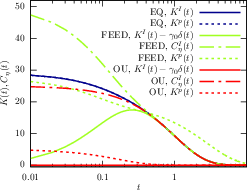
Figure 1: Memory kernel K(t) and noise autocorrelation function Cη(t) using the projection method (p) or the integration method (I) for the three different systems.
Both methods accurately capture some microscopic dynamics, as observed in identical velocity autocorrelation functions (VACFs) across models.
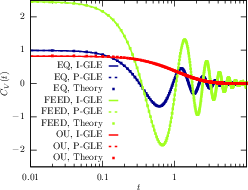
Figure 2: Velocity autocorrelation function CV(t) as extracted from different coarse-grained models compared to the theoretical prediction.
External Harmonic Potential
The study examines how coarse-grained models respond in harmonic potentials. In equilibrium (EQ), results align with the Boltzmann distribution. However, non-equilibrium systems (FEED, OU) show significant differences between the I-GLE and P-GLE models. The I-GLE captures complex behavior such as effective temperature dependence on potential strength and deviations from Boltzmann distribution, highlighting the intricate dynamics.
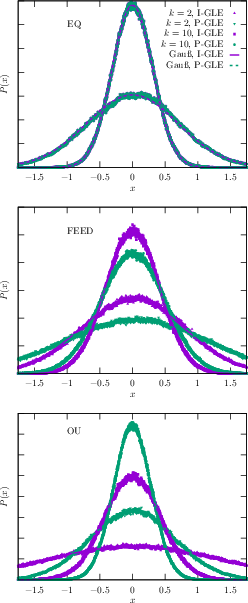
Figure 3: Position probability distribution P(x) as extracted from different coarse-grained models for harmonic external potentials.
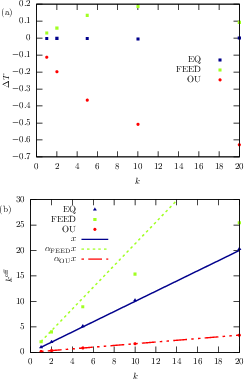
Figure 4: Effective temperature deviation $\Delta T = C_V(0) - C<sup>{k=0}_V(0).</sup></p></p>
<h2 class='paper-heading' id='active-microrheology'>Active Microrheology</h2>
<p>Active microrheological experiments reveal how colloids respond to constant external forces. The findings showcase distinct mobilities, confirming that I-GLE accurately connects to microscopic friction forces. Such insights underscore the model's practical relevance in simulating active particle behavior.
<img src="https://emergentmind-storage-cdn-c7atfsgud9cecchk.z01.azurefd.net/paper-images/2310-03565/FIG5.png" alt="Figure 5" title="" class="markdown-image" loading="lazy">
<p class="figure-caption">Figure 5: Average velocity $\langle v \rangleasresponsetoaconstantexternalpullingforceF_\text{ext}.</p></p><h2class=′paper−heading′id=′linear−response−and−first−fluctuation−dissipation−theorem′>LinearResponseandFirstFluctuation−DissipationTheorem</h2><p>Thestudyfurtherexplorestheunsteadyresponseofsystemsusingimpulseforces.Equilibriumconditionsadheretothe1FDT,whilenon−equilibriumsystems(e.g.,FEED,OU)exhibitdeviations.TheI−GLE,reflectingtruenon−equilibriumproperties,violatesthe1FDT,indicatingdistinctdissipationratesandworkpotential.<imgsrc="https://emergentmind−storage−cdn−c7atfsgud9cecchk.z01.azurefd.net/paper−images/2310−03565/FIG6.png"alt="Figure6"title=""class="markdown−image"loading="lazy"><pclass="figure−caption">Figure6:Lineartime−dependentresponse\chi(t) = \langle v_0(t) \rangletoanimpulseforce.</p></p><h2class=′paper−heading′id=′sawtooth−potential−and−non−equilibrium−flow′>SawtoothPotentialandNon−EquilibriumFlow</h2><p>Finally,thepaperinvestigatesworkperformanceusinganasymmetricsawtoothpotential.Whileequilibriumsystemsshownomovement,insightsintonon−equilibriumsystemsrevealdifferences.Specifically,theOUmodelshowcasesinherentflow,demonstratingitsabilitytoperformwork—anessentialcharacteristicforbiologicalandmechanicalapplications.<imgsrc="https://emergentmind−storage−cdn−c7atfsgud9cecchk.z01.azurefd.net/paper−images/2310−03565/FIG7.png"alt="Figure7"title=""class="markdown−image"loading="lazy"><pclass="figure−caption">Figure7:Time−dependentpositionx(t)$ of an individual tracer in a sawtooth potential.
Conclusions: Implications for Coarse-Grained Models
The findings emphasize the critical need for precise dynamic coarse-graining methods to accurately capture non-equilibrium phenomena, reflected in transport properties, energy dissipation, and system thermodynamics. Looking ahead, expanding these methodologies to complex systems could greatly advance understanding and applications in diverse fields such as biology and socio-economic modeling. The study underscores the potential of enhancing reconstructing techniques to effectively bridge microscopic and coarse-grained models in non-equilibrium contexts.