- The paper introduces SUnAA, a novel sparse unmixing method using convex combinations of library spectra to overcome limitations of conventional approaches.
- It employs a parameter-free active set algorithm and block coordinate descent to efficiently solve a non-convex optimization while enforcing physical constraints.
- Experimental results on simulated and Cuprite datasets show superior signal-to-reconstruction error performance and sharper abundance maps compared to baseline methods.
Sparse Unmixing via Archetypal Analysis: SUnAA
Introduction
This paper presents SUnAA, a new methodology for sparse unmixing of hyperspectral data based on archetypal analysis. Traditional sparse unmixing approaches, such as SUnSAL and its variants, typically rely on convex optimization frameworks and fixed spectral libraries but suffer from limitations in representing material variability and enforcing physical constraints like abundance sum-to-one. SUnAA distinguishes itself by modeling endmembers as convex combinations of library spectra, leading to a semi-supervised formulation. The resulting non-convex optimization problem is solved via an efficient parameter-free active set algorithm.
Methodological Innovations
SUnAA advances sparse unmixing with a model where the endmembers present in the scene are convex mixtures of library spectra. This formulation captures spectral variability and library mismatch effects, addressing limitations encountered in conventional sparse regression. The method enforces both endmember and abundance non-negativity and sum-to-one constraints, ensuring physically meaningful solutions. While the joint optimization over endmember contributions and abundances is non-convex, the problem is convex in each variable when the other is fixed, making block coordinate descent tractable. The authors employ an active set algorithm for both steps, leveraging solution sparsity for computational efficiency.
Extensive experiments were conducted on two simulated datacubes, DC1 and DC2, representing both relatively simple and challenging scenarios with varying levels of noise. SUnAA demonstrates superior performance in signal-to-reconstruction error (SRE), consistently outperforming seven baseline methods, including SUnSAL, SUnSAL-TV, S2WSU, MUA, MUSIC-CSR, SUnCNN, and SUnSAL-S.
For DC1, SUnAA achieves maximal SRE at higher SNRs (30 dB, 40 dB), only marginally trailing MUA for extremely low SNRs (20 dB). In the more complex DC2 scenario, characterized by the absence of pure pixels and presence of scaled versions of endmembers, SUnAA delivers substantial improvements in SRE across all noise levels, a region where conventional methods exhibit breakdowns due to library redundancy and non-sparsity in solutions. Visual comparisons show that SUnAA yields sharper and less oversmoothed abundance maps relative to methods imposing spatial regularizers or segmentation pre-processing, which tend to introduce artifacts or excessive smoothing.
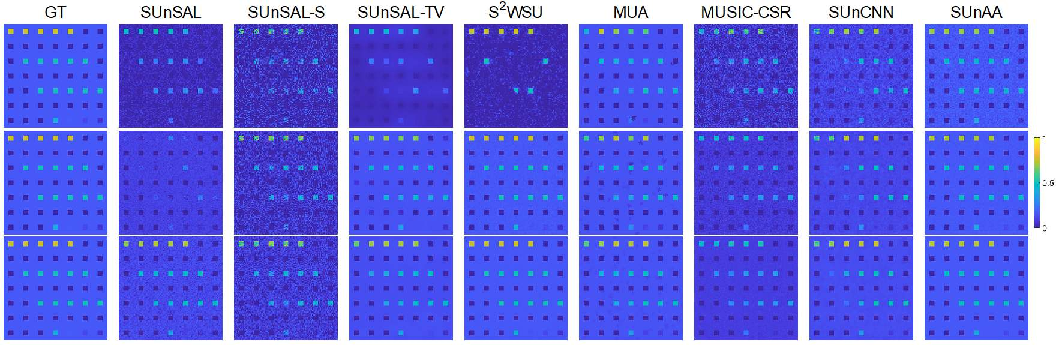
Figure 1: SRE metrics for DC1 and DC2 datasets highlighting SUnAA's superiority, especially under challenging library mismatch and noise conditions.
Real Dataset Evaluation: Cuprite Case Study
SUnAA was further validated on the Cuprite dataset, a well-studied hyperspectral scene with ground-truth mineralogical maps. Using a library of 498 USGS spectra and selecting r=16 endmembers, SUnAA exhibits pronounced qualitative improvements over conventional techniques in detecting dominant minerals such as Chalcedony, Alunite, and Kaolinite. Abundance maps produced by SUnAA accurately localize these minerals, with sharper textures and reduced oversmoothing compared to SUnSAL-TV and MUA, which suffer from regularization-induced loss of spatial detail.
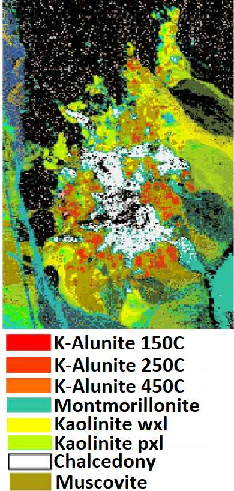
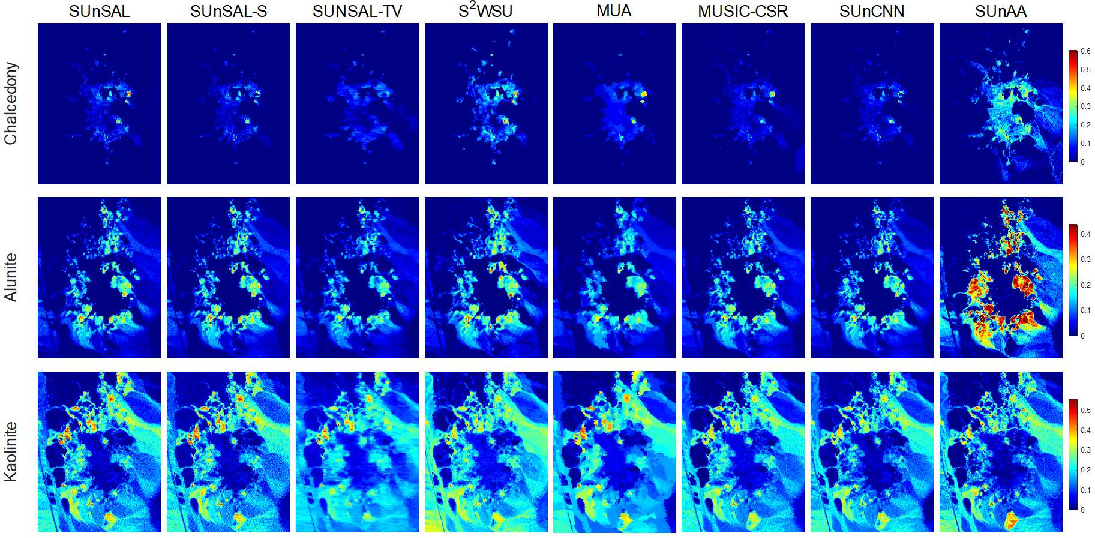
Figure 2: Estimated abundance maps for the Cuprite dataset, showcasing SUnAA's enhanced accuracy and spatial fidelity for dominant minerals.
A notable contribution is SUnAA's ability to estimate endmember spectra as scaled versions of library elements, thus adapting to real-world variability induced by atmospheric, illumination, or intrinsic material factors. The comparison between estimated endmembers and library spectra reveals that SUnAA can compensate for scaling and variability, improving the match to scene materials.
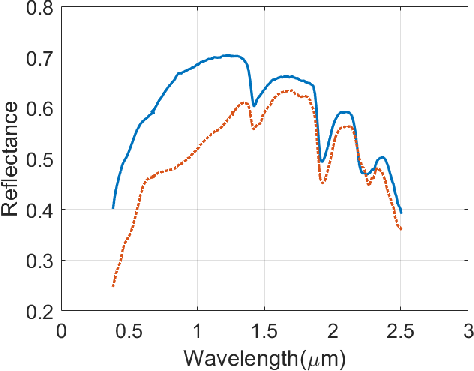
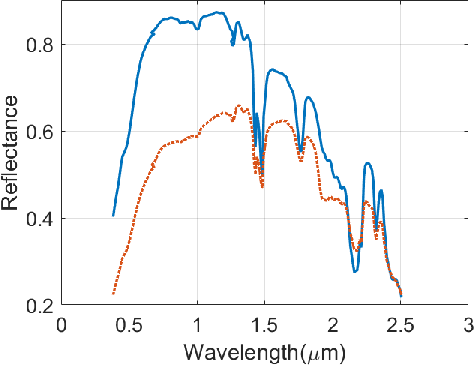
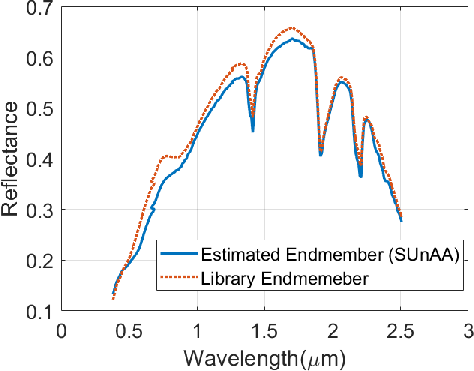
Figure 3: Endmembers of three dominant minerals estimated using SUnAA versus USGS library spectra, demonstrating the capacity for adaptive convex combinations.
Practical and Theoretical Implications
SUnAA’s methodological shift to archetypal analysis offers several practical benefits:
- Robustness to Library Mismatch: Modeling endmembers as convex combinations enables adaptation to real-world spectral variability, reducing reliance on exhaustive library pruning.
- Physical Constraints Enforcement: Non-negativity and sum-to-one constraints yield abundance and endmember contributions with clear physical interpretability.
- Parameter-free Optimization: The active set algorithm requires only the number of endmembers of interest, simplifying hyperparameter selection compared to deep learning approaches.
- Consistent Performance Across Noise Levels: Empirical results indicate marked stability and accuracy, even under challenging scenarios lacking pure pixels.
From a theoretical perspective, SUnAA represents an advance in semi-supervised unmixing, bridging archetypal analysis and sparse regression. The block coordinate descent approach to non-convex minimization ensures scalability and feasibility for large datasets. The capacity to flexibly represent material variability suggests new directions for unmixing under nonlinear or uncertain mixture models.
Future Directions
Potential lines of development include extension of SUnAA to accommodate nonlinear mixing models, integration with spatial regularization for improved robustness in highly textured scenes, and adaptation to real-time processing via parallelized active set algorithms. Investigation into automatic selection of endmember number and hybridization with deep encoder-decoder frameworks could yield further advances.
Conclusion
SUnAA establishes a new paradigm for sparse unmixing in hyperspectral analysis, leveraging archetypal analysis to overcome the limitations of fixed library models and convex optimization. The iterative parameter-free approach achieves superior quantitative and qualitative results on both simulated and real-world benchmarks, demonstrating robust detection and accurate abundance estimation, particularly in settings with significant library mismatch and spectral variability. SUnAA offers a promising foundation for future research in interpretable, adaptive unmixing methods.