- The paper examines the BMV experiment to assess if gravity mediated entanglement indicates intrinsic quantum features of gravity.
- It utilizes quantum field theory to compare quantum and classical gravitational interactions, highlighting key theoretical assumptions.
- Experimental modifications, such as aligning interaction times with light-crossing intervals, are proposed to strengthen evidence for quantum gravity.
The paper "What gravity mediated entanglement can really tell us about quantum gravity" scrutinizes the Bose-Marletto-Vedral (BMV) experiment aimed at detecting quantum gravity through gravity-mediated entanglement. The authors explore whether these experiments can prove the quantum nature of gravity without assuming quantum degrees within gravitational fields and offer insights into modifications that could strengthen claims about quantum gravity.
Entanglement and Quantum Gravity Experiments
The BMV Experimental Setup
The BMV proposal involves two particles in a superposition traveling along two paths, influenced solely by gravity. The concept aims for these paths to generate distinct gravitational fields which can entangle the particles.
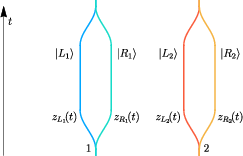
Figure 1: Schematic representation of the BMV setup, where two particles labelled by i=1,2 can undergo a superposition of two trajectories, zLi(t) and zRi(t), corresponding to quantum states ∣Li⟩ and ∣Ri⟩.
Despite technological challenges including isolating particles and minimizing decoherence, advancements are close to practical implementations. Yet, debates arise about whether gravity's capacity to entangle masses indicates its quantum nature. Arguments suggest abandoning locality or categorically defining gravity as quantum if gravitational fields entangle the particles.
Quantum Modelling of Interaction
The paper explores a quantum field theoretic model of the BMV experiment, considering weak-field quantized gravity via gravitational perturbations h^μν(x). Propagators from quantum field theory define interactions, distinguishing classical from quantum contributions to entanglement.
Quantum Controlled Classical Fields
The authors provide a classical field description, proposing a quantum-controlled classical model where each path corresponds to distinct classical gravitational interactions between masses, showing quantum-controlled fields can yield results similar to quantum descriptions.
Analysis of Locality and Entanglement
Locality Considerations
The paper discusses two distinct notions of locality: event locality (spacetime-based) and system locality (quantum mechanics-based). It's critical to distinguish these, especially within the context of local operations and classical communication (LOCC).
Entanglement Implications
Under conventional views influenced by LOCC arguments, if gravity entangles particles, it suggests deviations from classical descriptions. However, assuming the gravitational field as a mediator inherently links quantum information principles with spacetime characteristics—highlighting the need for assumptions about mediators.
Distinguishing Quantum Gravity
Proposed Modifications
To more definitively prove quantum gravitational behavior via the BMV experiment, modifications are recommended. Achieving interaction times proportional to light-crossing times would accentuate the quantum behavior of gravitational fields. Thus, adaptations could yield stronger evidence without relying on mediator assumptions.
Broader Context and Implications
Even with classical gravity mediating entanglement, valuable insights into quantum-gravity interactions arise. Observations affirm potential for quantum channels between masses influenced by gravity—informative for quantum gravity but distinct from proving quantum field components.
Conclusion
The review presented by the authors articulates nuances in using tabletop experiments to assert claims about quantum gravity. The distinctions lie in separating mediated entanglement from intrinsic quantum behaviors within gravity. Future adaptations to BMV experiments could yield compelling evidence aligning with theoretical predictions while enhancing understanding of fundamental spacetime interactions. Quantum-controlled models could robustly support experimental setups, suggesting intriguing paths for quantum gravity investigation.