- The paper presents a comprehensive analysis of Taurid meteor activity and orbital variations using two decades of multi-method observations.
- It employs visual, photographic, video, and radar data to reveal radiant drift, activity profiles, and resonance influences from Jupiter.
- The study highlights implications for meteoroid stream dynamics and parent body interactions, supporting refined dynamical models.
An Observational Synthesis of the Taurid Meteor Complex
The paper "An observational synthesis of the Taurid meteor complex" (2202.05141) provides a comprehensive analysis of the Taurid meteor showers (NTA, STA, BTA, ZPE) using a wide array of observational data collected over two decades. This synthesis aims to provide a solid observational foundation for future models of the Taurid Meteoroid Complex (TMC).
Overview of Observations
The study utilizes data collected through visual, optical, and radar methods to analyze the Taurid showers' activity, radiant drift, and orbital variations. Visual observations from sources such as the IMO Visual Meteor Data Base (VMDB) are complemented with photographic and video records, with notable contributions from networks like CAMS and SonotaCo. Radar observations, particularly from the Canadian Meteor Orbit Radar (CMOR), provide valuable insights into the less observable daytime showers (BTA and ZPE).
Activity Profiles
The Taurid showers exhibit significant variability in activity profiles both annually and across measurement techniques. The paper delineates the showers' average activity levels, highlighting a low annual activity (usually no more than 15 visual meteors per hour), with the STA generally showing predominance in autumn, and the ZPE leading over the BTA in spring.
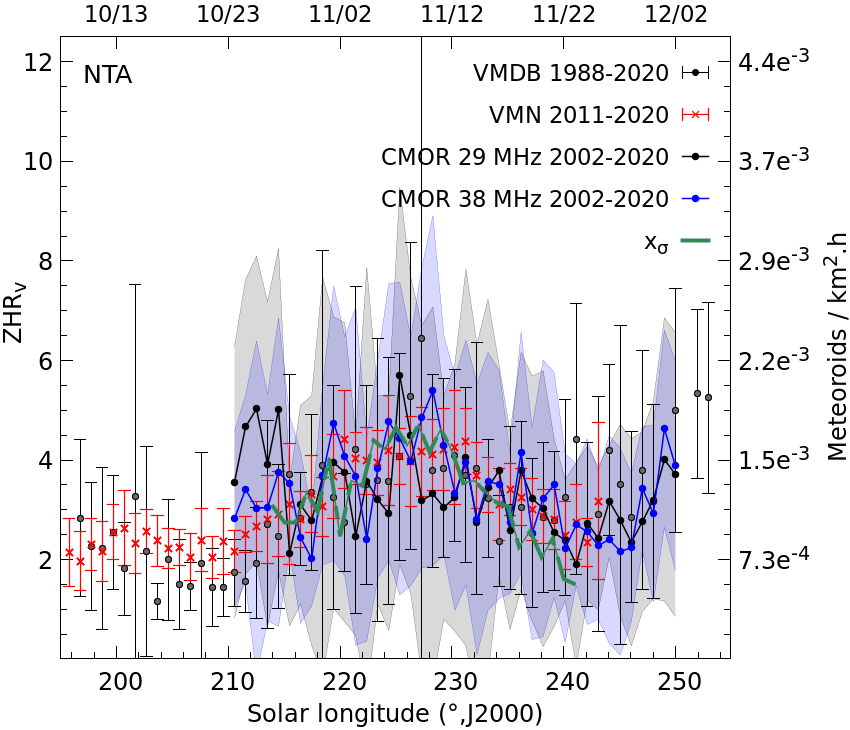
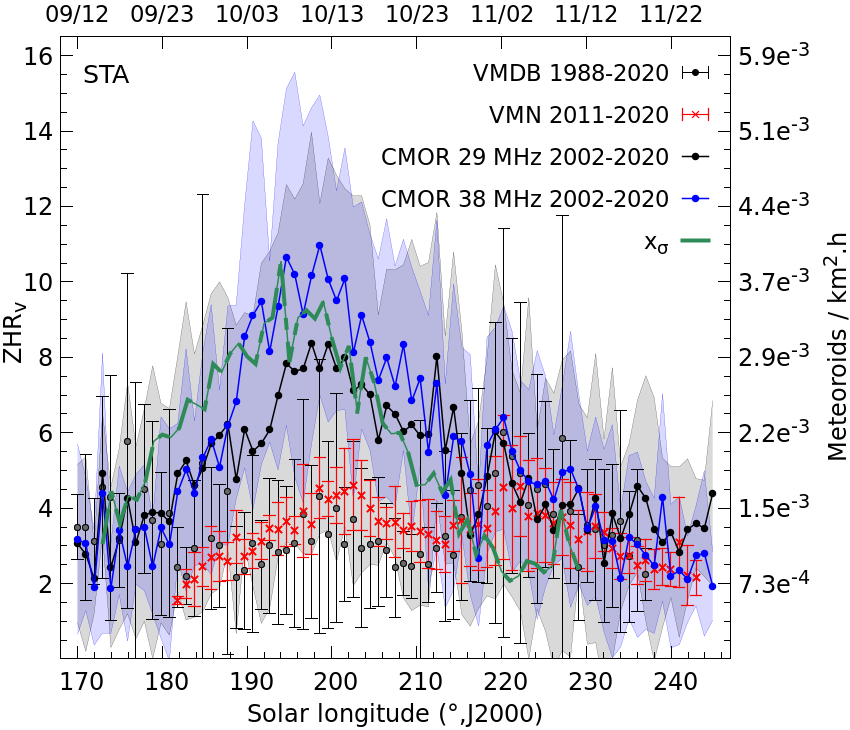
Figure 1: The average activity (ZHRv) of the NTA and STA measured from 29 MHz CMOR data, visual observations, and the VMN.
Radiant and Orbital Evolution
The radiants of the Taurid showers evolve over weeks, exhibiting different structures above and below the ecliptic. This complexity suggests an old meteoroid stream influenced by long-term dynamical processes, possibly linked to Comet 2P/Encke. The orbital evolution of the streams is discussed extensively, with correlations noted between orbital elements, providing constraints for dynamical modeling.
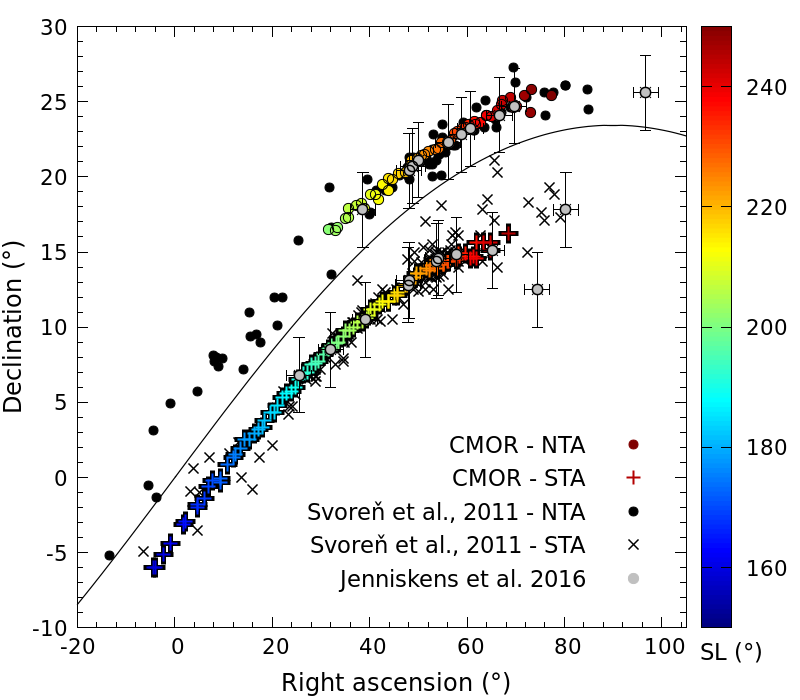
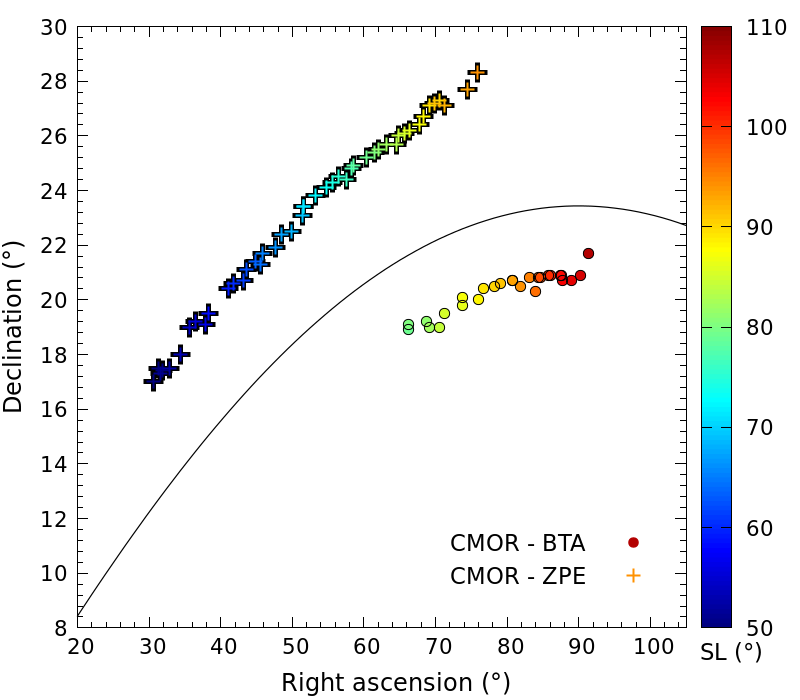
Figure 2: Geocentric right ascension and declination of the Taurids' radiants as a function of solar longitude, revealing the complexity and drift of the showers.
Resonance and Meteoroid Swarm
A key aspect of the Taurid complex is the 7:2 mean motion resonance with Jupiter, which influences the stream's structure and dynamics. Although optical observations frequently report enhanced fireball activity due to resonant swarm returns, radar data from CMOR has yet to identify these in smaller meteor sizes, suggesting rapid removal of smaller particles from resonance.
Physical Properties Implications
The Taurids provide valuable insights into meteoroid physical properties, with studies indicating significant heterogeneity in bulk density and size distributions. The Taurids' strength and density variations hint at cometary origins, though some materials reflect possible asteroidal characteristics, reinforcing the hypothesis of a complex, evolving origin potentially involving multiple parent bodies within the TMC.
The paper discusses contradictory evidence on the age of the Taurid complex. While the branch formation and resonance suggest a significant age - potentially 10,000 years or more - observations implicate more recent fragmentation events that could have contributed to the complex's current structure. The presence of multiple parent bodies and associated asteroids further complicates this picture, indicating diverse evolutionary pathways.
Conclusion
This synthesis underlines the complexity of the Taurid meteor showers, driven by both long-term evolutionary dynamics and transient resonant interactions. The findings highlight the need for robust dynamical models integrating these observational constraints to fully elucidate the Taurids' meteoroid stream formation and evolution. Such comprehensive modeling can significantly advance our understanding of meteoroid stream dynamics and their relationship with potential parent bodies.