- The paper introduces a bi-level optimization framework that coordinates traditional devices and smart PV inverters to minimize network active power losses.
- It employs an upper-level MISOCP for scheduling OLTCs and capacitor banks and a lower-level distributed control for real-time inverter adjustments.
- Simulation on the IEEE 33-bus network demonstrates a 15.7% reduction in daily power losses and improved voltage regulation compared to conventional methods.
Bi-level Volt/VAR Optimization in Distribution Networks with Smart PV Inverters
This paper introduces a bi-level optimization framework designed to enhance Volt/VAR Control (VVC) in distribution networks, particularly in scenarios with high penetration of smart residential photovoltaic (PV) inverters. Traditional mechanical devices such as on-load tap changers (OLTCs) and capacitor banks (CBs) are complemented and coordinated with the rapid-response capabilities of smart PV inverters, allowing for improved voltage regulation and reduced network losses.
Framework Overview
The bi-level optimization model is structured into two distinct levels:
- Upper-Level Optimization: This level is responsible for scheduling conventional mechanical devices with the aim of minimizing network active power losses. It is formulated as a Mixed Integer Second Order Cone Programming (MISOCP) problem, incorporating constraints that reflect PV inverter reactive outputs based on Karush-Kuhn-Tucker (KKT) conditions.
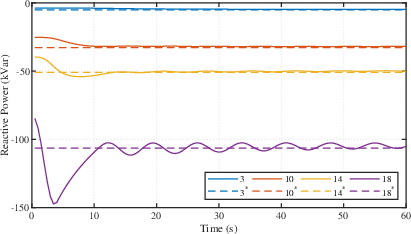
- Lower-Level Optimization: It models the fast, autonomous actions of smart PV inverters, which adjust their reactive outputs to resolve sudden voltage deviations and optimize their own objectives, such as minimizing reactive power costs or equalizing the inverter utilization ratios. This process is executed in a distributed manner, leveraging local measurements and communication among inverters.
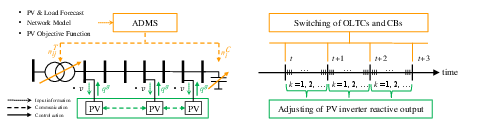
Figure 1: Overview of the implementation of the bi-level optimization model.
Implementation Details
Upper-Level Optimization
The upper-level dispatches OLTCs and CBs using a periodic schedule to minimize active power losses and maintain network stability. The optimization involves:
- Utilizing the DistFlow model to accurately represent power flows.
- Relaxing nonconvex constraints with second-order cone programming to ensure computational feasibility.
- Coordinating the network voltage profiles by setting tap positions on OLTCs and controlling CB units.
Lower-Level Optimization
Smart PV inverters operate autonomously within the scope defined by the upper-level. They iteratively adjust their reactive power outputs by solving a local optimization problem. Key elements include:
Case Study Analysis
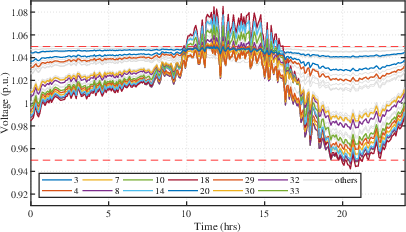
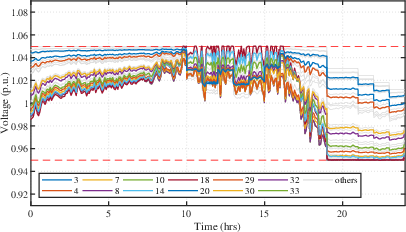
Simulation results from standard IEEE test feeders illustrate the effectiveness of the bi-level optimization approach. With regards to the IEEE 33-bus network:
Comparison with Traditional Models
The bi-level model demonstrates superior performance compared to single-level optimization models that either directly control PV inverter outputs or neglect their contributions altogether. Comparative analysis shows:
- The solution time increases with bi-level models due to additional complexity, yet the reduction in active power losses substantiates its efficacy.
- Traditional models fail to harness the full reactive capabilities of smart PV inverters, leading to suboptimal loss minimization.
Conclusion
The bi-level optimization framework presents a significant advancement in integrating smart PV inverters into the VVC architecture, enabling both system-wide coordination and swift local response to voltage fluctuations. Future research should focus on extending this framework to three-phase unbalanced networks and incorporating additional types of voltage regulation resources, such as active power control from PV inverters. This approach provides a robust and flexible solution for modern distribution networks challenged by high renewable energy penetration.