- The paper introduces a multilayer heterogeneous integration using an intermediate silicon layer to bridge III-V and SiN materials, achieving >10 mW output and sub-kHz linewidths.
- The study characterizes laser performance via LI measurements, showing that longer gain sections and optimal grating κ values significantly reduce threshold currents.
- The research employs self-injection locking with high-Q SiN ring resonators to drastically lower frequency noise, benefiting applications like coherent communications and LIDAR.
The paper "High-performance lasers for fully integrated silicon nitride photonics" by Chao Xiang et al. details the development of advanced lasers fully integrated on silicon nitride (SiN) photonic platforms. This research addresses existing challenges in integrating active laser components with SiN-based photonic circuits and proposes novel solutions to improve the performance and versatility of SiN photonic systems.
Innovations in Laser Design and Fabrication
In recent years, silicon nitride (SiN) has emerged as a preferable material for fabricating integrated photonics due to its low optical loss, wide transparency range, and compatibility with standard CMOS processes. However, the integration of SiN with active devices such as lasers, modulators, and photodetectors has faced challenges. The low refractive index of SiN at telecommunication wavelengths makes direct heterogeneous integration with high-index III-V gain materials difficult.
To address these challenges, the paper introduces a novel multilayer heterogeneous integration approach. This methodology utilizes an intermediate silicon (Si) layer acting as an index-matching layer between III-V materials and the SiN platform. This tri-layer structure facilitates not only optical gain for forming lasers but also augments the functional scope of SiN photonic circuits by enabling optical modulation and detection through available III-V/Si or Si devices.
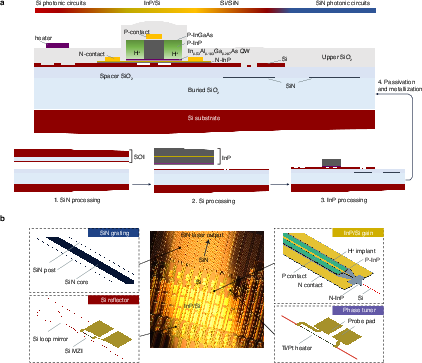
Figure 1: Schematic diagram and photograph of the fabricated InP/Si/SiN laser integrated with photonic circuits before probe metal deposition.
The laser design employs a sophisticated architecture (Figure 1), installing an InP/Si gain section and combining it with SiN and silicon components to address challenges such as mode transition loss and complex fabrication issues. A pivotal innovation in this design is the use of an intermediate Si layer to bridge refractive indices between III-V and SiN materials. The resultant lasers demonstrated high output power (over 10 mW) and sub-kHz fundamental linewidths.
The authors presented comprehensive characterization of the laser devices. They provided light-current (LI) characteristic data for varying gain section lengths and SiN grating κ values. As indicated by the data, longer gain sections combined with lower grating κ values contributed to an increase in laser output power and a decrease in threshold currents.
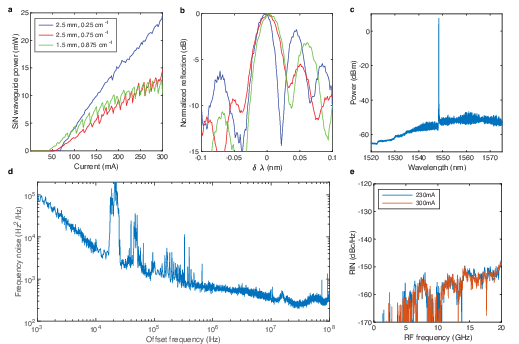
Figure 2: Characterization results of lasers with varying gain section lengths and grating κ values, illustrating different performance metrics such as LI measurements and frequency noise spectra.
In addition to the fundamental linewidth, the frequency noise and RIN are critically relevant for the operation of lasers in advanced applications. The study demonstrates lasers with <1 kHz linewidth and relative intensity noise better than -150 dBc/Hz, effectively addressing previous challenges associated with traditional monolithic III-V lasers whose semiconductor linewidths were generally limited to the MHz range.
Self-Injection Locking with High-Q SiN Ring Resonators
The research introduces the application of self-injection locking to enhance laser coherence in high-performance semiconductor lasers. By coupling a high-power, low-noise semiconductor laser to an ultra-high-Q SiN ring resonator, the authors demonstrate significant reduction in laser frequency noise, leading to a hertz-level fundamental linewidth. This advancement holds substantial implications for applications such as coherent communications, LIDAR, and high-fidelity RF filtering.
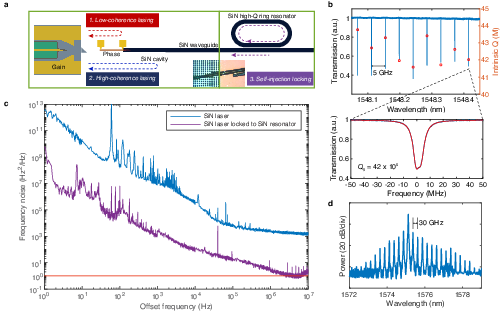
Figure 3: Schematic of lasing conditions and enhancement of laser performance through self-injection locking using high-Q SiN ring resonators.
Implications and Future Directions
This study presents advancements in the field of integrated photonics, primarily focusing on the development of high-performance lasers using SiN waveguides suitable for integration with III-V materials. The ability to achieve high output power, narrow linewidths, and low noise is pivotal for various applications, including LIDAR, coherent optical communications, and RF filtering. The utilization of ultra-low-loss SiN microresonators can further advance semiconductor laser performance, leading to more stable and phase-noise-reduced light sources.
Figure 3: Illustration and characterization of a high-coherence SiN laser, self-injection locked to a high-Q SiN ring resonator showing increased coherence and reduced frequency noise.
The demonstrated integration techniques set the stage for broader adoption of SiN-based photonics in industry applications, leveraging the material's inherent benefits in forming a viable alternative to traditional photonic platforms. The potential for generating broadband frequency combs and achieving ultra-low phase noise is poised to further revolutionize fields reliant on high-performance laser technology.
Practical and Theoretical Implications
The research delineates a significant step in the evolution of fully integrated SiN photonic platforms. By leveraging multilayer heterogeneous integration, this work addresses critical challenges such as mode transition loss and optimized cavity design for high device yield and output power at telecommunication wavelengths. These advancements potentially catalyze progress in high-bandwidth communications systems by enabling the inclusion of high-power, low phase noise laser sources in integrated SiN photonic chips.
The investigation into self-injection locking with high-Q SiN ring resonators reveals opportunities for advancing laser coherence through feedback mechanisms. The remarkable suppression in laser frequency noise with the inclusion of high-Q resonators highlights the potential for ultra-narrow linewidth semiconductor lasers, which are critical in precision applications.
Figure 3: High-coherence SiN laser characterization showing improvements in coherence through self-injection locking with a high-Q SiN ring resonator.
Conclusion
The paper demonstrates substantial advancements in integrating high-performance lasers into silicon nitride photonics, addressing previous limitations in mode transition loss, cavity design, and manufacturing complexity. The results exhibit significant progress in terms of output power and linewidth, positioning these devices for practical application in optical communication, LIDAR, and other photonic systems. Future developments may continue to enhance SiN photonic integrations, paving the way for breakthroughs in high-precision applications and expanding the landscape of silicon photonics industry capabilities.

