- The paper introduces Fusion-based Quantum Computing (FBQC) which combines entangled resource state generation with fusion measurements to simplify quantum architecture.
- The model achieves low operational depth and minimizes classical processing by measuring physical qubits immediately upon preparation.
- Topological fault tolerance is employed through redundant check operators and quantum error correction, enhancing resilience against photon loss and fusion errors.
Fusion-based Quantum Computation
Introduction
The paper introduces Fusion-based Quantum Computing (FBQC), a model that leverages two principal operations: the generation of small, constant-sized entangled resource states and projective entangling measurements termed "fusions." It integrates topological fault tolerance into this model, primarily focusing on photonic systems. FBQC presents significant architectural simplifications by employing identical modules that require minimal operational depth on each physical qubit, simultaneously reducing classical processing demands.
Architecture and Principles of FBQC
FBQC reshapes conventional approaches by directly utilizing resource state generation and fusion operations without necessitating ancillary primitives. This promotes a low-depth protocol wherein each physical qubit is promptly measured post-preparation, thereby curtailing classical processing overheads and enhancing resilience to erasure and Pauli errors.
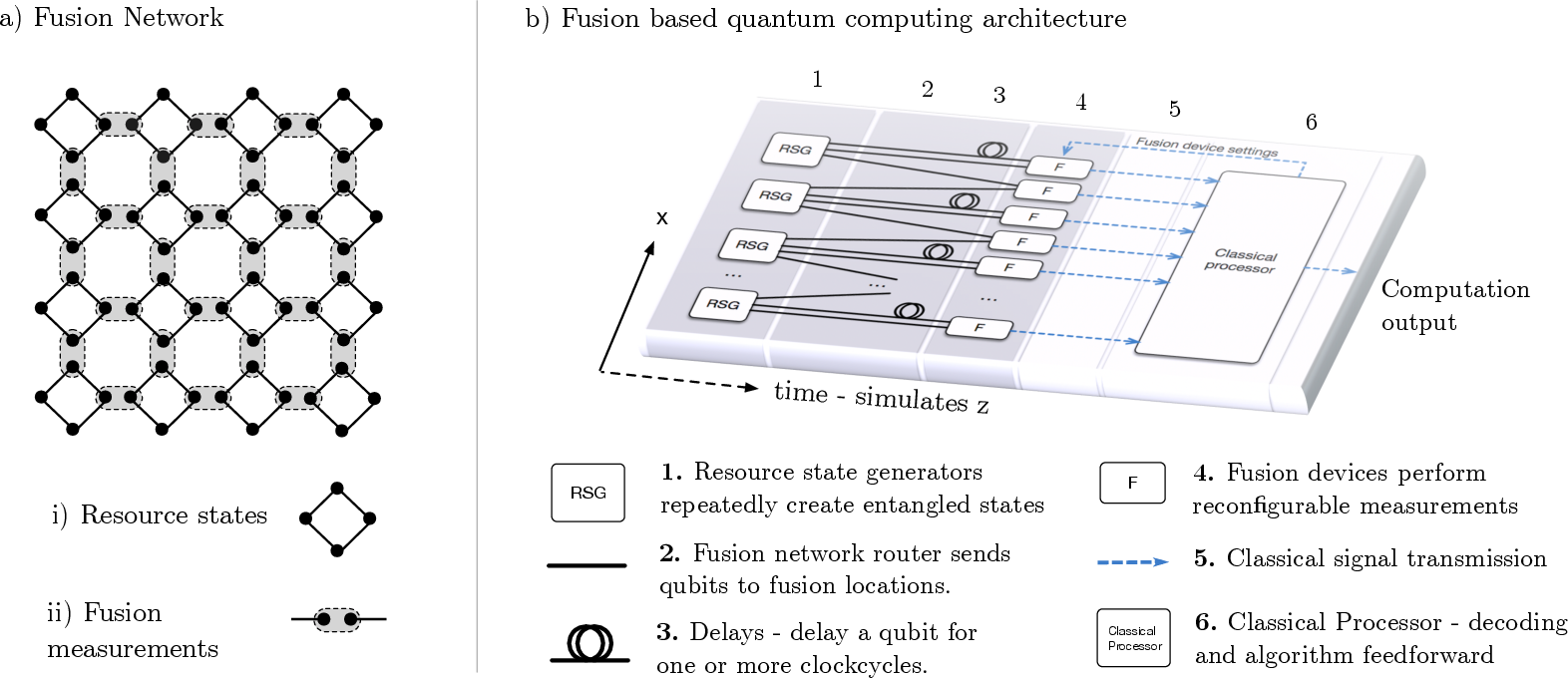
Figure 1: FBQC entangles qubits into a 2D lattice via fusion, showcasing an architecture with resource state generators linking qubits to subsequent fusions and classical processors managing decoding and logic.
By addressing linear optical quantum computing, FBQC adapts to the inherent non-determinism of fusion operations using quantum error correction protocols to manage potential fusion failures effectively, thus improving fault tolerance thresholds compared to other schemes.
Fault-Tolerant Fusion Networks (FTFN)
The construction of FTFNs introduces redundancy in measurement outcomes through a group of "check operators," encapsulating the fault tolerance design. The surviving stabilizer group determines post-fusion state correlations, enabling error corrections based on parity checks arising from fusion measurements.
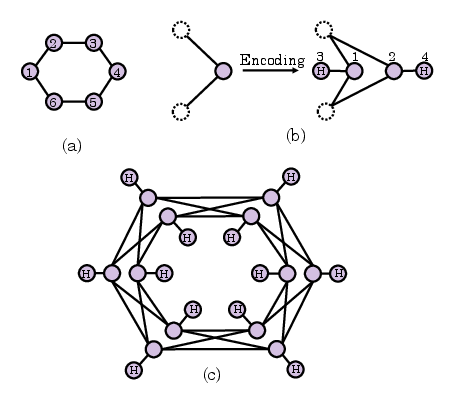
Figure 2: A 6-ring resource state with stabilizers outlined highlights encoded qubit transformation into a Shor code, demonstrating multistage entanglement structure.
The FBQC model uses topological structures to construct low-density parity check codes, where the resultant fusion network behaves as a 2D topological code extended over time. The function of classical decoding produces a classical syndrome graph, guiding logical operators to decode errors effectively.
Implementation and Error Analysis
The implementation discussion focuses on photonic fusion operations, engaging Bell fusions through linear optical circuits. Photon loss and fusion failure become a cornerstone consideration, particularly in balancing erasure tolerance and performance. Techniques such as boosting fusions with Bell pairs increase resilience, allowing for acceptable loss thresholds in photonic qubits.
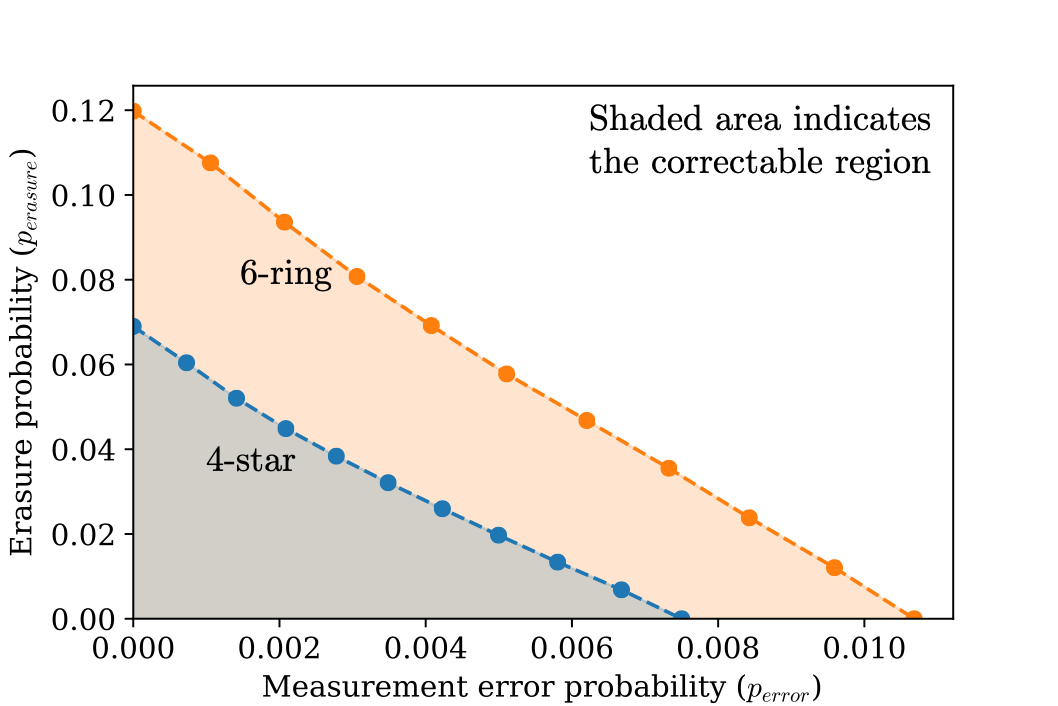
Figure 3: Correctable regions for the 4-star and six-ring networks under fusion erasure and error parameters, indicating superior thresholds for the six-ring network.
Practical encoding strategies are advised to enhance the erasure stability, emphasizing Shor encodings to preserve the fault-tolerant landscape amidst photonic rigor and fusion failings.
Quantum Computation and Logical Gates
Logical operations within FBQC are realized by transforming resource measurements, architecting boundaries for logical qubits via topological features, or using lattice surgeries. Classical feedforward on a logical level—decoupled from quantum operations—plays a critical role, interfacing directly with the Pauli frame representation of the quantum state.
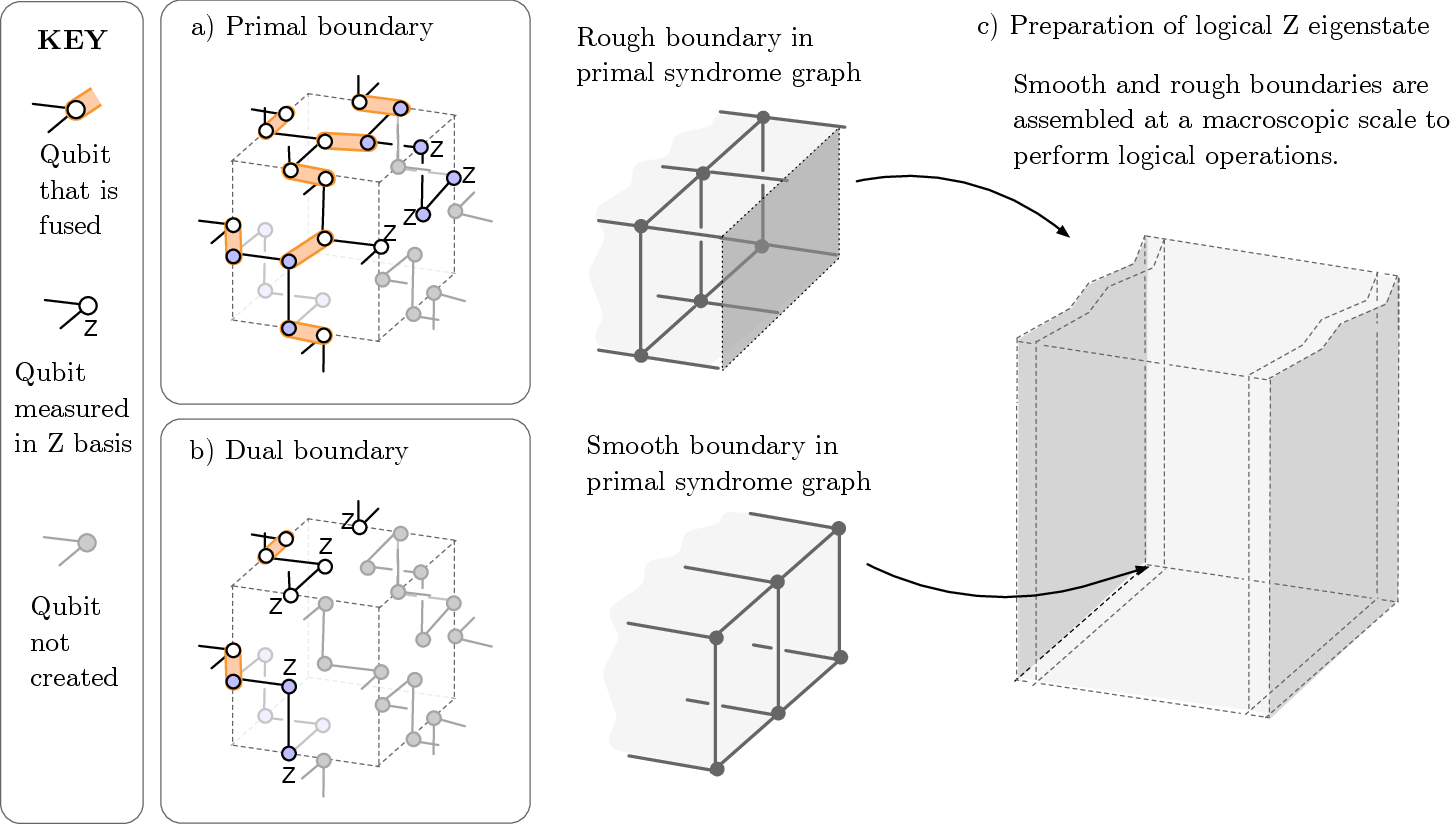
Figure 4: Representation of boundaries employing primal and dual boundaries to perform quantum computation operations, synthesizing unit cells to create and manipulate logical qubits.
Conclusion
FBQC stands as an adaptable, hardware-agnostic model, enhancing fault tolerance and architectural efficiency for various quantum systems. It demonstrates significant improvements in loss and error handling thresholds, thereby presenting a robust path toward scalable quantum computing. The interconnectivity of FBQC operations with advanced classical decoding frameworks forms the backbone for its applied success across photonic and potentially hybrid quantum architectures.

