Papers
Topics
Authors
Recent
Search
2000 character limit reached

Programming by Rewards

Published 14 Jul 2020 in cs.LG, cs.AI, cs.PL, cs.SE, and stat.ML | (2007.06835v1)

Abstract: We formalize and study ``programming by rewards'' (PBR), a new approach for specifying and synthesizing subroutines for optimizing some quantitative metric such as performance, resource utilization, or correctness over a benchmark. A PBR specification consists of (1) input features $x$, and (2) a reward function $r$, modeled as a black-box component (which we can only run), that assigns a reward for each execution. The goal of the synthesizer is to synthesize a "decision function" $f$ which transforms the features to a decision value for the black-box component so as to maximize the expected reward $E[r \circ f (x)]$ for executing decisions $f(x)$ for various values of $x$. We consider a space of decision functions in a DSL of loop-free if-then-else programs, which can branch on linear functions of the input features in a tree-structure and compute a linear function of the inputs in the leaves of the tree. We find that this DSL captures decision functions that are manually written in practice by programmers. Our technical contribution is the use of continuous-optimization techniques to perform synthesis of such decision functions as if-then-else programs. We also show that the framework is theoretically-founded ---in cases when the rewards satisfy nice properties, the synthesized code is optimal in a precise sense. We have leveraged PBR to synthesize non-trivial decision functions related to search and ranking heuristics in the PROSE codebase (an industrial strength program synthesis framework) and achieve competitive results to manually written procedures over multiple man years of tuning. We present empirical evaluation against other baseline techniques over real-world case studies (including PROSE) as well on simple synthetic benchmarks.
Citations (2)

Summary

  • The paper introduces Programming by Rewards, a novel approach that synthesizes decision functions using black-box rewards combined with white-box decision structures.
  • It employs a domain-specific language and continuous optimization techniques like gradient descent to efficiently tune parameters and reduce sample complexity.
  • Empirical results in the PROSE codebase demonstrate that the method achieves competitive accuracy with fewer reward queries compared to traditional synthesis techniques.

Programming by Rewards and its Impact on Software Optimization

Introduction

The paper "Programming by Rewards" introduces a method called Programming by Rewards (PBR) that aims to synthesize programs using black-box rewards to optimize specific quantitative metrics such as performance, resource utilization, or correctness. This approach leverages a decision function encoded in a domain-specific language (DSL) containing loop-free if-then-else programs, and maximizes expected rewards through continuous optimization techniques.

Programming by Rewards (PBR) Framework

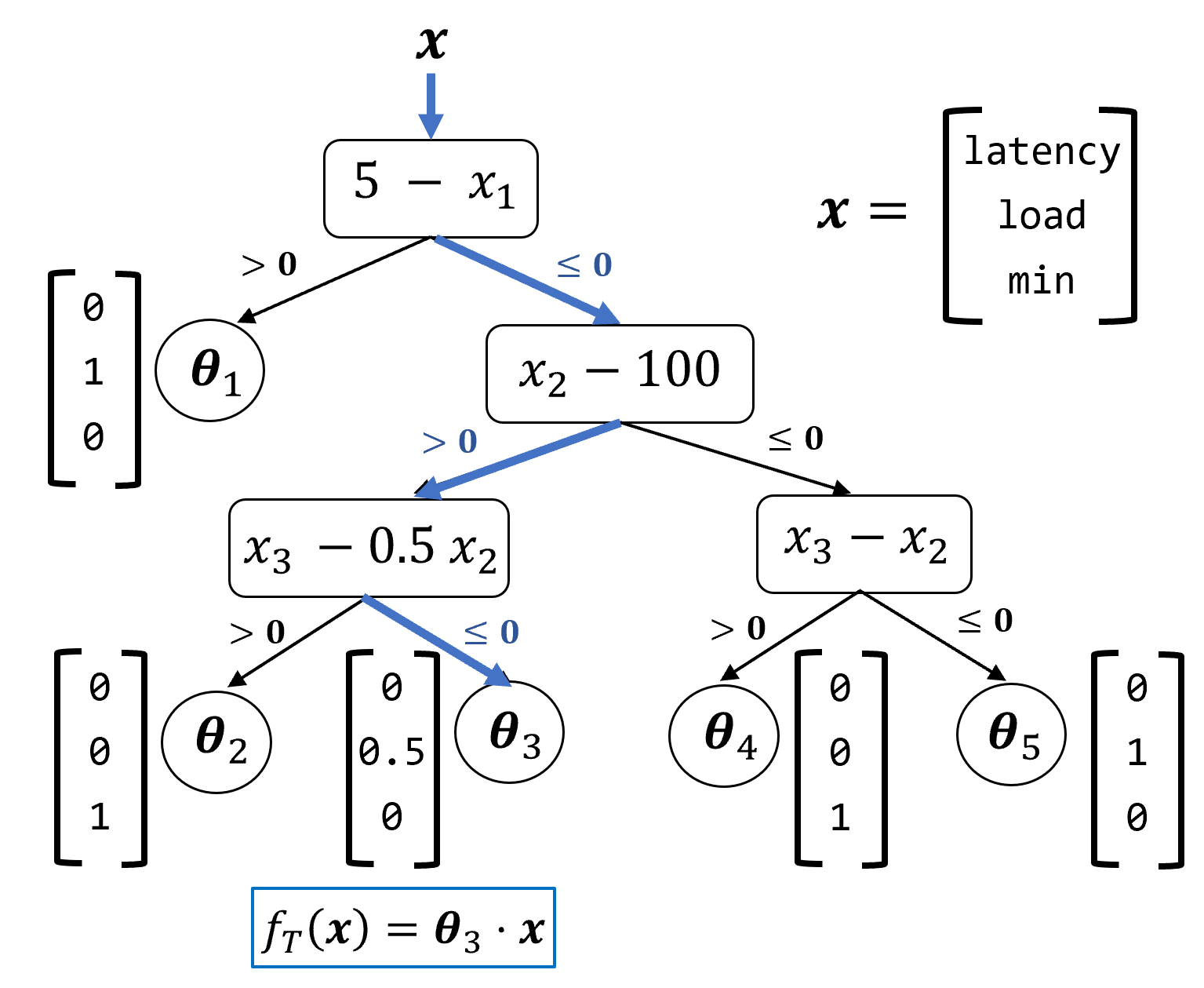
PBR differentiates itself from existing approaches by treating the decision-making code as a white-box to exploit its structure, while considering the reward function as a black-box component. This middle-ground approach allows for enhanced scalability in real-world implementations. The framework employs gradient descent and other continuous optimization techniques for the synthesis of decision functions, resulting in models that achieve greater accuracy and faster convergence compared to traditional RL techniques. Figure 1

Figure 1: Example decision function in Imp (left) and its equivalent binary decision tree with linear models in leaf nodes (right).

Decision Functions and DSL

The decision functions addressed in this paper are motivated by real-world software scenarios like efficient search, ranking heuristics, and real-time services. They predominantly involve linear combinations of program variables and nested if-then-else conditions without loops. The authors define a DSL named Imp to articulate decision functions, modeling a typical pattern found in real-world programming practices.

Learning Decision Functions

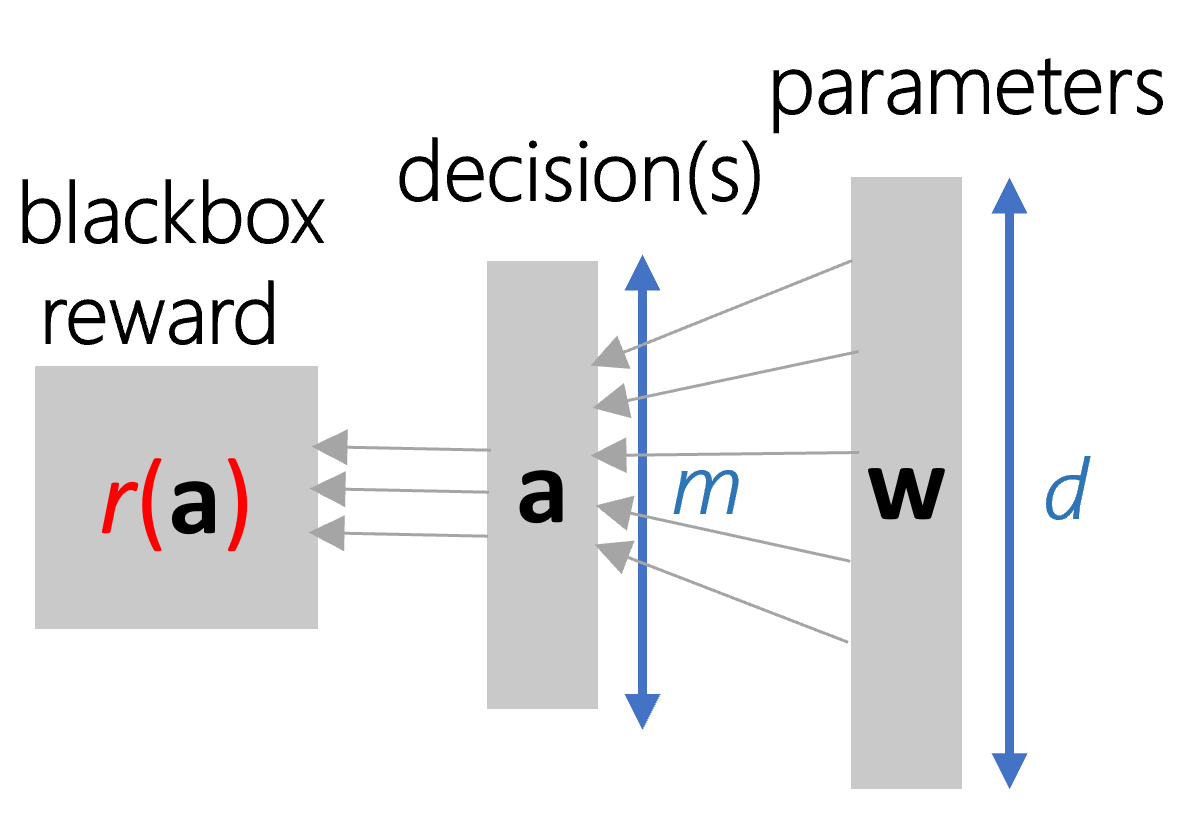
The learning algorithms formulated for this study enable both offline and online learning settings. These algorithms aim to reduce sample complexity and time, balancing between computational resources and reward queries. For constant and linear functions, the algorithms provide theoretical guarantees under certain assumptions regarding reward function properties like concavity and Lipschitz continuity. Figure 2

Figure 2: The black-box reward rr modeled as r()r(), highlighting the relation where output =f(;)∈Rm= f(; ) \in \mathbb{R}^m, yet ∈Rd\in \mathbb{R}^d.

Empirical Evaluation and Implementation

The empirical studies validate the efficacy of PBR in synthesizing parameter-tuned decision functions, particularly within the PROSE codebase from Microsoft. The approach demonstrates improvements in real-world systems by achieving competitive accuracy levels with much fewer reward guesses compared to hand-tuned systems. Additionally, experiments comparing PBR to existing synthesis techniques and multi-arm bandit methods underscore PBR’s superior sample efficiency and computational performance.

Conclusion

The PBR framework presents a promising direction for integrating AI-driven optimization in programming, particularly by synthesizing interpretable and efficient decision-making functions that optimize complex reward functions. Future work involves refining the model guarantees and expanding the applicability across broader software environments.

In summary, this work represents a significant step forward in reducing the manual effort in parameter tuning while improving system performance by leveraging automated program synthesis techniques effectively integrated with AI-driven strategies.

Paper to Video (Beta)

Whiteboard

No one has generated a whiteboard explanation for this paper yet.

Open Problems

We haven't generated a list of open problems mentioned in this paper yet.

Collections

Sign up for free to add this paper to one or more collections.