- The paper demonstrates a phase transition in weighted CFGs, revealing the emergence of structured information from randomness.
- It employs lognormal distributions and Shannon entropy to quantify energy-entropy balance within language grammars.
- Findings suggest implications for human language learning and open avenues for analytical solutions using partition functions.
Random LLM
Introduction
The paper "Random LLM" explores the conceptual framework of random languages using weighted context-free grammars (CFGs) to elucidate how structured information emerges from randomness. This study extends the understanding of CFGs beyond their conventional applications in linguistics and computer science by infusing concepts from statistical mechanics. The research demonstrates a phase transition from randomness to structure, which the authors equate to balancing energy and entropy. This transition marks the emergence of nontrivial information, thereby highlighting the deep structure inherent in the language.
Weighted Context-Free Grammars
CFGs define the foundation of the study, characterized by an alphabet of symbols and a set of production rules. The weighted CFG introduced here assigns weights to both internal (Mabc) and terminal (OaA) transformations. These weights are interpreted as parameters within a Gibbs-like framework, allowing CFGs to be analyzed using statistical physics principles. The transition from unstructured randomness to meaningful structure is modulated by "temperature" parameters ϵd (deep) and ϵs (surface). These temperatures influence the grammar's information content and correlate with energy fluctuations.
Phase Transition
The research identifies a critical phase transition as the distribution of weights broadens. By modeling probabilities with lognormal distributions, controlled by the parameters ϵd and ϵs, the study predicts a shift at ϵ∗=N3/log2N. This shift signifies the onset of structured information within CFGs.
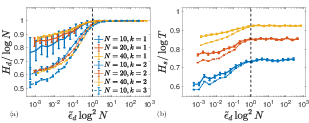
Figure 1: Shannon entropy of random CFGs as functions of ϵ~d=ϵd/N3.
Shannon Entropy and Structure Emergence
Shannon entropy is employed to quantify information content within CFGs. The paper contrasts block entropy rates of hidden (Hd) and observable (Hs) configurations, finding that both exhibit a marked decrease at the critical transition point ϵ∗. This indicates a decline in randomness as CFGs transmit more structured information. Importantly, Q2, an order parameter defined in the study, scales as N3 below the transition, suggesting comprehensive information flow through all hidden symbols.
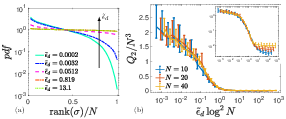
Figure 2: (a) Zipf plot of hidden symbols for N=40. (b) Order parameter Q2, with bars indicating percentile ranges over grammars at each parameter value.
Implications for Language Learning
The study addresses potential implications for human language acquisition theories, notably the Principles and Parameters (P&P) framework. By associating parameter settings with symmetry-breaking transitions within CFGs, this work implies that language learning may involve emergent mechanisms rather than strictly innate structures. As CFGs align with most human languages, albeit with exceptions like Swiss-German and Bambara, this approach supports the adaptability and richness of human syntactic learning.
Theoretical Perspectives and Future Directions
The authors argue for a deeper theoretical exploration of CFGs as physical systems. A notable advancement would be the solvability of the Random LLM (RLM) using the partition function Z. Such solvability would illuminate the symmetry-breaking transitions within CFGs, potentially offering insights into human language syntax. Future efforts are anticipated to solve the RLM analytically, enhancing the understanding of emergent language structures.
Conclusion
The "Random LLM" paper proposes a novel approach to examining CFGs using statistical mechanics. By incorporating weight distributions and analyzing phase transitions, the study elucidates complex grammar systems and the emergence of structured language. This framework promises to bridge linguistic theory and physical systems, offering future prospects for decoding language structures and contributing to language learning research.

