- The paper introduces a streaming active learning framework combining exploratory techniques and stochastic semi-supervised learning (SSSL) to address class imbalance in fraud detection.
- The study demonstrates that SSSL with random sampling significantly enhances precision and recall compared to traditional HRQ methods.
- The use of PCA for data visualization provides clear insights into decision boundaries and helps optimize active learning strategy selection.
Streaming Active Learning Strategies for Credit Card Fraud Detection
Introduction
The paper "Streaming Active Learning Strategies for Real-Life Credit Card Fraud Detection: Assessment and Visualization" explores the application of active learning (AL) strategies for improving the detection accuracy of credit card fraud in a real-world context. It addresses challenges like the imbalanced nature of fraud detection datasets and the high cost of labeling transactions, proposing a range of strategies under a streaming setup to enhance predictive performance.
Problem Set Up
The fraud detection system aims to identify fraudulent credit card transactions in a transactional stream by leveraging machine learning classifiers. Key obstacles include handling vast quantities of streaming data, dealing with severely imbalanced class distributions, and adapting to non-stationarity due to changes in fraudster and consumer behavior. Given the practical limitations of daily labeling budgets, the system seeks to balance the trade-off between exploiting well-understood fraud patterns and exploring potentially new fraudulent activities.
Active Learning Strategies
The paper categorizes its active learning strategies into exploratory active learning and stochastic semi-supervised learning (SSSL). The Highest Risk Querying (HRQ) method forms the baseline by focusing on transactions with the highest posterior fraud probability according to a classifier.
Exploratory AL
Exploratory AL techniques introduce exploration via randomness or metrics like uncertainty sampling. Combination methods such as uncertainty querying with intermittent randomness are evaluated; however, they display mixed results in improving fraud detection efficiently under real-world constraints.
Stochastic Semi-supervised Learning
Notably, SSSL leverages the data's imbalance by labeling transactions with low fraud probability automatically as genuine, thereby enriching the training set with assumed non-fraud examples. This approach capitalizes on the statistical rarity of frauds to enhance classifier learning effectively and is demonstrated to outperform simpler AL strategies like HRQ.
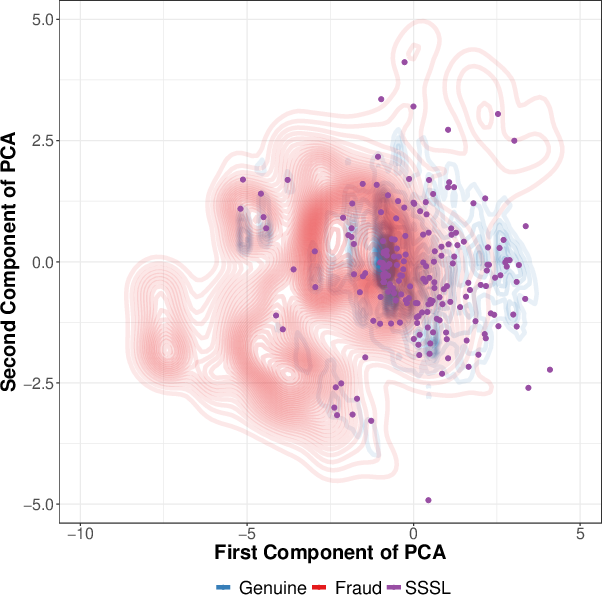
Figure 1: Class conditional distributions in PC1/PC2 space and the transactions selected by the SR strategy, highlighting the efficiency of SSSL.
Experimental Evaluation
The study employs a dataset encompassing millions of transactions over sixty days. Several active learning strategies are comparatively assessed using metrics like Top100 Precision, AUC-PR, and AUC-ROC. Results indicate that SSSL significantly enhances detecting true positives over the standard HRQ method. In particular, random sampling for SSSL (denoted as SR) consistently boosted precision and recall across trials.
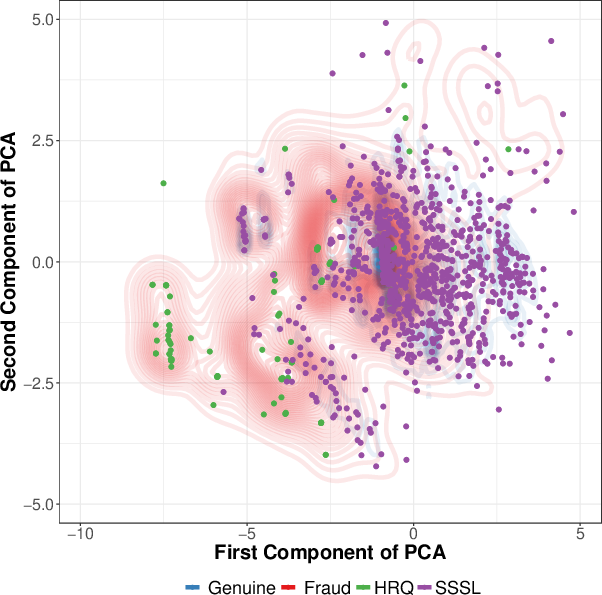
Figure 2: Class conditional distributions in the PC1/PC2 space with the transactions selected by the SR strategy and HRQ, showing the effectiveness in sampling genuine classes.
Influence of Data Visualization
The use of dimensionality reduction techniques such as PCA is highlighted to visualize decision boundaries and validate the bias of AL strategies. Such visual analysis aids in understanding the effect of querying strategies on the distribution of labeled examples and helps optimize future strategy selection.
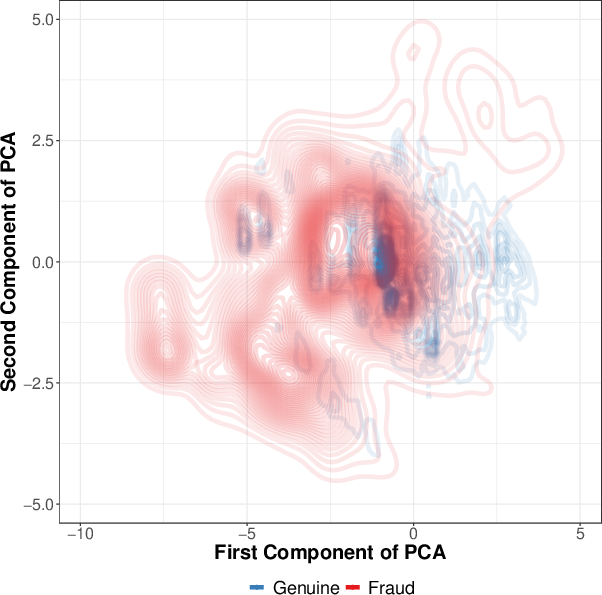
Figure 3: Class conditional distributions of transactions in the PC1/PC2 space over consecutive days, providing insight into distribution overlap and variance.
Conclusion
The research establishes that integrating stochastic semi-supervised methods with active learning greatly benefits fraud detection systems operating under real-world constraints. Future work is suggested to further refine ensemble methods and adapt strategies to evolving fraud patterns, optimizing for both fraudulent transaction and card-level detection. The flexible integration of labeling strategies into traditional systems heralds a significant step forward in scalable fraud detection solutions.
This inquiry reinforces the notion that a well-balanced, dynamically adaptive query strategy in active learning frameworks can significantly mitigate class imbalance issues and improve detection efficiency, thus lowering operational costs and enhancing fraud detection accuracy in practical scenarios.