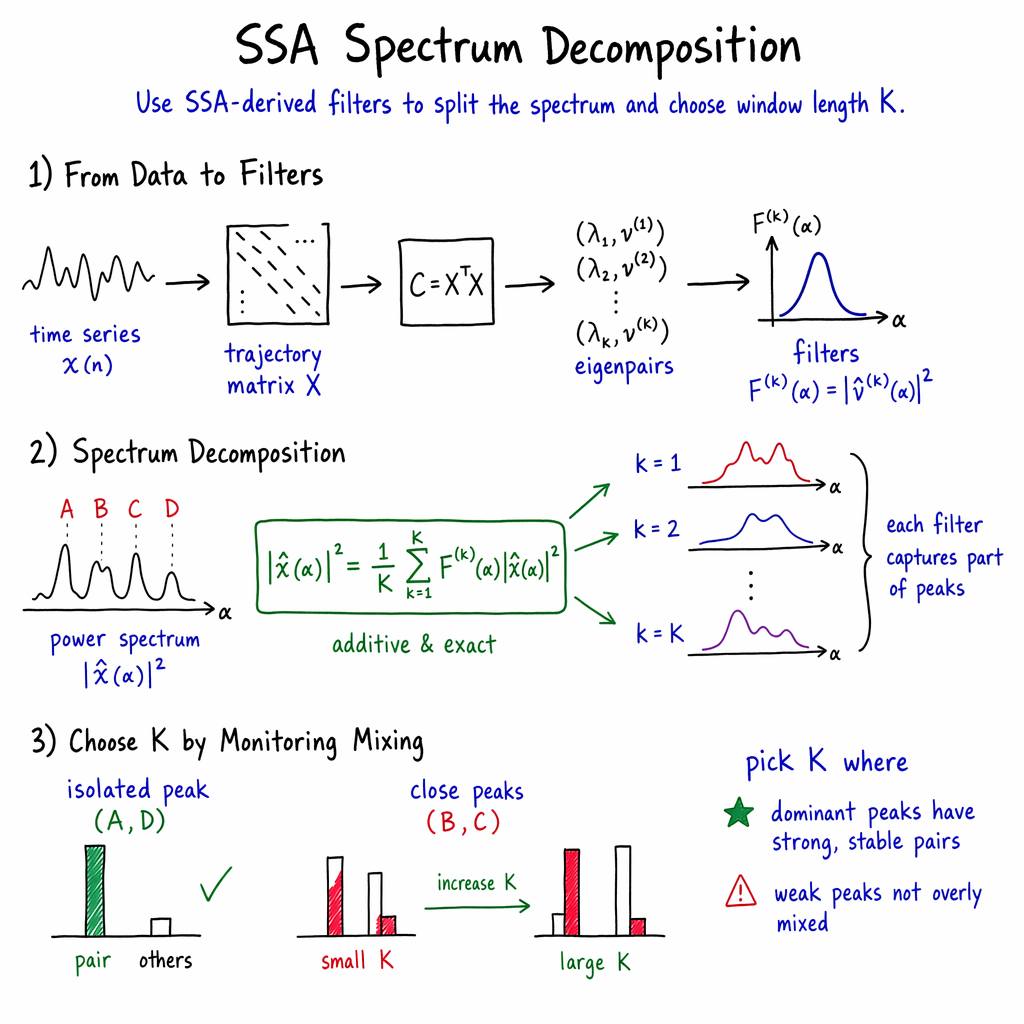
- The paper demonstrates the filtering interpretation of SSA, showing how the window length K critically influences the spectral decomposition of time series.
- It applies SSA to both schematic models and real data, such as EUR/USD exchange rates, highlighting clear distinctions between trend, oscillatory, and noise components.
- The study suggests further research into adaptive, machine learning-based methods to optimize window length selection for enhanced time series analysis.
Spectral Structure of Singular Spectrum Decomposition for Time Series
Introduction to Singular Spectrum Decomposition
The paper "Spectral Structure of Singular Spectrum Decomposition for Time Series" (1507.07330) discusses the intricacies of Singular Spectrum Analysis (SSA), a nonparametric and adaptive approach for decomposing time series data into constituent components. SSA typically divides a time series into trend, oscillatory, and noise elements. It involves transforming the time series into a trajectory matrix, followed by singular value decomposition (SVD) and subsequent grouping and reconstruction processes.
The central focus of the paper is the parameter window length K, an arbitrary integer used in forming the trajectory matrix. This parameter critically influences the decomposition efficacy of SSA, yet lacks a universally accepted criterion for determination. The paper advocates for a detailed examination of SSA's spectral structure and the dependence on window length K by applying filtering interpretations, thereby enhancing the practical application of SSA.
Singular Spectrum Analysis Algorithm
The SSA algorithm as described follows a structured four-step methodology involving the transformation of the original time series into a trajectory matrix and performing SVD to extract eigenvalues and eigenvectors. These are used in reconstructing the original time series into constituent parts. The paper sheds light on the filtering interpretation of SSA, illustrating that the decomposition of the power spectrum of the original time series is achievable through eigenvectors from the lagged-covariance matrix, offering crucial insights into its spectral structure.
This filtering perspective utilizes two essential steps: (1) the adaptive construction of normalized filters using eigenvectors, and (2) the application of these filters to the original time series. This method partitions the Fourier space optimally, employing the constructed filters.
Examples of Spectral Decomposition
The paper presents two computations to clarify the application and implications of SSA's spectral decomposition. First, a schematic model is evaluated wherein a time series with superimposed harmonic components and noise is analyzed with various window lengths. By decomposing its spectrum, the paper identifies the interaction and separation efficacy of spectral components corresponding to different window lengths.
Subsequently, the paper applies the decomposition technique to real-world data: EUR/USD daily currency exchange rates, demonstrating the decomposition process in handling complex, multi-peak spectral structures. Here, different window lengths yield distinct separation and phase relationships among time series components, underscoring SSA's adaptability in various spectral situations.
Implications and Future Directions
The filtering interpretation of SSA extends conventional understanding, allowing for the decomposition not just of time series but their power spectra too. Such decomposition serves as an insightful monitor for SSA, particularly for determining the optimal window length K in practice. Still, as indicated, the choice of K remains nuanced, depending heavily on the specific spectral characteristics of the analyzed series.
The paper posits that further rigorous investigation into SSA's filter properties might purse greater precision and control over time-series decomposition, offering fertile ground for future research. This might include the exploration of adaptive algorithms informed by real-time spectral monitoring or machine learning to effectively automate and optimize the choice of parameters like window length.
Conclusion
The paper establishes the potential and flexibility of Singular Spectrum Analysis via its filtering interpretation, chiefly in spectral application contexts. By dissecting both theoretical and practical aspects of SSA's algorithmic structure, it contributes significant advancements toward refining time-series analytical methods. Coupled with a rich array of examples, it demonstrates the comprehensiveness and adaptability of SSA in navigating complex spectral topographies, potentially influencing developments in related computational and data science fields.