Implicit Approximation of the Supercooled Stefan Problem with Blow-Ups
This presentation examines a numerical breakthrough for the supercooled Stefan problem, a moving-boundary equation where the free boundary can jump discontinuously in finite time. The authors prove global convergence of two implicit approximation schemes that correctly capture these blow-ups, including an implicit time-stepping method for general drivers and a fully discrete binomial-tree scheme for Brownian motion. Numerical experiments demonstrate that implicit coupling sharply localizes discontinuous jumps on coarse meshes, while explicit methods disperse the same event over many time steps, and that the implicit Donsker scheme retains empirical square-root convergence even in irregular blow-up regimes where theoretical rates remain unproven.Script
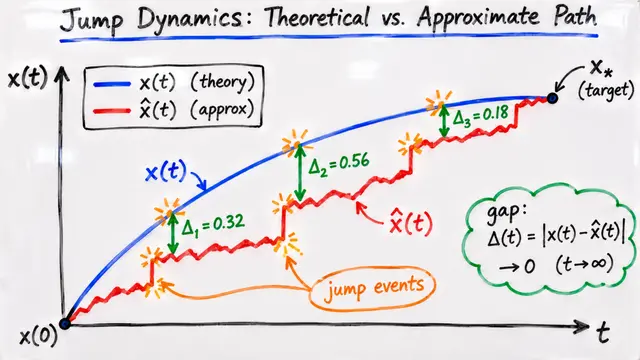
In the supercooled Stefan problem, a free boundary separating phases can absorb a macroscopic amount of mass instantaneously. The boundary becomes discontinuous, jumping forward in finite time, and classical numerical methods struggle to represent this blow-up faithfully.
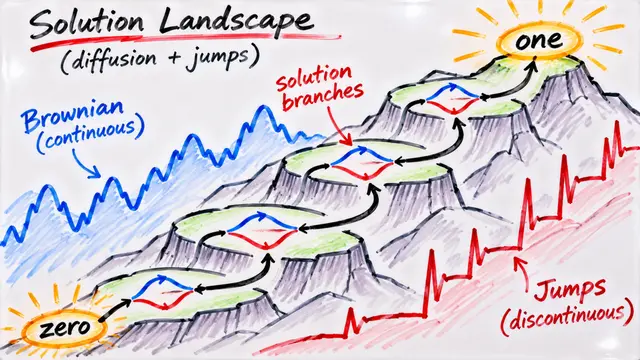
The authors adopt a probabilistic formulation where particles drift above a moving absorbing boundary that rises according to the probability that particles have already been absorbed. This creates a singular feedback loop: the boundary displacement depends on a hitting-time distribution that itself depends on the boundary position.
The key distinction is implicit coupling. In the explicit scheme, the current boundary displacement cannot depend on the current particle configuration, so a jump disperses over several time intervals. The implicit method allows the full cascade to trigger at the same discrete time, sharply localizing the discontinuity even on coarse meshes.
For Brownian drivers, the authors construct a fully discrete Donsker-type scheme that propagates mass on a recombining lattice. This binomial tree eliminates Monte Carlo sampling and reduces asymptotic complexity from order epsilon to the minus fourth power for particle methods down to order epsilon to the minus third. Numerical experiments show empirical square-root convergence even in blow-up regimes, despite the proven rate requiring weak-feedback assumptions that exclude discontinuities.
The sharpest empirical comparison concerns convergence at blow-ups. When the free boundary jumps, the implicit Donsker method exhibits order close to one-half across irregular and low-regularity initial densities, while the explicit time-stepping method deteriorates arbitrarily. This suggests that implicit coupling fundamentally changes the discrete representation of singularities, though a general convergence rate in the blow-up regime remains an open question.
This work proves that implicit schemes converge globally to the minimal solution, including through finite-time blow-ups, and demonstrates that localization of discontinuities on practical meshes depends critically on coupling structure. To explore the full technical details and generate your own video summaries of research like this, visit EmergentMind.com.