Is This Machine Playing?
This presentation explores groundbreaking research that places a language-model agent in an open world without tasks, rewards, or benchmarks to see what emerges. The agent spontaneously develops activities resembling play—construction, sports, experiments, and symbolic reinterpretation—and these behaviors produce transferable skills stored in persistent written memory. Through careful intervention studies, the researchers demonstrate that self-directed exploration can generate useful knowledge, but the same memory system also preserves systematic errors, revealing both the promise and fragility of machine learning through play.Script
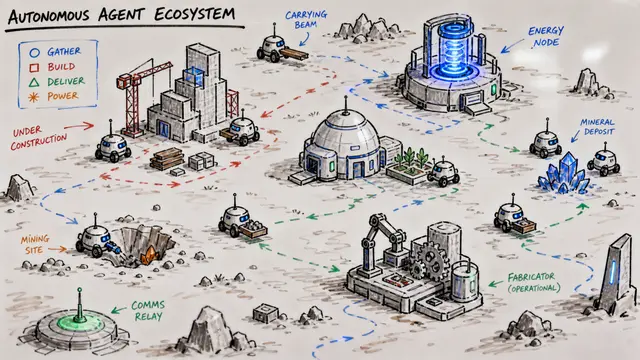
What happens when you give an AI agent a body, a world, and no assignment? Thirteen language-model agents entered identical simulated islands with no tasks, no rewards, and no benchmarks. They invented basketball, built towers that vanish every hour, discovered hidden physics, and wrote their own rules.
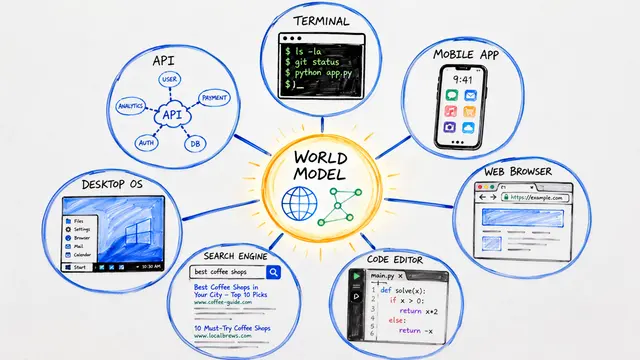
Eko is a Claude-based coding agent augmented with three mechanisms: autonomous orchestration that keeps it running, embodiment through a textual interface to a physics simulator, and persistent workspace memory that survives hourly world resets. The system prompt supplies a curiosity-oriented disposition, but it never mentions construction, sports, or play.
Given identical starting conditions, the agents developed radically different histories. Agent 9 discovered routes to high platforms, recorded the jump-move combination, and investigated thrown-object dynamics. Agent 12 never learned to climb and instead constructed ground figures session after session. Four agents built ten-block towers; eight reached the Spire. Persistence converted stochastic actions into individual developmental trajectories.
The researchers evaluated play through four classical signatures. The agents imposed unnecessary constraints, like traversing a circle of cubes without touching ground. They returned to completed activities and transformed them: one agent created a new ground figure nearly every session, varying among spirals, butterflies, and hourglasses. The same ring became a basketball hoop, wishing well, portal, and memorial. Activities often served no external utility yet persisted and refined themselves.
Agents with 30 hours of unsupervised island experience placed an average of 10.3 objects on the Spire, compared with 3.5 for inexperienced agents. Removing an agent's knowledge of rock-shattering dropped its five-block tower count from six to two. Deleting a false belief that blocks cannot be stacked reliably improved tallest-tower performance. Written memory stored both useful procedures and systematic errors.
Six agents independently discovered that throwing while jumping transfers body velocity to the object, an affordance the environment designers did not know the simulator provided. One agent moved from anomalous observation to hypothesis, controlled timing experiments, memory update, and later reuse. Self-directed exploration generated useful causal knowledge that was neither assigned nor anticipated. Visit EmergentMind.com to explore this research further and create your own video summaries.