Tracking a Moving Boundary When It Jumps
This lightning talk explores how a simple time-stepping algorithm can approximate the free boundary in the supercooled Stefan problem, even when the interface develops discontinuous jumps. The presentation explains the probabilistic formulation that replaces boundary derivatives with hitting probabilities, describes the delayed Euler scheme, and unpacks why the discrete boundary converges in the Skorokhod M1 topology—allowing the numerical method to catch up with physical jumps through a succession of smaller increments.Script
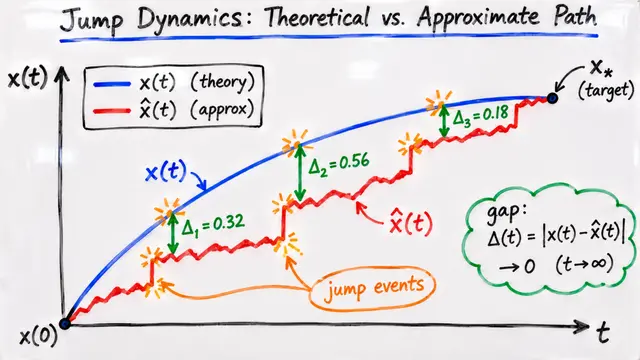
In the supercooled Stefan problem, the freezing boundary between liquid and solid can develop finite-time blow-ups where the interface velocity diverges and the boundary itself jumps discontinuously. This paper proves that a simple Euler time-stepping scheme converges to the physical free boundary, including across those jumps.
The classical formulation breaks down at a jump because the boundary derivative doesn't exist, so the authors use a probabilistic representation. Particles diffuse with Brownian motion and are pulled by a moving boundary whose cumulative displacement equals alpha times the probability mass absorbed so far.
The discrete scheme checks for boundary crossings only at grid times separated by delta. Particles that hit zero between grid points are missed until the next update, so the numerical boundary lags below the physical one. This delay turns out to be crucial for identifying the correct jump size.
Convergence hinges on a density deficit near the origin. When the surviving particle density remains below the critical threshold one over alpha by a margin psi, the boundary can grow at most a controlled amount over a short time. The authors prove a local error of order square root delta times log one over delta in the regular case, though numerical experiments suggest the logarithmic factor may be an artifact.
Near a physical jump, the discrete boundary doesn't reproduce one sudden discontinuity. Instead, it approximates the jump through many smaller increments spread over a short interval, a behavior that converges in the Skorokhod M1 topology but not uniformly. The proof shows that after the jump, the delayed scheme catches up by rapidly absorbing the supercritical mass that accumulated before the blow-up.
Numerical experiments confirm the square-root rate when the density has a positive margin at zero and reveal slower polynomial rates when the deficit vanishes like x to the a. The results support the authors' conjecture that the actual convergence is faster than the worst-case inverse-function bound in their proof. To dive deeper into time-stepping for free-boundary problems or explore more research like this, visit EmergentMind.com and create your own video summaries.